







Araghchi says Iran interested in talks if US is ‘serious’
Trump open to 20-year pause on uranium enrichment
Iran’s Foreign Minister Abbas Araghchi said on Friday that Tehran has “no trust” in the United States and is interested in negotiating with Washington only if it is serious as talks on ending the war remained on hold.
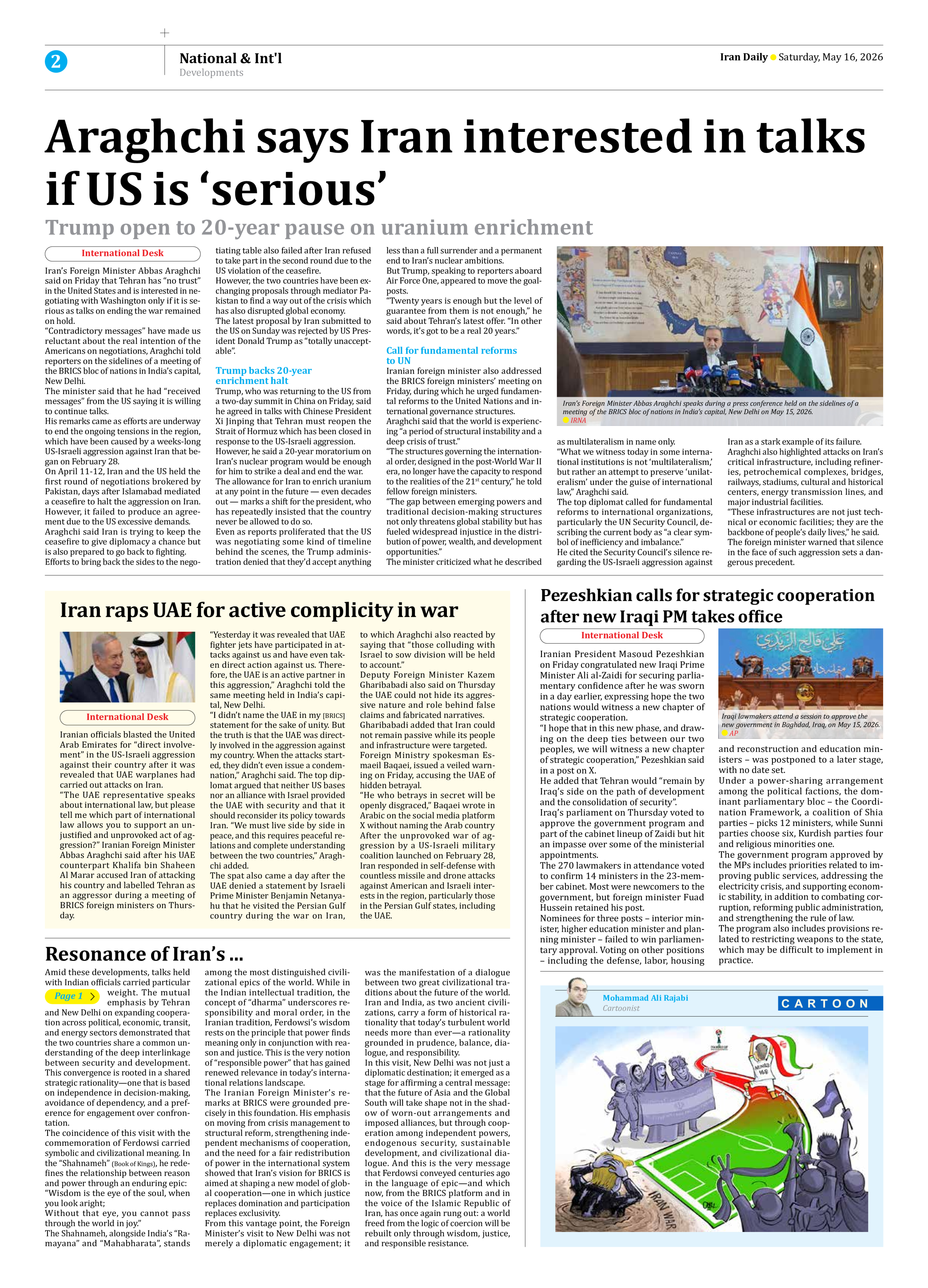
“Contradictory messages” have made us reluctant about the real intention of the Americans on negotiations, Araghchi told reporters on the sidelines of a meeting of the BRICS bloc of nations in India’s capital, New Delhi.
The minister said that he had “received messages” from the US saying it is willing to continue talks.
His remarks came as efforts are underway to end the ongoing tensions in the region, which have been caused by a weeks-long US-Israeli aggression against Iran that began on February 28.
On April 11-12, Iran and the US held the first round of negotiations brokered by Pakistan, days after Islamabad mediated a ceasefire to halt the aggression on Iran. However, it failed to produce an agreement due to the US excessive demands.
Araghchi said Iran is trying to keep the ceasefire to give diplomacy a chance but is also prepared to go back to fighting.
Efforts to bring back the sides to the negotiating table also failed after Iran refused to take part in the second round due to the US violation of the ceasefire.
However, the two countries have been exchanging proposals through mediator Pakistan to find a way out of the crisis which has also disrupted global economy.
The latest proposal by Iran submitted to the US on Sunday was rejected by US President Donald Trump as “totally unacceptable”.
Trump backs 20-year
enrichment halt
Trump, who was returning to the US from a two-day summit in China on Friday, said he agreed in talks with Chinese President Xi Jinping that Tehran must reopen the Strait of Hormuz which has been closed in response to the US-Israeli aggression.
However, he said a 20-year moratorium on Iran’s nuclear program would be enough for him to strike a deal and end the war.
The allowance for Iran to enrich uranium at any point in the future — even decades out — marks a shift for the president, who has repeatedly insisted that the country never be allowed to do so.
Even as reports proliferated that the US was negotiating some kind of timeline behind the scenes, the Trump administration denied that they’d accept anything less than a full surrender and a permanent end to Iran’s nuclear ambitions.
But Trump, speaking to reporters aboard Air Force One, appeared to move the goalposts.
“Twenty years is enough but the level of guarantee from them is not enough,” he said about Tehran’s latest offer. “In other words, it’s got to be a real 20 years.”
Call for fundamental reforms
to UN
Iranian foreign minister also addressed the BRICS foreign ministers’ meeting on Friday, during which he urged fundamental reforms to the United Nations and international governance structures.
Araghchi said that the world is experiencing “a period of structural instability and a deep crisis of trust.”
“The structures governing the international order, designed in the post-World War II era, no longer have the capacity to respond to the realities of the 21st century,” he told fellow foreign ministers.
“The gap between emerging powers and traditional decision-making structures not only threatens global stability but has fueled widespread injustice in the distribution of power, wealth, and development opportunities.”
The minister criticized what he described as multilateralism in name only.
“What we witness today in some international institutions is not ‘multilateralism,’ but rather an attempt to preserve ‘unilateralism’ under the guise of international law,” Araghchi said.
The top diplomat called for fundamental reforms to international organizations, particularly the UN Security Council, describing the current body as “a clear symbol of inefficiency and imbalance.”
He cited the Security Council’s silence regarding the US-Israeli aggression against Iran as a stark example of its failure.
Araghchi also highlighted attacks on Iran’s critical infrastructure, including refineries, petrochemical complexes, bridges, railways, stadiums, cultural and historical centers, energy transmission lines, and major industrial facilities.
“These infrastructures are not just technical or economic facilities; they are the backbone of people’s daily lives,” he said.
The foreign minister warned that silence in the face of such aggression sets a dangerous precedent.