







Zanjan’s filigree art under pressure as silver prices soar
Zanjan’s traditional filigree (Malileh) art, a delicate silver-weaving craft that has long been practiced in the province and has survived various ups and downs to reach the present generation, is now struggling under a heavy burden of problems — chief among them the soaring price of raw silver.
Experts warn that without urgent support, this centuries-old art may disappear entirely. Filigree work in Zanjan is regarded as a refined and authentic craft that, despite numerous obstacles, has remained alive thanks to the taste, creativity, and dedication of its artisans, according to IRNA.
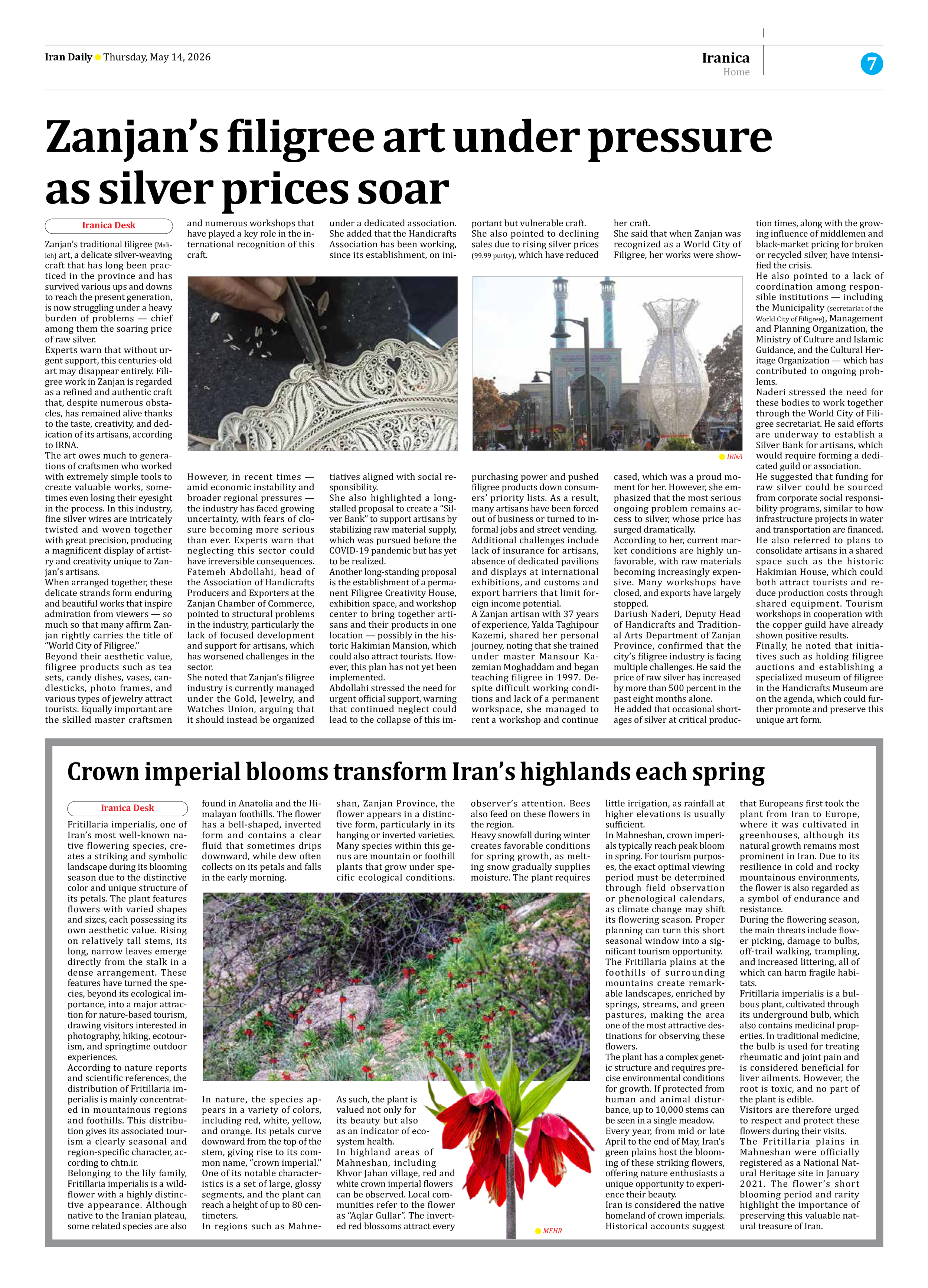
The art owes much to generations of craftsmen who worked with extremely simple tools to create valuable works, sometimes even losing their eyesight in the process. In this industry, fine silver wires are intricately twisted and woven together with great precision, producing a magnificent display of artistry and creativity unique to Zanjan’s artisans.
When arranged together, these delicate strands form enduring and beautiful works that inspire admiration from viewers — so much so that many affirm Zanjan rightly carries the title of “World City of Filigree.”
Beyond their aesthetic value, filigree products such as tea sets, candy dishes, vases, candlesticks, photo frames, and various types of jewelry attract tourists. Equally important are the skilled master craftsmen and numerous workshops that have played a key role in the international recognition of this craft.
However, in recent times — amid economic instability and broader regional pressures — the industry has faced growing uncertainty, with fears of closure becoming more serious than ever. Experts warn that neglecting this sector could have irreversible consequences.
Fatemeh Abdollahi, head of the Association of Handicrafts Producers and Exporters at the Zanjan Chamber of Commerce, pointed to structural problems in the industry, particularly the lack of focused development and support for artisans, which has worsened challenges in the sector.
She noted that Zanjan’s filigree industry is currently managed under the Gold, Jewelry, and Watches Union, arguing that it should instead be organized under a dedicated association. She added that the Handicrafts Association has been working, since its establishment, on initiatives aligned with social responsibility.
She also highlighted a long-stalled proposal to create a “Silver Bank” to support artisans by stabilizing raw material supply, which was pursued before the COVID-19 pandemic but has yet to be realized.
Another long-standing proposal is the establishment of a permanent Filigree Creativity House, exhibition space, and workshop center to bring together artisans and their products in one location — possibly in the historic Hakimian Mansion, which could also attract tourists. However, this plan has not yet been implemented.
Abdollahi stressed the need for urgent official support, warning that continued neglect could lead to the collapse of this important but vulnerable craft.
She also pointed to declining sales due to rising silver prices (99.99 purity), which have reduced purchasing power and pushed filigree products down consumers’ priority lists. As a result, many artisans have been forced out of business or turned to informal jobs and street vending.
Additional challenges include lack of insurance for artisans, absence of dedicated pavilions and displays at international exhibitions, and customs and export barriers that limit foreign income potential.
A Zanjan artisan with 37 years of experience, Yalda Taghipour Kazemi, shared her personal journey, noting that she trained under master Mansour Kazemian Moghaddam and began teaching filigree in 1997. Despite difficult working conditions and lack of a permanent workspace, she managed to rent a workshop and continue her craft.
She said that when Zanjan was recognized as a World City of Filigree, her works were showcased, which was a proud moment for her. However, she emphasized that the most serious ongoing problem remains access to silver, whose price has surged dramatically.
According to her, current market conditions are highly unfavorable, with raw materials becoming increasingly expensive. Many workshops have closed, and exports have largely stopped.
Dariush Naderi, Deputy Head of Handicrafts and Traditional Arts Department of Zanjan Province, confirmed that the city’s filigree industry is facing multiple challenges. He said the price of raw silver has increased by more than 500 percent in the past eight months alone.
He added that occasional shortages of silver at critical production times, along with the growing influence of middlemen and black-market pricing for broken or recycled silver, have intensified the crisis.
He also pointed to a lack of coordination among responsible institutions — including the Municipality (secretariat of the World City of Filigree), Management and Planning Organization, the Ministry of Culture and Islamic Guidance, and the Cultural Heritage Organization — which has contributed to ongoing problems.
Naderi stressed the need for these bodies to work together through the World City of Filigree secretariat. He said efforts are underway to establish a Silver Bank for artisans, which would require forming a dedicated guild or association.
He suggested that funding for raw silver could be sourced from corporate social responsibility programs, similar to how infrastructure projects in water and transportation are financed.
He also referred to plans to consolidate artisans in a shared space such as the historic Hakimian House, which could both attract tourists and reduce production costs through shared equipment. Tourism workshops in cooperation with the copper guild have already shown positive results.
Finally, he noted that initiatives such as holding filigree auctions and establishing a specialized museum of filigree in the Handicrafts Museum are on the agenda, which could further promote and preserve this unique art form.