







Suspension bridges among Iran’s most thrilling tourist attractions
Suspension bridges are among the most exciting tourist attractions in Iran, drawing large numbers of travelers and visitors throughout the year who seek a unique experience of walking at height.
A bridge is generally used to connect two points on opposite sides of a river, valley, or other natural landscape. However, such structures are not always solid and fixed; they can also be flexible and dynamic, as in the case of suspension bridges, according to IRNA.
When crossing a suspension bridge, visitors are often less focused on the destination ahead and more attentive to the moving pathway beneath their feet.
Negel
The Negel Glass Suspension Bridge, located in Negel village in Kurdistan Province, is considered one of the longest and largest in Iran and the Middle East. The bridge was inaugurated in 2021 and has since become a popular tourist attraction. It was built with the aim of developing regional infrastructure and attracting more visitors to Kurdistan Province. The bridge stretches 450 meters in length and stands 88 meters above a river flowing through the village.
The distance from Tehran to the bridge is approximately 550 kilometers, a journey of around seven to eight hours by car. The bridge is located along the Sanandaj–Marivan road, about 65 kilometers from Sanandaj, which takes roughly one hour and 15 minutes by car. It is also about 60 kilometers from Marivan, a journey of around one hour.
In addition to the glass bridge, a variety of recreational facilities are available for visitors, including an 88-meter jump platform, a 370-meter zipline, as well as swing and rafting activities along a 4-kilometer route for water sports enthusiasts.
Due to its geographical location and natural attractions, the bridge area can be visited throughout the year; however, such structures are not always solid and fixed; they can also be flexible and dynamic, as is the case with suspension bridges, according to IRNA.
A visit to the Negel Glass Suspension Bridge offers an unforgettable experience for nature lovers, history enthusiasts, and adventure seekers alike.
Hir
Hir, a pleasant town in Ardabil Province located south of Ardabil city, is known for its orchards of cherries and sour cherries and is often referred to as the “City of Cherry Blossoms” and a garden city of the province due to its unique natural scenery.
One of its main attractions is the Hir Glass Suspension Bridge, built over a river in a remarkable valley. The bridge stands at a height of 100 meters above the ground, is 250 meters long, and 1.2 meters wide. Its deck consists of five-layer glass panels (each three centimeters thick), connected by metal joints and supported by steel cables. The bridge was designed and constructed by Iranian engineers.
The complex is not limited to the suspension bridge itself and includes various recreational facilities such as a swimming pool, a musical fountain, bungee jumping, a trampoline, and a zipline that crosses the valley at a height of nearly 150 meters. Due to its location near the Sarab-Ardabil road and its pristine natural environment, Hir is considered one of the most attractive destinations in Ardabil Province.
Access to the Hir Bridge is possible via the Ardabil-Khalkhal road. Hir is located about 30 kilometers southeast of Ardabil, and after reaching the town, visitors can access the Darband Valley, where the bridge is situated. The distance from Tehran to the bridge is approximately 560 kilometers, taking around 7 to 8 hours by car.
The best time to visit the Hir Suspension Bridge is from late spring to late summer, when the weather is mild and the surrounding nature is at its most vibrant.
Nahj ol-Balagheh
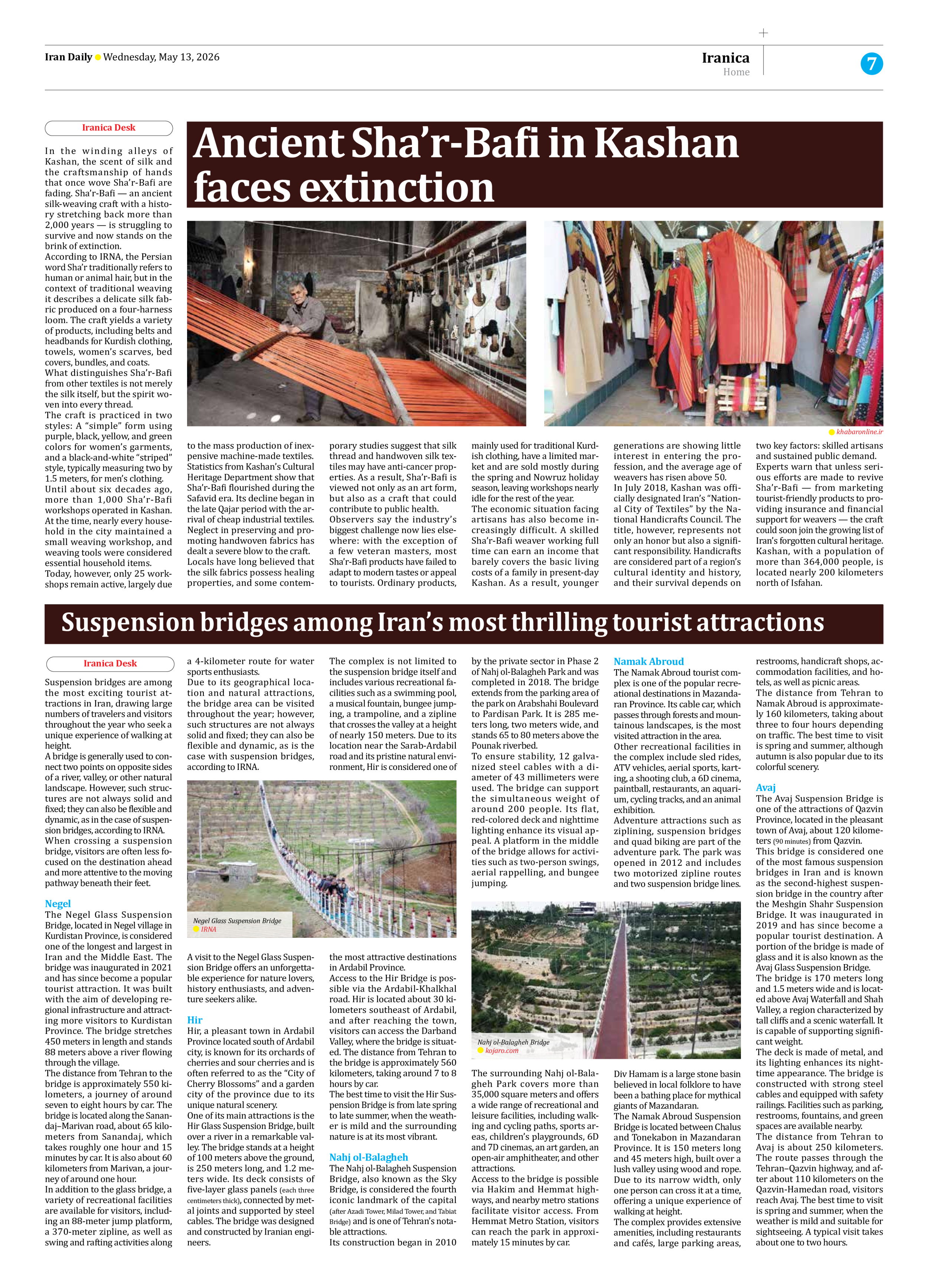
The Nahj ol-Balagheh Suspension Bridge, also known as the Sky Bridge, is considered the fourth iconic landmark of the capital (after Azadi Tower, Milad Tower, and Tabiat Bridge) and is one of Tehran’s notable attractions.
Its construction began in 2010 by the private sector in Phase 2 of Nahj ol-Balagheh Park and was completed in 2018. The bridge extends from the parking area of the park on Arabshahi Boulevard to Pardisan Park. It is 285 meters long, two meters wide, and stands 65 to 80 meters above the Pounak riverbed.
To ensure stability, 12 galvanized steel cables with a diameter of 43 millimeters were used. The bridge can support the simultaneous weight of around 200 people. Its flat, red-colored deck and nighttime lighting enhance its visual appeal. A platform in the middle of the bridge allows for activities such as two-person swings, aerial rappelling, and bungee jumping.
The surrounding Nahj ol-Balagheh Park covers more than 35,000 square meters and offers a wide range of recreational and leisure facilities, including walking and cycling paths, sports areas, children’s playgrounds, 6D and 7D cinemas, an art garden, an open-air amphitheater, and other attractions.
Access to the bridge is possible via Hakim and Hemmat highways, and nearby metro stations facilitate visitor access. From Hemmat Metro Station, visitors can reach the park in approximately 15 minutes by car.
Namak Abroud
The Namak Abroud tourist complex is one of the popular recreational destinations in Mazandaran Province. Its cable car, which passes through forests and mountainous landscapes, is the most visited attraction in the area.
Other recreational facilities in the complex include sled rides, ATV vehicles, aerial sports, karting, a shooting club, a 6D cinema, paintball, restaurants, an aquarium, cycling tracks, and an animal exhibition.
Adventure attractions such as ziplining, suspension bridges and quad biking are part of the adventure park. The park was opened in 2012 and includes two motorized zipline routes and two suspension bridge lines. Div Hamam is a large stone basin believed in local folklore to have been a bathing place for mythical giants of Mazandaran.
The Namak Abroud Suspension Bridge is located between Chalus and Tonekabon in Mazandaran Province. It is 150 meters long and 45 meters high, built over a lush valley using wood and rope. Due to its narrow width, only one person can cross it at a time, offering a unique experience of walking at height.
The complex provides extensive amenities, including restaurants and cafés, large parking areas, restrooms, handicraft shops, accommodation facilities, and hotels, as well as picnic areas.
The distance from Tehran to Namak Abroud is approximately 160 kilometers, taking about three to four hours depending on traffic. The best time to visit is spring and summer, although autumn is also popular due to its colorful scenery.
Avaj
The Avaj Suspension Bridge is one of the attractions of Qazvin Province, located in the pleasant town of Avaj, about 120 kilometers (90 minutes) from Qazvin.
This bridge is considered one of the most famous suspension bridges in Iran and is known as the second-highest suspension bridge in the country after the Meshgin Shahr Suspension Bridge. It was inaugurated in 2019 and has since become a popular tourist destination. A portion of the bridge is made of glass and it is also known as the Avaj Glass Suspension Bridge.
The bridge is 170 meters long and 1.5 meters wide and is located above Avaj Waterfall and Shah Valley, a region characterized by tall cliffs and a scenic waterfall. It is capable of supporting significant weight.
The deck is made of metal, and its lighting enhances its nighttime appearance. The bridge is constructed with strong steel cables and equipped with safety railings. Facilities such as parking, restrooms, fountains, and green spaces are available nearby.
The distance from Tehran to Avaj is about 250 kilometers. The route passes through the Tehran–Qazvin highway, and after about 110 kilometers on the Qazvin-Hamedan road, visitors reach Avaj. The best time to visit is spring and summer, when the weather is mild and suitable for sightseeing. A typical visit takes about one to two hours.