







Ancient Sha’r-Bafi in Kashan faces extinction
In the winding alleys of Kashan, the scent of silk and the craftsmanship of hands that once wove Sha’r-Bafi are fading. Sha’r-Bafi — an ancient silk-weaving craft with a history stretching back more than 2,000 years — is struggling to survive and now stands on the brink of extinction.
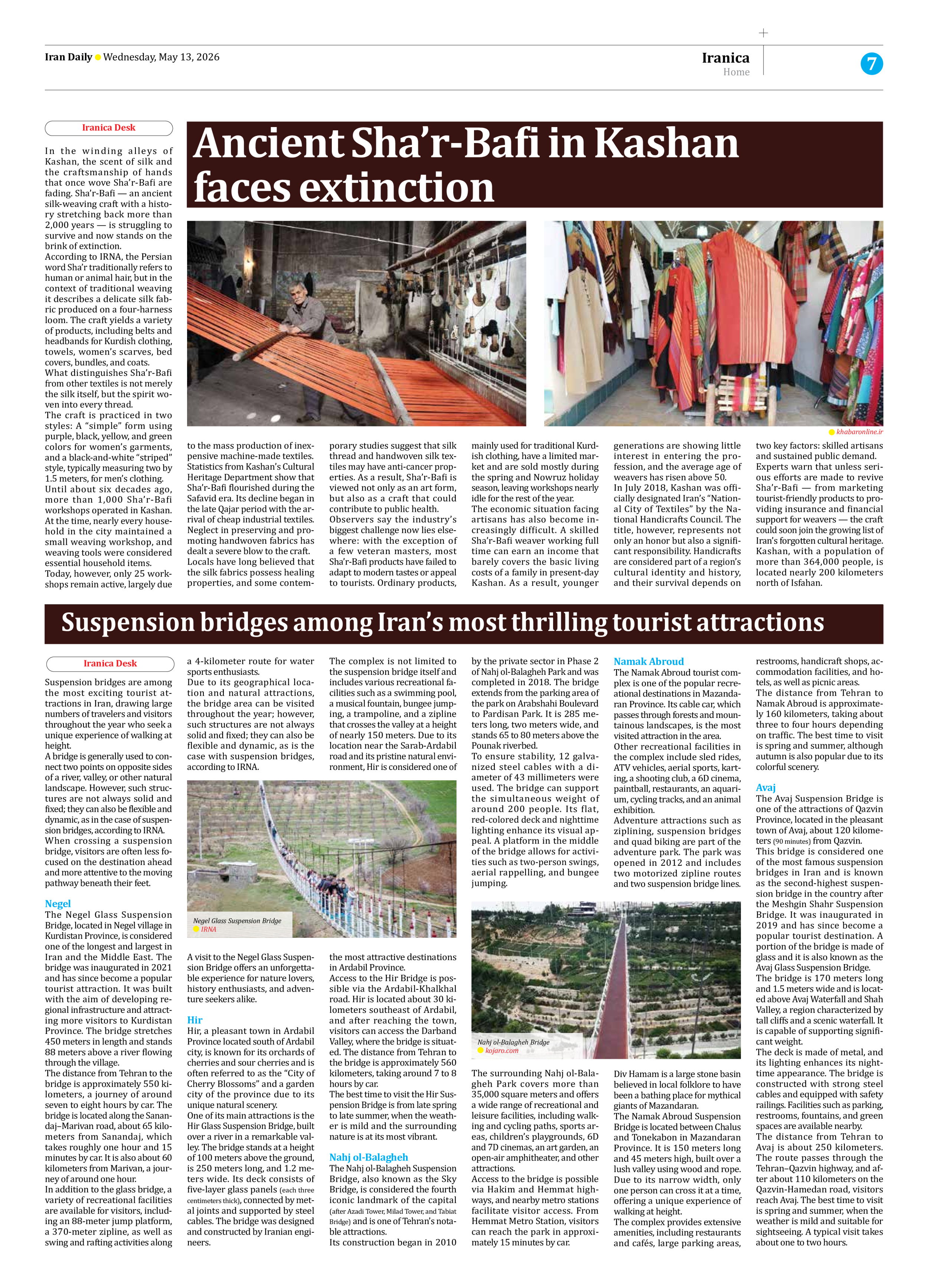
According to IRNA, the Persian word Sha’r traditionally refers to human or animal hair, but in the context of traditional weaving it describes a delicate silk fabric produced on a four-harness loom. The craft yields a variety of products, including belts and headbands for Kurdish clothing, towels, women’s scarves, bed covers, bundles, and coats.
What distinguishes Sha’r-Bafi from other textiles is not merely the silk itself, but the spirit woven into every thread.
The craft is practiced in two styles: A “simple” form using purple, black, yellow, and green colors for women’s garments, and a black-and-white “striped” style, typically measuring two by 1.5 meters, for men’s clothing.
Until about six decades ago, more than 1,000 Sha’r-Bafi workshops operated in Kashan. At the time, nearly every household in the city maintained a small weaving workshop, and weaving tools were considered essential household items.
Today, however, only 25 workshops remain active, largely due to the mass production of inexpensive machine-made textiles.
Statistics from Kashan’s Cultural Heritage Department show that Sha’r-Bafi flourished during the Safavid era. Its decline began in the late Qajar period with the arrival of cheap industrial textiles. Neglect in preserving and promoting handwoven fabrics has dealt a severe blow to the craft.
Locals have long believed that the silk fabrics possess healing properties, and some contemporary studies suggest that silk thread and handwoven silk textiles may have anti-cancer properties. As a result, Sha’r-Bafi is viewed not only as an art form, but also as a craft that could contribute to public health.
Observers say the industry’s biggest challenge now lies elsewhere: with the exception of a few veteran masters, most Sha’r-Bafi products have failed to adapt to modern tastes or appeal to tourists. Ordinary products, mainly used for traditional Kurdish clothing, have a limited market and are sold mostly during the spring and Nowruz holiday season, leaving workshops nearly idle for the rest of the year.
The economic situation facing artisans has also become increasingly difficult. A skilled Sha’r-Bafi weaver working full time can earn an income that barely covers the basic living costs of a family in present-day Kashan. As a result, younger generations are showing little interest in entering the profession, and the average age of weavers has risen above 50.
In July 2018, Kashan was officially designated Iran’s “National City of Textiles” by the National Handicrafts Council. The title, however, represents not only an honor but also a significant responsibility. Handicrafts are considered part of a region’s cultural identity and history, and their survival depends on two key factors: skilled artisans and sustained public demand.
Experts warn that unless serious efforts are made to revive Sha’r-Bafi — from marketing tourist-friendly products to providing insurance and financial support for weavers — the craft could soon join the growing list of Iran’s forgotten cultural heritage.
Kashan, with a population of more than 364,000 people, is located nearly 200 kilometers north of Isfahan.