







Pezeshkian urges stronger ‘economic diplomacy’ to boost forex revenues
President Masoud Pezeshkian underlined on Tuesday the need to pursue “economic diplomacy” at a time that the country is facing wartime pressures, calling for the expansion of exports with focus on enhancing foreign exchange revenues.
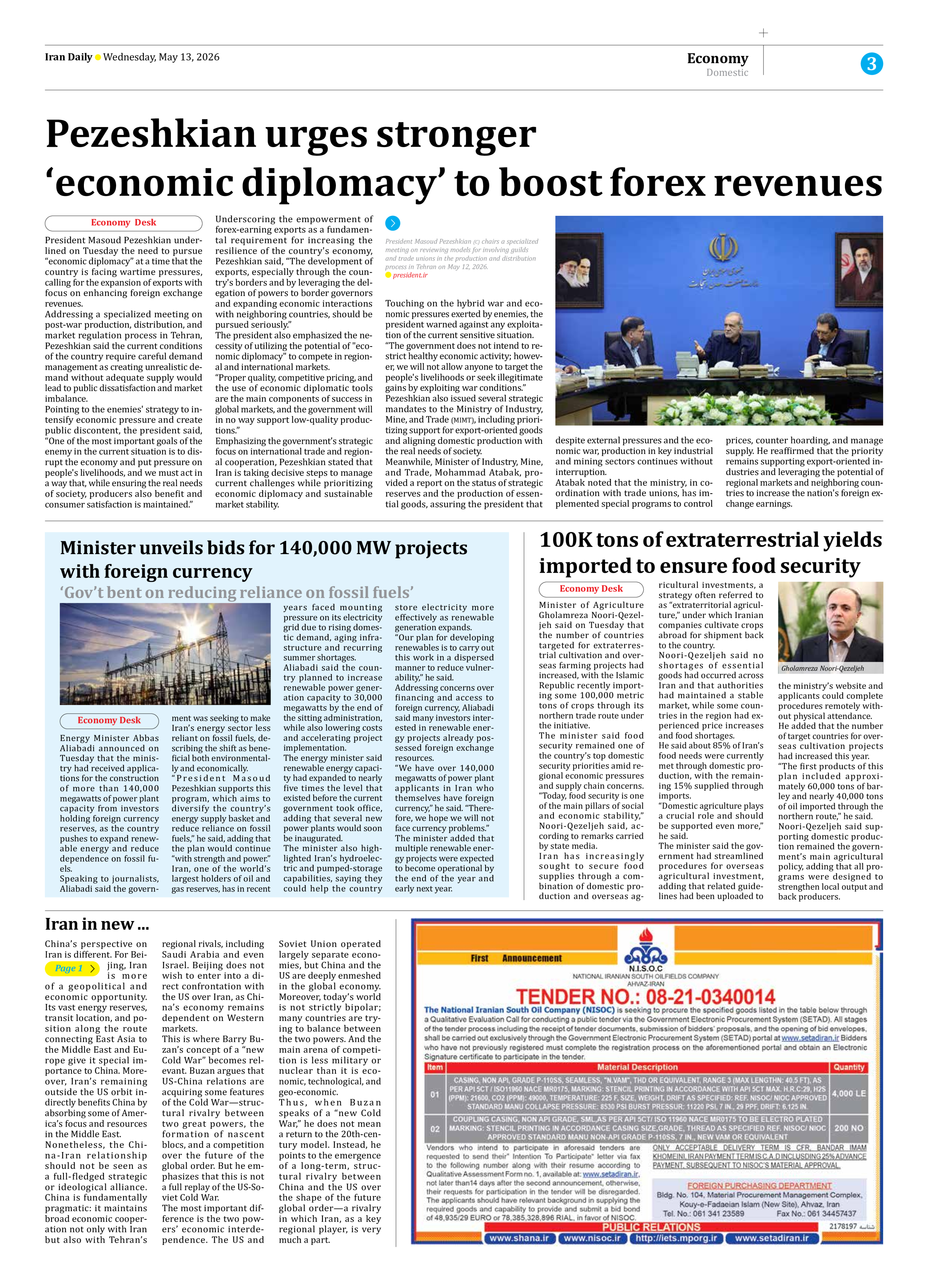
Addressing a specialized meeting on post-war production, distribution, and market regulation process in Tehran, Pezeshkian said the current conditions of the country require careful demand management as creating unrealistic demand without adequate supply would lead to public dissatisfaction and market imbalance.
Pointing to the enemies' strategy to intensify economic pressure and create public discontent, the president said, “One of the most important goals of the enemy in the current situation is to disrupt the economy and put pressure on people's livelihoods, and we must act in a way that, while ensuring the real needs of society, producers also benefit and consumer satisfaction is maintained.”
Underscoring the empowerment of forex-earning exports as a fundamental requirement for increasing the resilience of the country's economy, Pezeshkian said, “The development of exports, especially through the country's borders and by leveraging the delegation of powers to border governors and expanding economic interactions with neighboring countries, should be pursued seriously.”
The president also emphasized the necessity of utilizing the potential of "economic diplomacy" to compete in regional and international markets.
“Proper quality, competitive pricing, and the use of economic diplomatic tools are the main components of success in global markets, and the government will in no way support low-quality productions.”
Emphasizing the government’s strategic focus on international trade and regional cooperation, Pezeshkian stated that Iran is taking decisive steps to manage current challenges while prioritizing economic diplomacy and sustainable market stability.
Touching on the hybrid war and economic pressures exerted by enemies, the president warned against any exploitation of the current sensitive situation.
“The government does not intend to restrict healthy economic activity; however, we will not allow anyone to target the people's livelihoods or seek illegitimate gains by exploiting war conditions.”
Pezeshkian also issued several strategic mandates to the Ministry of Industry, Mine, and Trade (MIMT), including prioritizing support for export-oriented goods and aligning domestic production with the real needs of society.
Meanwhile, Minister of Industry, Mine, and Trade, Mohammad Atabak, provided a report on the status of strategic reserves and the production of essential goods, assuring the president that despite external pressures and the economic war, production in key industrial and mining sectors continues without interruption.
Atabak noted that the ministry, in coordination with trade unions, has implemented special programs to control prices, counter hoarding, and manage supply. He reaffirmed that the priority remains supporting export-oriented industries and leveraging the potential of regional markets and neighboring countries to increase the nation's foreign exchange earnings.