







Reading Room
‘State terrorism; the evil of our times’
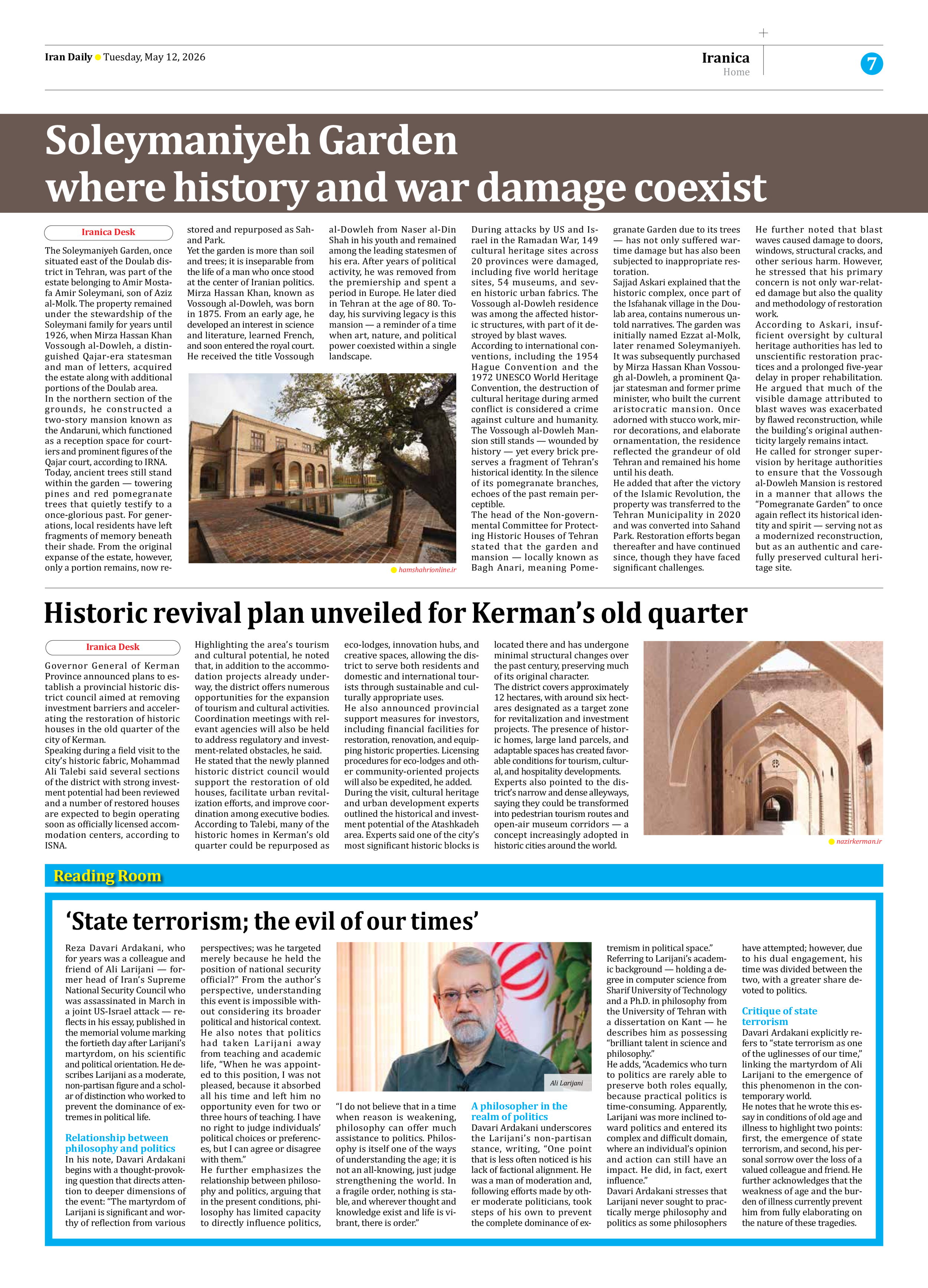
Reza Davari Ardakani, who for years was a colleague and friend of Ali Larijani — former head of Iran’s Supreme National Security Council who was assassinated in March in a joint US-Israel attack — reflects in his essay, published in the memorial volume marking the fortieth day after Larijani’s martyrdom, on his scientific and political orientation. He describes Larijani as a moderate, non-partisan figure and a scholar of distinction who worked to prevent the dominance of extremes in political life.
Relationship between philosophy and politics
In his note, Davari Ardakani begins with a thought-provoking question that directs attention to deeper dimensions of the event: “The martyrdom of Larijani is significant and worthy of reflection from various perspectives; was he targeted merely because he held the position of national security official?” From the author’s perspective, understanding this event is impossible without considering its broader political and historical context.
He also notes that politics had taken Larijani away from teaching and academic life, “When he was appointed to this position, I was not pleased, because it absorbed all his time and left him no opportunity even for two or three hours of teaching. I have no right to judge individuals’ political choices or preferences, but I can agree or disagree with them.”
He further emphasizes the relationship between philosophy and politics, arguing that in the present conditions, philosophy has limited capacity to directly influence politics, “I do not believe that in a time when reason is weakening, philosophy can offer much assistance to politics. Philosophy is itself one of the ways of understanding the age; it is not an all-knowing, just judge strengthening the world. In a fragile order, nothing is stable, and wherever thought and knowledge exist and life is vibrant, there is order.”
A philosopher in the realm of politics
Davari Ardakani underscores the Larijani’s non-partisan stance, writing, “One point that is less often noticed is his lack of factional alignment. He was a man of moderation and, following efforts made by other moderate politicians, took steps of his own to prevent the complete dominance of extremism in political space.”
Referring to Larijani’s academic background — holding a degree in computer science from Sharif University of Technology and a Ph.D. in philosophy from the University of Tehran with a dissertation on Kant — he describes him as possessing “brilliant talent in science and philosophy.”
He adds, “Academics who turn to politics are rarely able to preserve both roles equally, because practical politics is time-consuming. Apparently, Larijani was more inclined toward politics and entered its complex and difficult domain, where an individual’s opinion and action can still have an impact. He did, in fact, exert influence.”
Davari Ardakani stresses that Larijani never sought to practically merge philosophy and politics as some philosophers have attempted; however, due to his dual engagement, his time was divided between the two, with a greater share devoted to politics.
Critique of state terrorism
Davari Ardakani explicitly refers to “state terrorism as one of the uglinesses of our time,” linking the martyrdom of Ali Larijani to the emergence of this phenomenon in the contemporary world.
He notes that he wrote this essay in conditions of old age and illness to highlight two points: first, the emergence of state terrorism, and second, his personal sorrow over the loss of a valued colleague and friend. He further acknowledges that the weakness of age and the burden of illness currently prevent him from fully elaborating on the nature of these tragedies.