





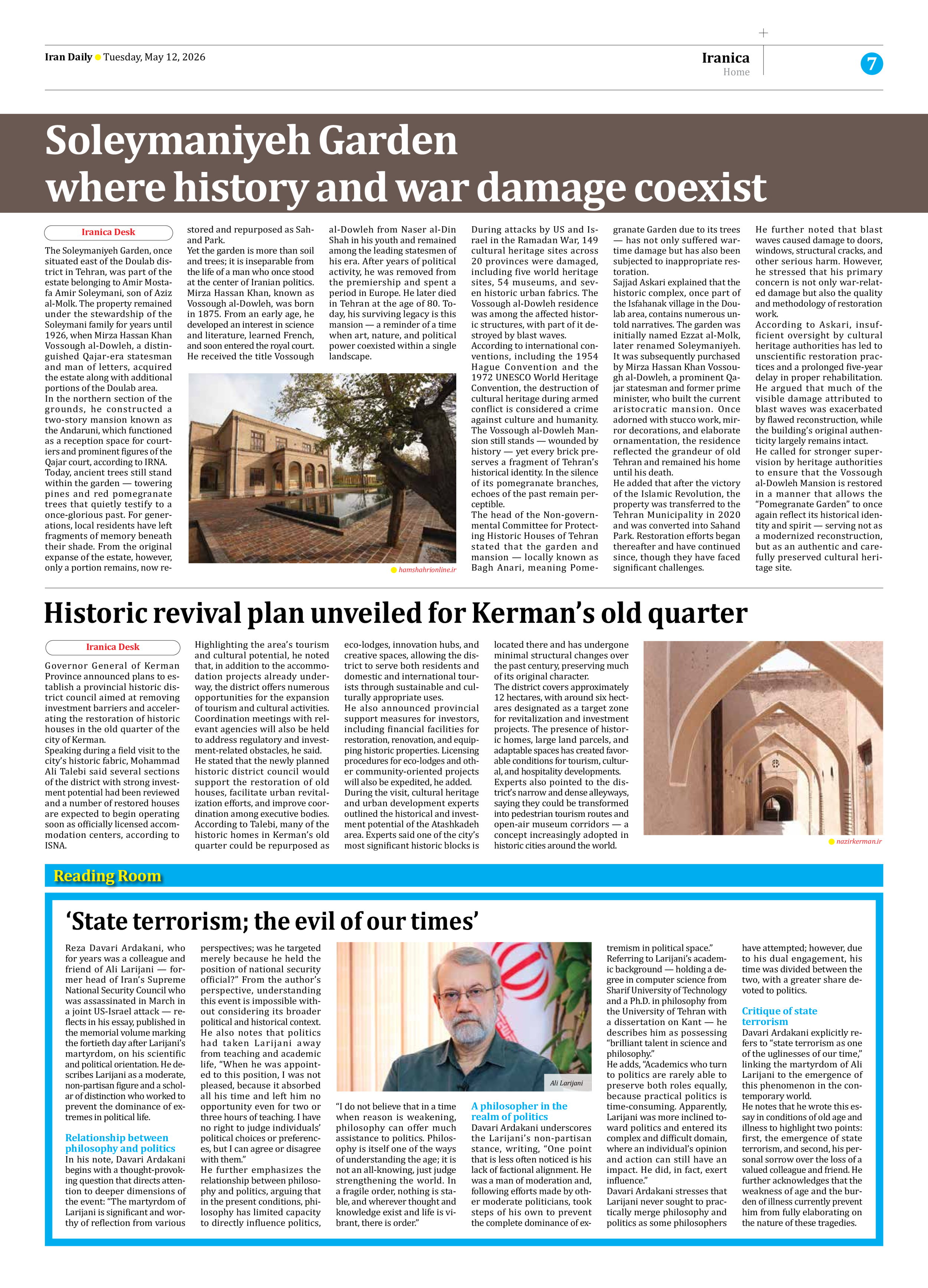


Soleymaniyeh Garden where history and war damage coexist
The Soleymaniyeh Garden, once situated east of the Doulab district in Tehran, was part of the estate belonging to Amir Mostafa Amir Soleymani, son of Aziz al-Molk. The property remained under the stewardship of the Soleymani family for years until 1926, when Mirza Hassan Khan Vossough al-Dowleh, a distinguished Qajar-era statesman and man of letters, acquired the estate along with additional portions of the Doulab area.
In the northern section of the grounds, he constructed a two-story mansion known as the Andaruni, which functioned as a reception space for courtiers and prominent figures of the Qajar court, according to IRNA.
Today, ancient trees still stand within the garden — towering pines and red pomegranate trees that quietly testify to a once-glorious past. For generations, local residents have left fragments of memory beneath their shade. From the original expanse of the estate, however, only a portion remains, now restored and repurposed as Sahand Park.
Yet the garden is more than soil and trees; it is inseparable from the life of a man who once stood at the center of Iranian politics. Mirza Hassan Khan, known as Vossough al-Dowleh, was born in 1875. From an early age, he developed an interest in science and literature, learned French, and soon entered the royal court.
He received the title Vossough al-Dowleh from Naser al-Din Shah in his youth and remained among the leading statesmen of his era. After years of political activity, he was removed from the premiership and spent a period in Europe. He later died in Tehran at the age of 80. Today, his surviving legacy is this mansion — a reminder of a time when art, nature, and political power coexisted within a single landscape.
During attacks by US and Israel in the Ramadan War, 149 cultural heritage sites across 20 provinces were damaged, including five world heritage sites, 54 museums, and seven historic urban fabrics. The Vossough al-Dowleh residence was among the affected historic structures, with part of it destroyed by blast waves.
According to international conventions, including the 1954 Hague Convention and the 1972 UNESCO World Heritage Convention, the destruction of cultural heritage during armed conflict is considered a crime against culture and humanity. The Vossough al-Dowleh Mansion still stands — wounded by history — yet every brick preserves a fragment of Tehran’s historical identity. In the silence of its pomegranate branches, echoes of the past remain perceptible.
The head of the Non-governmental Committee for Protecting Historic Houses of Tehran stated that the garden and mansion — locally known as Bagh Anari, meaning Pomegranate Garden due to its trees — has not only suffered wartime damage but has also been subjected to inappropriate restoration.
Sajjad Askari explained that the historic complex, once part of the Isfahanak village in the Doulab area, contains numerous untold narratives. The garden was initially named Ezzat al-Molk, later renamed Soleymaniyeh. It was subsequently purchased by Mirza Hassan Khan Vossough al-Dowleh, a prominent Qajar statesman and former prime minister, who built the current aristocratic mansion. Once adorned with stucco work, mirror decorations, and elaborate ornamentation, the residence reflected the grandeur of old Tehran and remained his home until his death.
He added that after the victory of the Islamic Revolution, the property was transferred to the Tehran Municipality in 2020 and was converted into Sahand Park. Restoration efforts began thereafter and have continued since, though they have faced significant challenges.
He further noted that blast waves caused damage to doors, windows, structural cracks, and other serious harm. However, he stressed that his primary concern is not only war-related damage but also the quality and methodology of restoration work.
According to Askari, insufficient oversight by cultural heritage authorities has led to unscientific restoration practices and a prolonged five-year delay in proper rehabilitation. He argued that much of the visible damage attributed to blast waves was exacerbated by flawed reconstruction, while the building’s original authenticity largely remains intact.
He called for stronger supervision by heritage authorities to ensure that the Vossough al-Dowleh Mansion is restored in a manner that allows the “Pomegranate Garden” to once again reflect its historical identity and spirit — serving not as a modernized reconstruction, but as an authentic and carefully preserved cultural heritage site.