





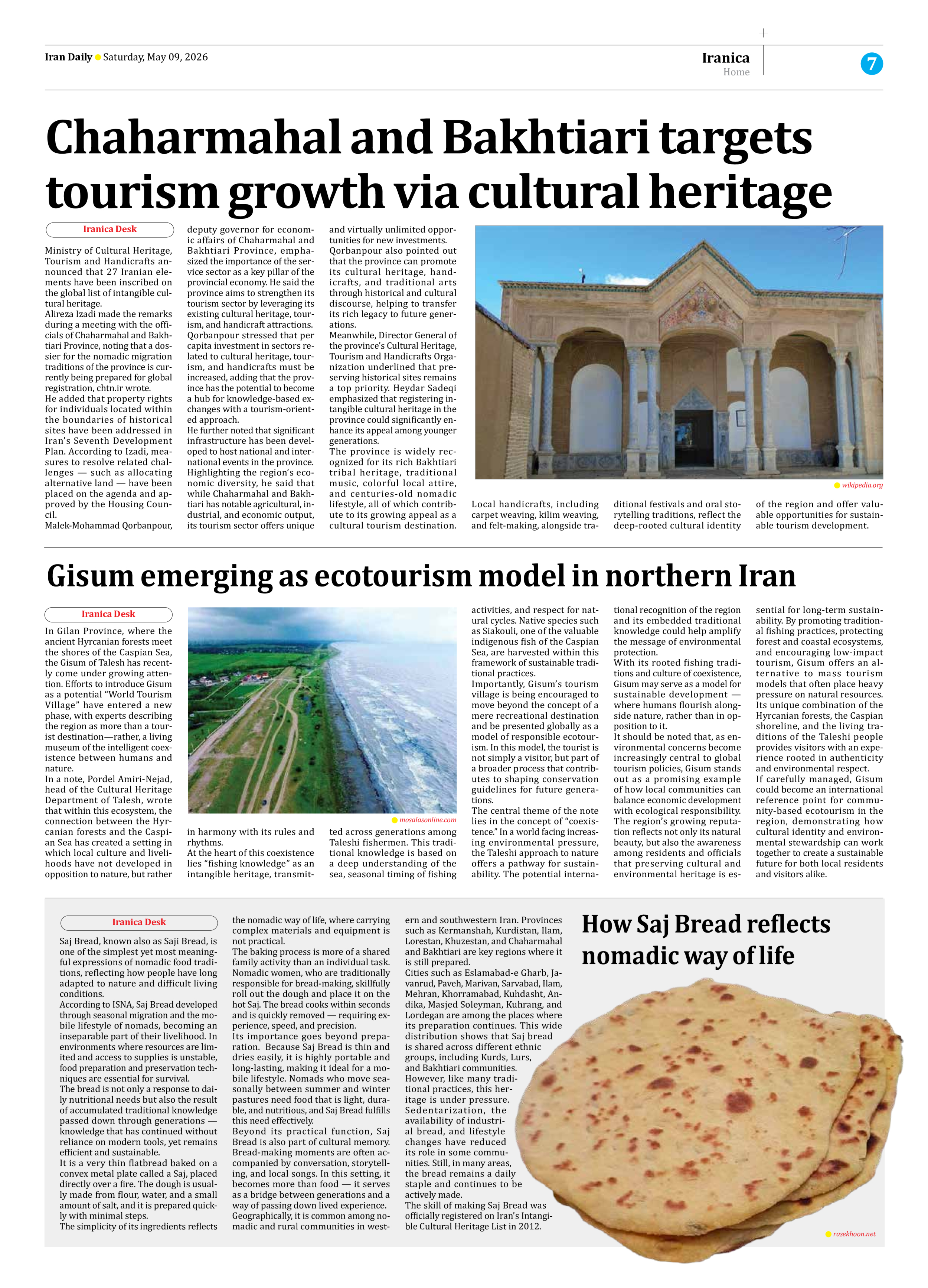


How Saj Bread reflects nomadic way of life
Saj Bread, known also as Saji Bread, is one of the simplest yet most meaningful expressions of nomadic food traditions, reflecting how people have long adapted to nature and difficult living conditions.
According to ISNA, Saj Bread developed through seasonal migration and the mobile lifestyle of nomads, becoming an inseparable part of their livelihood. In environments where resources are limited and access to supplies is unstable, food preparation and preservation techniques are essential for survival.
The bread is not only a response to daily nutritional needs but also the result of accumulated traditional knowledge passed down through generations — knowledge that has continued without reliance on modern tools, yet remains efficient and sustainable.
It is a very thin flatbread baked on a convex metal plate called a Saj, placed directly over a fire. The dough is usually made from flour, water, and a small amount of salt, and it is prepared quickly with minimal steps.
The simplicity of its ingredients reflects the nomadic way of life, where carrying complex materials and equipment is not practical.
The baking process is more of a shared family activity than an individual task. Nomadic women, who are traditionally responsible for bread-making, skillfully roll out the dough and place it on the hot Saj. The bread cooks within seconds and is quickly removed — requiring experience, speed, and precision.
Its importance goes beyond preparation. Because Saj Bread is thin and dries easily, it is highly portable and long-lasting, making it ideal for a mobile lifestyle. Nomads who move seasonally between summer and winter pastures need food that is light, durable, and nutritious, and Saj Bread fulfills this need effectively.
Beyond its practical function, Saj Bread is also part of cultural memory. Bread-making moments are often accompanied by conversation, storytelling, and local songs. In this setting, it becomes more than food — it serves as a bridge between generations and a way of passing down lived experience.
Geographically, it is common among nomadic and rural communities in western and southwestern Iran. Provinces such as Kermanshah, Kurdistan, Ilam, Lorestan, Khuzestan, and Chaharmahal and Bakhtiari are key regions where it is still prepared.
Cities such as Eslamabad-e Gharb, Javanrud, Paveh, Marivan, Sarvabad, Ilam, Mehran, Khorramabad, Kuhdasht, Andika, Masjed Soleyman, Kuhrang, and Lordegan are among the places where its preparation continues. This wide distribution shows that Saj bread is shared across different ethnic groups, including Kurds, Lurs, and Bakhtiari communities.
However, like many traditional practices, this heritage is under pressure. Sedentarization, the availability of industrial bread, and lifestyle changes have reduced its role in some communities. Still, in many areas, the bread remains a daily staple and continues to be actively made.
The skill of making Saj Bread was officially registered on Iran’s Intangible Cultural Heritage List in 2012.