





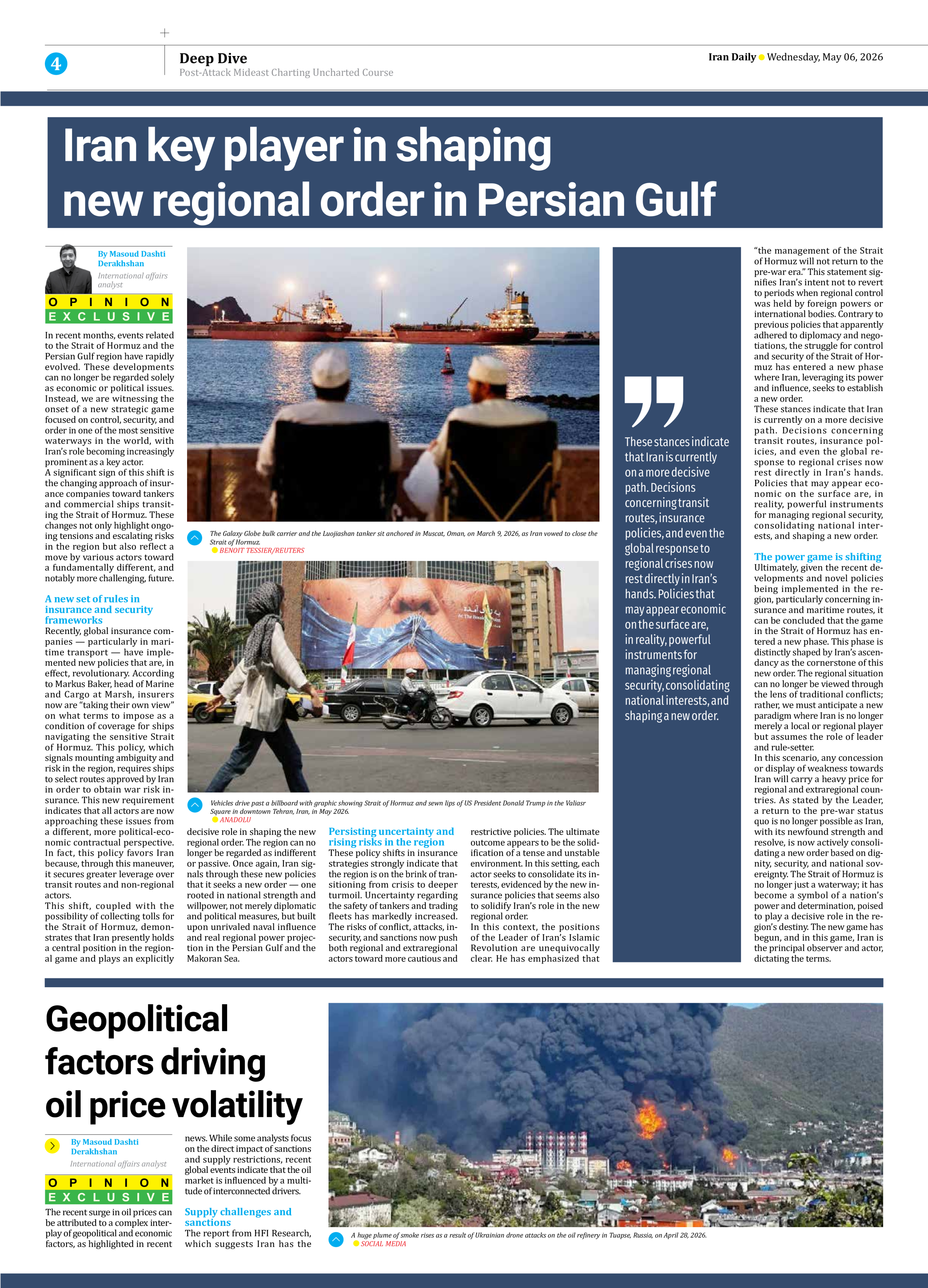


Iran key player in shaping new regional order in Persian Gulf
By Masoud Dashti Derakhshan
International affairs analyst
In recent months, events related to the Strait of Hormuz and the Persian Gulf region have rapidly evolved. These developments can no longer be regarded solely as economic or political issues. Instead, we are witnessing the onset of a new strategic game focused on control, security, and order in one of the most sensitive waterways in the world, with Iran’s role becoming increasingly prominent as a key actor.
A significant sign of this shift is the changing approach of insurance companies toward tankers and commercial ships transiting the Strait of Hormuz. These changes not only highlight ongoing tensions and escalating risks in the region but also reflect a move by various actors toward a fundamentally different, and notably more challenging, future.
A new set of rules in insurance and security frameworks
Recently, global insurance companies — particularly in maritime transport — have implemented new policies that are, in effect, revolutionary. According to Markus Baker, head of Marine and Cargo at Marsh, insurers now are “taking their own view” on what terms to impose as a condition of coverage for ships navigating the sensitive Strait of Hormuz. This policy, which signals mounting ambiguity and risk in the region, requires ships to select routes approved by Iran in order to obtain war risk insurance. This new requirement indicates that all actors are now approaching these issues from a different, more political-economic contractual perspective. In fact, this policy favors Iran because, through this maneuver, it secures greater leverage over transit routes and non-regional actors.
This shift, coupled with the possibility of collecting tolls for the Strait of Hormuz, demonstrates that Iran presently holds a central position in the regional game and plays an explicitly decisive role in shaping the new regional order. The region can no longer be regarded as indifferent or passive. Once again, Iran signals through these new policies that it seeks a new order — one rooted in national strength and willpower, not merely diplomatic and political measures, but built upon unrivaled naval influence and real regional power projection in the Persian Gulf and the Makoran Sea.
Persisting uncertainty and rising risks in the region
These policy shifts in insurance strategies strongly indicate that the region is on the brink of transitioning from crisis to deeper turmoil. Uncertainty regarding the safety of tankers and trading fleets has markedly increased. The risks of conflict, attacks, insecurity, and sanctions now push both regional and extraregional actors toward more cautious and restrictive policies. The ultimate outcome appears to be the solidification of a tense and unstable environment. In this setting, each actor seeks to consolidate its interests, evidenced by the new insurance policies that seems also to solidify Iran’s role in the new regional order.
In this context, the positions of the Leader of Iran’s Islamic Revolution are unequivocally clear. He has emphasized that “the management of the Strait of Hormuz will not return to the pre-war era.” This statement signifies Iran’s intent not to revert to periods when regional control was held by foreign powers or international bodies. Contrary to previous policies that apparently adhered to diplomacy and negotiations, the struggle for control and security of the Strait of Hormuz has entered a new phase where Iran, leveraging its power and influence, seeks to establish a new order.
These stances indicate that Iran is currently on a more decisive path. Decisions concerning transit routes, insurance policies, and even the global response to regional crises now rest directly in Iran’s hands. Policies that may appear economic on the surface are, in reality, powerful instruments for managing regional security, consolidating national interests, and shaping a new order.
The power game is shifting
Ultimately, given the recent developments and novel policies being implemented in the region, particularly concerning insurance and maritime routes, it can be concluded that the game in the Strait of Hormuz has entered a new phase. This phase is distinctly shaped by Iran’s ascendancy as the cornerstone of this new order. The regional situation can no longer be viewed through the lens of traditional conflicts; rather, we must anticipate a new paradigm where Iran is no longer merely a local or regional player but assumes the role of leader and rule-setter.
In this scenario, any concession or display of weakness towards Iran will carry a heavy price for regional and extraregional countries. As stated by the Leader, a return to the pre-war status quo is no longer possible as Iran, with its newfound strength and resolve, is now actively consolidating a new order based on dignity, security, and national sovereignty. The Strait of Hormuz is no longer just a waterway; it has become a symbol of a nation’s power and determination, poised to play a decisive role in the region’s destiny. The new game has begun, and in this game, Iran is the principal observer and actor, dictating the terms.