





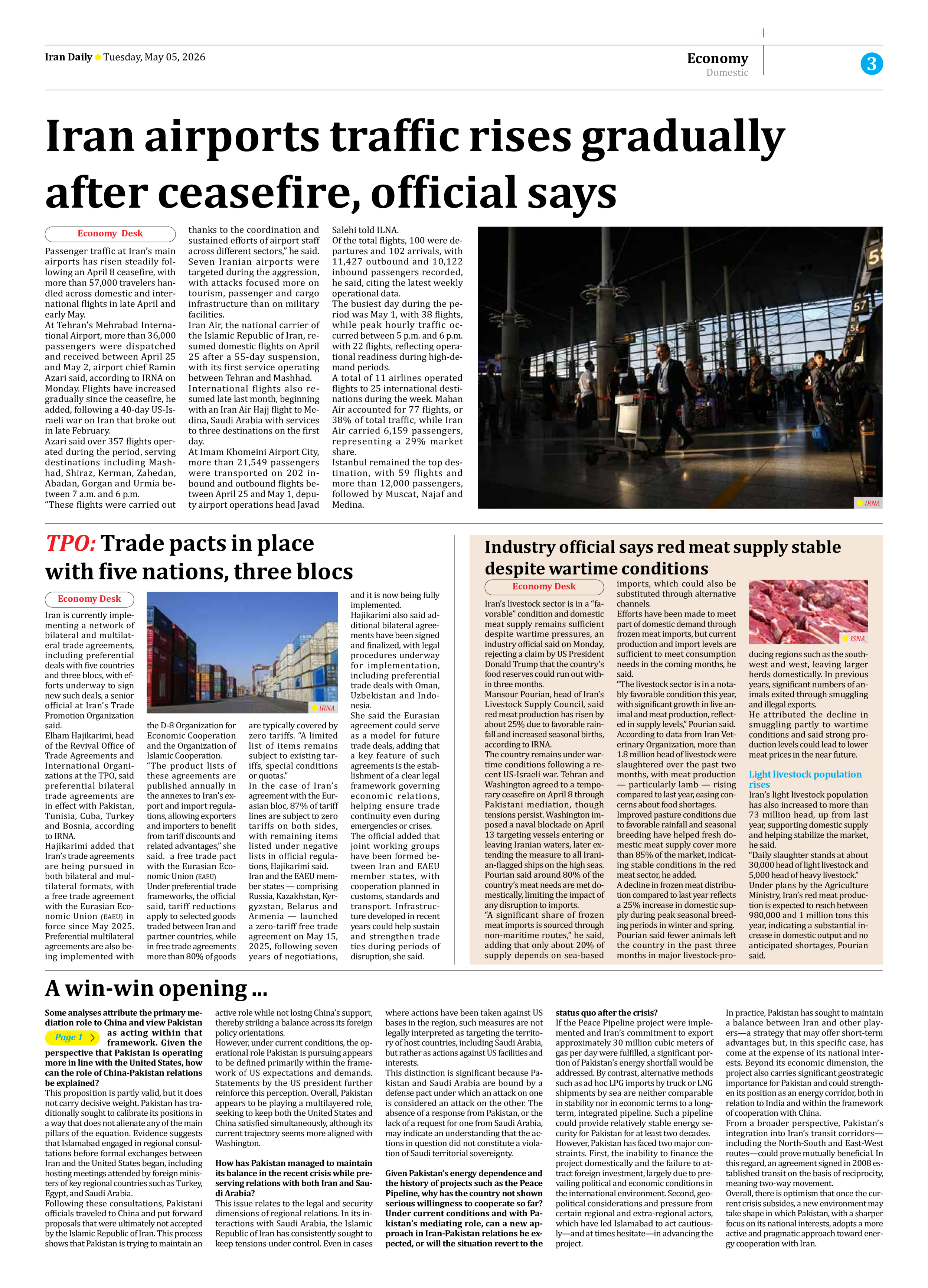


Industry official says red meat supply stable despite wartime conditions
Iran’s livestock sector is in a “favorable” condition and domestic meat supply remains sufficient despite wartime pressures, an industry official said on Monday, rejecting a claim by US President Donald Trump that the country’s food reserves could run out within three months.
Mansour Pourian, head of Iran’s Livestock Supply Council, said red meat production has risen by about 25% due to favorable rainfall and increased seasonal births, according to IRNA.
The country remains under wartime conditions following a recent US-Israeli war. Tehran and Washington agreed to a temporary ceasefire on April 8 through Pakistani mediation, though tensions persist. Washington imposed a naval blockade on April 13 targeting vessels entering or leaving Iranian waters, later extending the measure to all Iranian-flagged ships on the high seas.
Pourian said around 80% of the country’s meat needs are met domestically, limiting the impact of any disruption to imports.
“A significant share of frozen meat imports is sourced through non-maritime routes,” he said, adding that only about 20% of supply depends on sea-based imports, which could also be substituted through alternative channels.
Efforts have been made to meet part of domestic demand through frozen meat imports, but current production and import levels are sufficient to meet consumption needs in the coming months, he said.
“The livestock sector is in a notably favorable condition this year, with significant growth in live animal and meat production, reflected in supply levels,” Pourian said.
According to data from Iran Veterinary Organization, more than 1.8 million head of livestock were slaughtered over the past two months, with meat production — particularly lamb — rising compared to last year, easing concerns about food shortages.
Improved pasture conditions due to favorable rainfall and seasonal breeding have helped fresh domestic meat supply cover more than 85% of the market, indicating stable conditions in the red meat sector, he added.
A decline in frozen meat distribution compared to last year reflects a 25% increase in domestic supply during peak seasonal breeding periods in winter and spring.
Pourian said fewer animals left the country in the past three months in major livestock-producing regions such as the southwest and west, leaving larger herds domestically. In previous years, significant numbers of animals exited through smuggling and illegal exports.
He attributed the decline in smuggling partly to wartime conditions and said strong production levels could lead to lower meat prices in the near future.
Light livestock population rises
Iran’s light livestock population has also increased to more than 73 million head, up from last year, supporting domestic supply and helping stabilize the market, he said.
“Daily slaughter stands at about 30,000 head of light livestock and 5,000 head of heavy livestock.”
Under plans by the Agriculture Ministry, Iran’s red meat production is expected to reach between 980,000 and 1 million tons this year, indicating a substantial increase in domestic output and no anticipated shortages, Pourian said.