







Iran seeks to etch Minab tragedy into global cultural memory
Iran’s Minister of Cultural Heritage, Tourism and Handicrafts, Reza Salehi-Amiri, said on Saturday the country is bringing its full cultural capacity to bear to turn the Minab school tragedy into a “lasting” national and international memory, outlining a coordinated push across arts, media and legal channels.
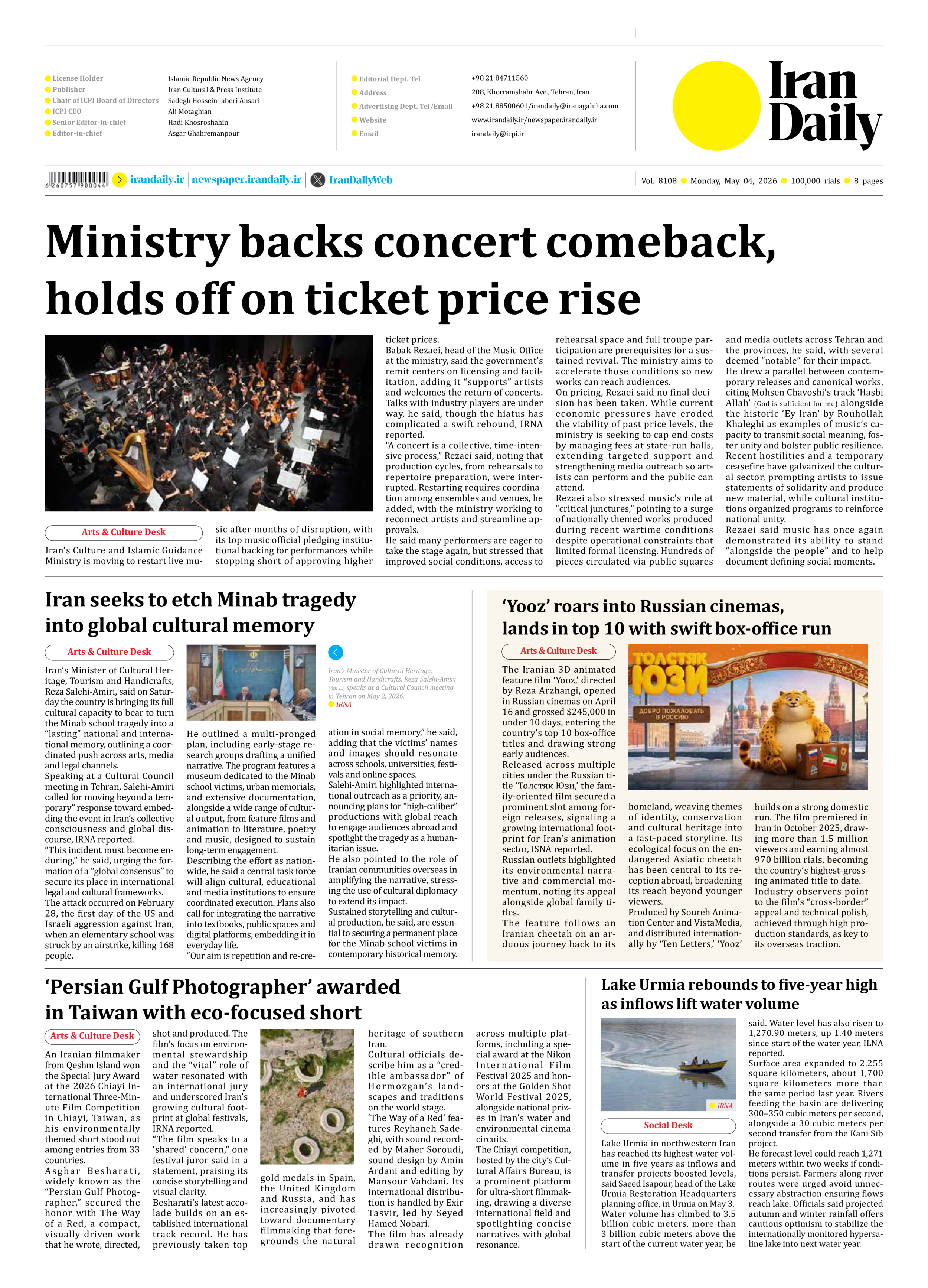
Speaking at a Cultural Council meeting in Tehran, Salehi-Amiri called for moving beyond a temporary” response toward embedding the event in Iran’s collective consciousness and global discourse, IRNA reported.
“This incident must become enduring,” he said, urging the formation of a “global consensus” to secure its place in international legal and cultural frameworks.
The attack occurred on February 28, the first day of the US and Israeli aggression against Iran, when an elementary school was struck by an airstrike, killing 168 people.
He outlined a multi-pronged plan, including early-stage research groups drafting a unified narrative. The program features a museum dedicated to the Minab school victims, urban memorials, and extensive documentation, alongside a wide range of cultural output, from feature films and animation to literature, poetry and music, designed to sustain long-term engagement.
Describing the effort as nationwide, he said a central task force will align cultural, educational and media institutions to ensure coordinated execution. Plans also call for integrating the narrative into textbooks, public spaces and digital platforms, embedding it in everyday life.
“Our aim is repetition and re-creation in social memory,” he said, adding that the victims’ names and images should resonate across schools, universities, festivals and online spaces.
Salehi-Amiri highlighted international outreach as a priority, announcing plans for “high-caliber” productions with global reach to engage audiences abroad and spotlight the tragedy as a humanitarian issue.
He also pointed to the role of Iranian communities overseas in amplifying the narrative, stressing the use of cultural diplomacy to extend its impact.
Sustained storytelling and cultural production, he said, are essential to securing a permanent place for the Minab school victims in contemporary historical memory.