







Ancient Achaemenid seal reveals early Persian naval power
A notable seal impression preserved at the National Museum of Iran has been identified as dating to the Achaemenid period, approximately 492-460 BCE. Despite its modest size, the artifact provides striking evidence of the technological skill and maritime capabilities of Persian seafarers more than 2,500 years ago.
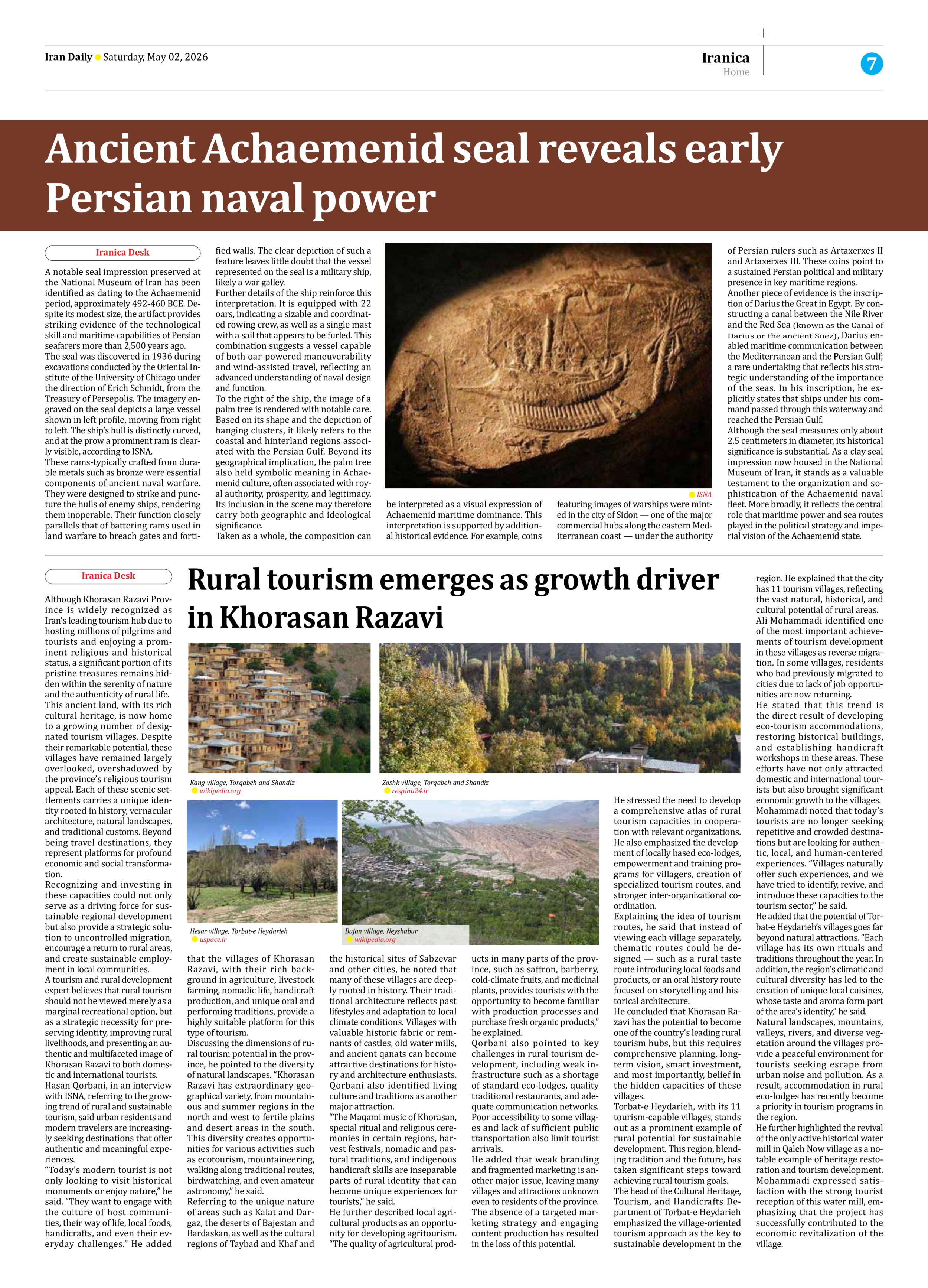
The seal was discovered in 1936 during excavations conducted by the Oriental Institute of the University of Chicago under the direction of Erich Schmidt, from the Treasury of Persepolis. The imagery engraved on the seal depicts a large vessel shown in left profile, moving from right to left. The ship’s hull is distinctly curved, and at the prow a prominent ram is clearly visible, according to ISNA.
These rams-typically crafted from durable metals such as bronze were essential components of ancient naval warfare. They were designed to strike and puncture the hulls of enemy ships, rendering them inoperable. Their function closely parallels that of battering rams used in land warfare to breach gates and fortified walls. The clear depiction of such a feature leaves little doubt that the vessel represented on the seal is a military ship, likely a war galley.
Further details of the ship reinforce this interpretation. It is equipped with 22 oars, indicating a sizable and coordinated rowing crew, as well as a single mast with a sail that appears to be furled. This combination suggests a vessel capable of both oar-powered maneuverability and wind-assisted travel, reflecting an advanced understanding of naval design and function.
To the right of the ship, the image of a palm tree is rendered with notable care. Based on its shape and the depiction of hanging clusters, it likely refers to the coastal and hinterland regions associated with the Persian Gulf. Beyond its geographical implication, the palm tree also held symbolic meaning in Achaemenid culture, often associated with royal authority, prosperity, and legitimacy. Its inclusion in the scene may therefore carry both geographic and ideological significance.
Taken as a whole, the composition can be interpreted as a visual expression of Achaemenid maritime dominance. This interpretation is supported by additional historical evidence. For example, coins featuring images of warships were minted in the city of Sidon — one of the major commercial hubs along the eastern Mediterranean coast — under the authority of Persian rulers such as Artaxerxes II and Artaxerxes III. These coins point to a sustained Persian political and military presence in key maritime regions.
Another piece of evidence is the inscription of Darius the Great in Egypt. By constructing a canal between the Nile River and the Red Sea (known as the Canal of Darius or the ancient Suez), Darius enabled maritime communication between the Mediterranean and the Persian Gulf; a rare undertaking that reflects his strategic understanding of the importance of the seas. In his inscription, he explicitly states that ships under his command passed through this waterway and reached the Persian Gulf.
Although the seal measures only about 2.5 centimeters in diameter, its historical significance is substantial. As a clay seal impression now housed in the National Museum of Iran, it stands as a valuable testament to the organization and sophistication of the Achaemenid naval fleet. More broadly, it reflects the central role that maritime power and sea routes played in the political strategy and imperial vision of the Achaemenid state.