





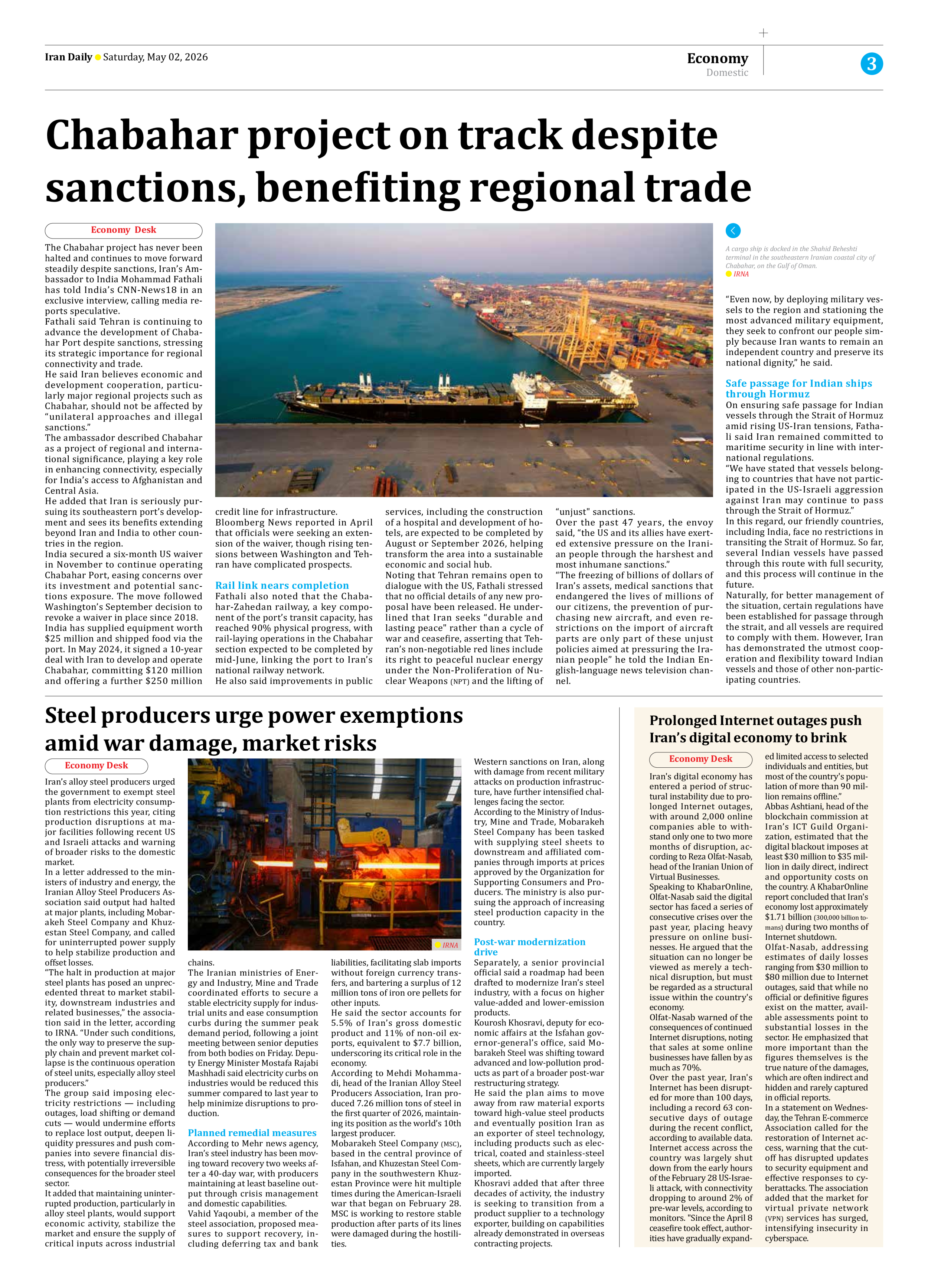


Steel producers urge power exemptions amid war damage, market risks
Iran’s alloy steel producers urged the government to exempt steel plants from electricity consumption restrictions this year, citing production disruptions at major facilities following recent US and Israeli attacks and warning of broader risks to the domestic market.
In a letter addressed to the ministers of industry and energy, the Iranian Alloy Steel Producers Association said output had halted at major plants, including Mobarakeh Steel Company and Khuzestan Steel Company, and called for uninterrupted power supply to help stabilize production and offset losses.
“The halt in production at major steel plants has posed an unprecedented threat to market stability, downstream industries and related businesses,” the association said in the letter, according to IRNA. “Under such conditions, the only way to preserve the supply chain and prevent market collapse is the continuous operation of steel units, especially alloy steel producers.”
The group said imposing electricity restrictions — including outages, load shifting or demand cuts — would undermine efforts to replace lost output, deepen liquidity pressures and push companies into severe financial distress, with potentially irreversible consequences for the broader steel sector.
It added that maintaining uninterrupted production, particularly in alloy steel plants, would support economic activity, stabilize the market and ensure the supply of critical inputs across industrial chains.
The Iranian ministries of Energy and Industry, Mine and Trade coordinated efforts to secure a stable electricity supply for industrial units and ease consumption curbs during the summer peak demand period, following a joint meeting between senior deputies from both bodies on Friday. Deputy Energy Minister Mostafa Rajabi Mashhadi said electricity curbs on industries would be reduced this summer compared to last year to help minimize disruptions to production.
Planned remedial measures
According to Mehr news agency, Iran’s steel industry has been moving toward recovery two weeks after a 40-day war, with producers maintaining at least baseline output through crisis management and domestic capabilities.
Vahid Yaqoubi, a member of the steel association, proposed measures to support recovery, including deferring tax and bank liabilities, facilitating slab imports without foreign currency transfers, and bartering a surplus of 12 million tons of iron ore pellets for other inputs.
He said the sector accounts for 5.5% of Iran’s gross domestic product and 11% of non-oil exports, equivalent to $7.7 billion, underscoring its critical role in the economy.
According to Mehdi Mohammadi, head of the Iranian Alloy Steel Producers Association, Iran produced 7.26 million tons of steel in the first quarter of 2026, maintaining its position as the world’s 10th largest producer.
Mobarakeh Steel Company (MSC), based in the central province of Isfahan, and Khuzestan Steel Company in the southwestern Khuzestan Province were hit multiple times during the American-Israeli war that began on February 28. MSC is working to restore stable production after parts of its lines were damaged during the hostilities.
Western sanctions on Iran, along with damage from recent military attacks on production infrastructure, have further intensified challenges facing the sector.
According to the Ministry of Industry, Mine and Trade, Mobarakeh Steel Company has been tasked with supplying steel sheets to downstream and affiliated companies through imports at prices approved by the Organization for Supporting Consumers and Producers. The ministry is also pursuing the approach of increasing steel production capacity in the country.
Post-war modernization drive
Separately, a senior provincial official said a roadmap had been drafted to modernize Iran’s steel industry, with a focus on higher value-added and lower-emission products.
Kourosh Khosravi, deputy for economic affairs at the Isfahan governor-general’s office, said Mobarakeh Steel was shifting toward advanced and low-pollution products as part of a broader post-war restructuring strategy.
He said the plan aims to move away from raw material exports toward high-value steel products and eventually position Iran as an exporter of steel technology, including products such as electrical, coated and stainless-steel sheets, which are currently largely imported.
Khosravi added that after three decades of activity, the industry is seeking to transition from a product supplier to a technology exporter, building on capabilities already demonstrated in overseas contracting projects.