





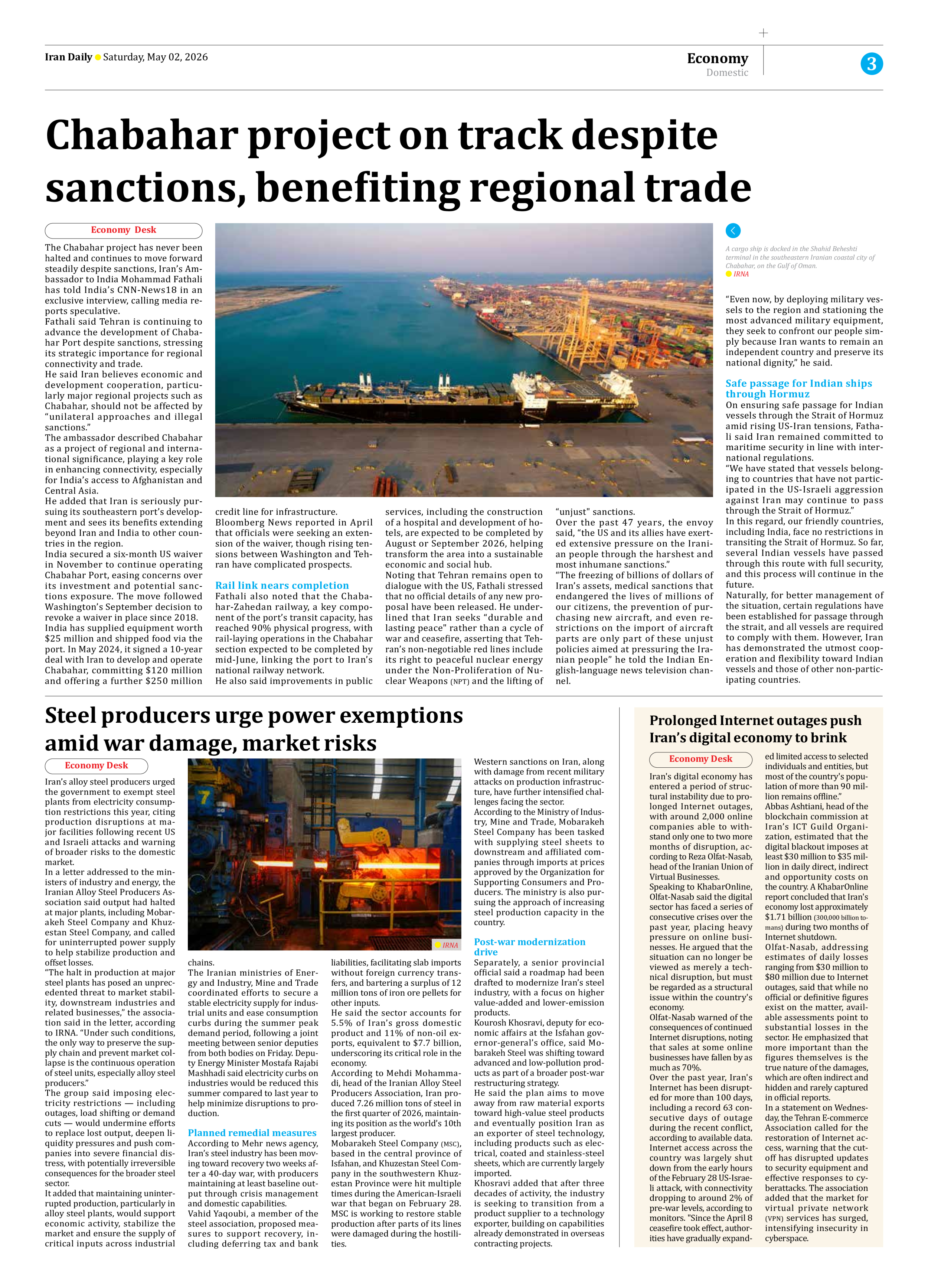


Chabahar project on track despite sanctions, benefiting regional trade
The Chabahar project has never been halted and continues to move forward steadily despite sanctions, Iran’s Ambassador to India Mohammad Fathali has told India’s CNN-News18 in an exclusive interview, calling media reports speculative.
Fathali said Tehran is continuing to advance the development of Chabahar Port despite sanctions, stressing its strategic importance for regional connectivity and trade.
He said Iran believes economic and development cooperation, particularly major regional projects such as Chabahar, should not be affected by “unilateral approaches and illegal sanctions.”
The ambassador described Chabahar as a project of regional and international significance, playing a key role in enhancing connectivity, especially for India’s access to Afghanistan and Central Asia.
He added that Iran is seriously pursuing its southeastern port’s development and sees its benefits extending beyond Iran and India to other countries in the region.
India secured a six-month US waiver in November to continue operating Chabahar Port, easing concerns over its investment and potential sanctions exposure. The move followed Washington’s September decision to revoke a waiver in place since 2018.
India has supplied equipment worth $25 million and shipped food via the port. In May 2024, it signed a 10-year deal with Iran to develop and operate Chabahar, committing $120 million and offering a further $250 million credit line for infrastructure.
Bloomberg News reported in April that officials were seeking an extension of the waiver, though rising tensions between Washington and Tehran have complicated prospects.
Rail link nears completion
Fathali also noted that the Chabahar-Zahedan railway, a key component of the port’s transit capacity, has reached 90% physical progress, with rail-laying operations in the Chabahar section expected to be completed by mid-June, linking the port to Iran’s national railway network.
He also said improvements in public services, including the construction of a hospital and development of hotels, are expected to be completed by August or September 2026, helping transform the area into a sustainable economic and social hub.
Noting that Tehran remains open to dialogue with the US, Fathali stressed that no official details of any new proposal have been released. He underlined that Iran seeks “durable and lasting peace" rather than a cycle of war and ceasefire, asserting that Tehran’s non-negotiable red lines include its right to peaceful nuclear energy under the Non-Proliferation of Nuclear Weapons (NPT) and the lifting of “unjust" sanctions.
Over the past 47 years, the envoy said, “the US and its allies have exerted extensive pressure on the Iranian people through the harshest and most inhumane sanctions.”
“The freezing of billions of dollars of Iran’s assets, medical sanctions that endangered the lives of millions of our citizens, the prevention of purchasing new aircraft, and even restrictions on the import of aircraft parts are only part of these unjust policies aimed at pressuring the Iranian people” he told the Indian English-language news television channel.
“Even now, by deploying military vessels to the region and stationing the most advanced military equipment, they seek to confront our people simply because Iran wants to remain an independent country and preserve its national dignity,” he said.
Safe passage for Indian ships through Hormuz
On ensuring safe passage for Indian vessels through the Strait of Hormuz amid rising US-Iran tensions, Fathali said Iran remained committed to maritime security in line with international regulations.
“We have stated that vessels belonging to countries that have not participated in the US-Israeli aggression against Iran may continue to pass through the Strait of Hormuz.”
In this regard, our friendly countries, including India, face no restrictions in transiting the Strait of Hormuz. So far, several Indian vessels have passed through this route with full security, and this process will continue in the future.
Naturally, for better management of the situation, certain regulations have been established for passage through the strait, and all vessels are required to comply with them. However, Iran has demonstrated the utmost cooperation and flexibility toward Indian vessels and those of other non-participating countries.