





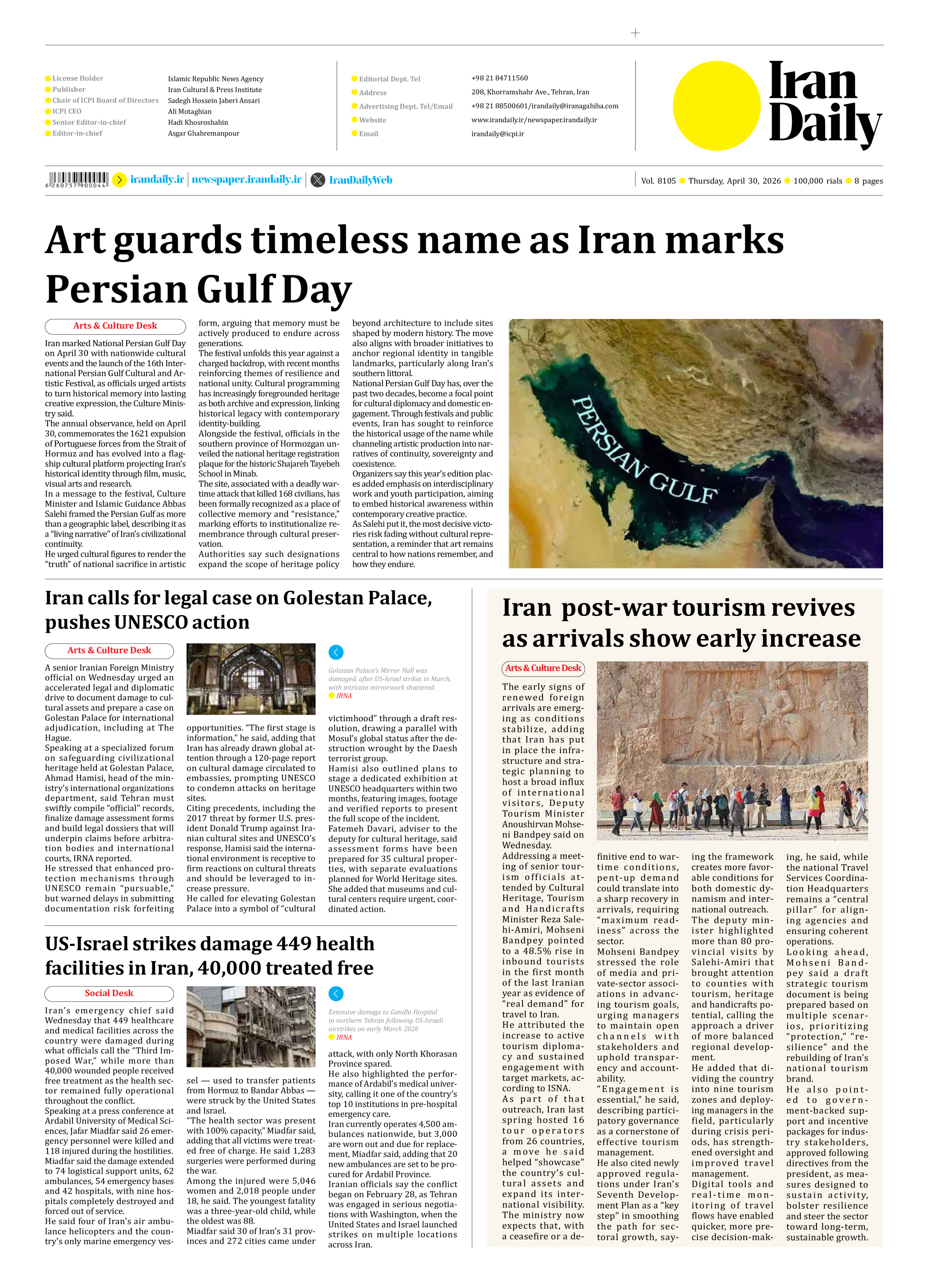


Art guards timeless name as Iran marks Persian Gulf Day
Iran marked National Persian Gulf Day on April 30 with nationwide cultural events and the launch of the 16th International Persian Gulf Cultural and Artistic Festival, as officials urged artists to turn historical memory into lasting creative expression, the Culture Ministry said.
The annual observance, held on April 30, commemorates the 1621 expulsion of Portuguese forces from the Strait of Hormuz and has evolved into a flagship cultural platform projecting Iran’s historical identity through film, music, visual arts and research.
In a message to the festival, Culture Minister and Islamic Guidance Abbas Salehi framed the Persian Gulf as more than a geographic label, describing it as a “living narrative” of Iran’s civilizational continuity.
He urged cultural figures to render the “truth” of national sacrifice in artistic form, arguing that memory must be actively produced to endure across generations.
The festival unfolds this year against a charged backdrop, with recent months reinforcing themes of resilience and national unity. Cultural programming has increasingly foregrounded heritage as both archive and expression, linking historical legacy with contemporary identity-building.
Alongside the festival, officials in the southern province of Hormozgan unveiled the national heritage registration plaque for the historic Shajareh Tayebeh School in Minab.
The site, associated with a deadly wartime attack that killed 168 civilians, has been formally recognized as a place of collective memory and “resistance,” marking efforts to institutionalize remembrance through cultural preservation.
Authorities say such designations expand the scope of heritage policy beyond architecture to include sites shaped by modern history. The move also aligns with broader initiatives to anchor regional identity in tangible landmarks, particularly along Iran’s southern littoral.
National Persian Gulf Day has, over the past two decades, become a focal point for cultural diplomacy and domestic engagement. Through festivals and public events, Iran has sought to reinforce the historical usage of the name while channeling artistic production into narratives of continuity, sovereignty and coexistence.
Organizers say this year’s edition places added emphasis on interdisciplinary work and youth participation, aiming to embed historical awareness within contemporary creative practice.
As Salehi put it, the most decisive victories risk fading without cultural representation, a reminder that art remains central to how nations remember, and how they endure.