





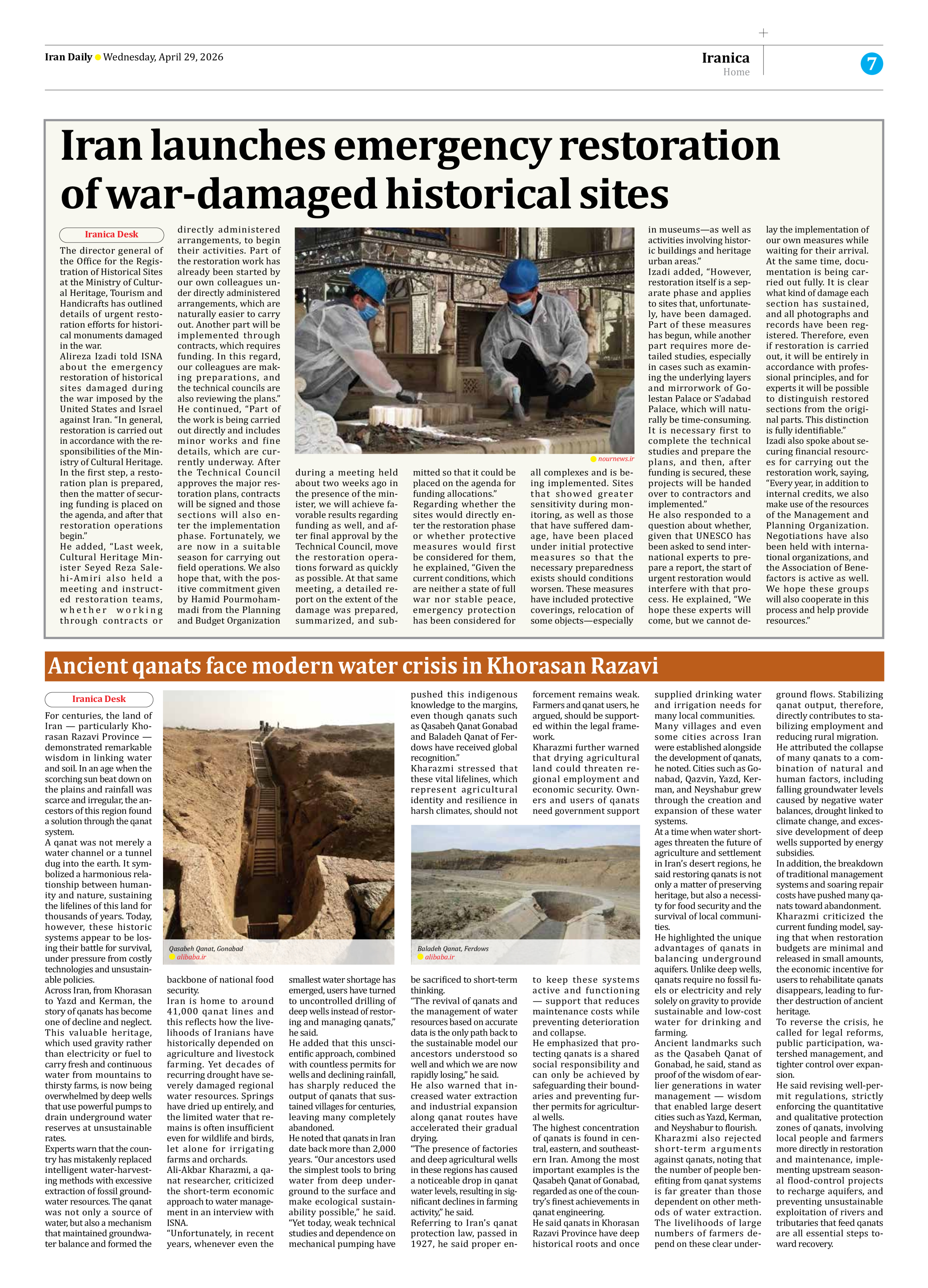


Ancient qanats face modern water crisis in Khorasan Razavi
For centuries, the land of Iran — particularly Khorasan Razavi Province — demonstrated remarkable wisdom in linking water and soil. In an age when the scorching sun beat down on the plains and rainfall was scarce and irregular, the ancestors of this region found a solution through the qanat system.
A qanat was not merely a water channel or a tunnel dug into the earth. It symbolized a harmonious relationship between humanity and nature, sustaining the lifelines of this land for thousands of years. Today, however, these historic systems appear to be losing their battle for survival, under pressure from costly technologies and unsustainable policies.
Across Iran, from Khorasan to Yazd and Kerman, the story of qanats has become one of decline and neglect. This valuable heritage, which used gravity rather than electricity or fuel to carry fresh and continuous water from mountains to thirsty farms, is now being overwhelmed by deep wells that use powerful pumps to drain underground water reserves at unsustainable rates.
Experts warn that the country has mistakenly replaced intelligent water-harvesting methods with excessive extraction of fossil groundwater resources. The qanat was not only a source of water, but also a mechanism that maintained groundwater balance and formed the backbone of national food security.
Iran is home to around 41,000 qanat lines and this reflects how the livelihoods of Iranians have historically depended on agriculture and livestock farming. Yet decades of recurring drought have severely damaged regional water resources. Springs have dried up entirely, and the limited water that remains is often insufficient even for wildlife and birds, let alone for irrigating farms and orchards.
Ali-Akbar Kharazmi, a qanat researcher, criticized the short-term economic approach to water management in an interview with ISNA.
“Unfortunately, in recent years, whenever even the smallest water shortage has emerged, users have turned to uncontrolled drilling of deep wells instead of restoring and managing qanats,” he said.
He added that this unscientific approach, combined with countless permits for wells and declining rainfall, has sharply reduced the output of qanats that sustained villages for centuries, leaving many completely abandoned.
He noted that qanats in Iran date back more than 2,000 years. “Our ancestors used the simplest tools to bring water from deep underground to the surface and make ecological sustainability possible,” he said. “Yet today, weak technical studies and dependence on mechanical pumping have pushed this indigenous knowledge to the margins, even though qanats such as Qasabeh Qanat Gonabad and Baladeh Qanat of Ferdows have received global recognition.”
Kharazmi stressed that these vital lifelines, which represent agricultural identity and resilience in harsh climates, should not be sacrificed to short-term thinking.
“The revival of qanats and the management of water resources based on accurate data is the only path back to the sustainable model our ancestors understood so well and which we are now rapidly losing,” he said.
He also warned that increased water extraction and industrial expansion along qanat routes have accelerated their gradual drying.
“The presence of factories and deep agricultural wells in these regions has caused a noticeable drop in qanat water levels, resulting in significant declines in farming activity,” he said.
Referring to Iran’s qanat protection law, passed in 1927, he said proper enforcement remains weak. Farmers and qanat users, he argued, should be supported within the legal framework.
Kharazmi further warned that drying agricultural land could threaten regional employment and economic security. Owners and users of qanats need government support to keep these systems active and functioning — support that reduces maintenance costs while preventing deterioration and collapse.
He emphasized that protecting qanats is a shared social responsibility and can only be achieved by safeguarding their boundaries and preventing further permits for agricultural wells.
The highest concentration of qanats is found in central, eastern, and southeastern Iran. Among the most important examples is the Qasabeh Qanat of Gonabad, regarded as one of the country’s finest achievements in qanat engineering.
He said qanats in Khorasan Razavi Province have deep historical roots and once supplied drinking water and irrigation needs for many local communities.
Many villages and even some cities across Iran were established alongside the development of qanats, he noted. Cities such as Gonabad, Qazvin, Yazd, Kerman, and Neyshabur grew through the creation and expansion of these water systems.
At a time when water shortages threaten the future of agriculture and settlement in Iran’s desert regions, he said restoring qanats is not only a matter of preserving heritage, but also a necessity for food security and the survival of local communities.
He highlighted the unique advantages of qanats in balancing underground aquifers. Unlike deep wells, qanats require no fossil fuels or electricity and rely solely on gravity to provide sustainable and low-cost water for drinking and farming.
Ancient landmarks such as the Qasabeh Qanat of Gonabad, he said, stand as proof of the wisdom of earlier generations in water management — wisdom that enabled large desert cities such as Yazd, Kerman, and Neyshabur to flourish.
Kharazmi also rejected short-term arguments against qanats, noting that the number of people benefiting from qanat systems is far greater than those dependent on other methods of water extraction. The livelihoods of large numbers of farmers depend on these clear underground flows. Stabilizing qanat output, therefore, directly contributes to stabilizing employment and reducing rural migration.
He attributed the collapse of many qanats to a combination of natural and human factors, including falling groundwater levels caused by negative water balances, drought linked to climate change, and excessive development of deep wells supported by energy subsidies.
In addition, the breakdown of traditional management systems and soaring repair costs have pushed many qanats toward abandonment.
Kharazmi criticized the current funding model, saying that when restoration budgets are minimal and released in small amounts, the economic incentive for users to rehabilitate qanats disappears, leading to further destruction of ancient heritage.
To reverse the crisis, he called for legal reforms, public participation, watershed management, and tighter control over expansion.
He said revising well-permit regulations, strictly enforcing the quantitative and qualitative protection zones of qanats, involving local people and farmers more directly in restoration and maintenance, implementing upstream seasonal flood-control projects to recharge aquifers, and preventing unsustainable exploitation of rivers and tributaries that feed qanats are all essential steps toward recovery.