





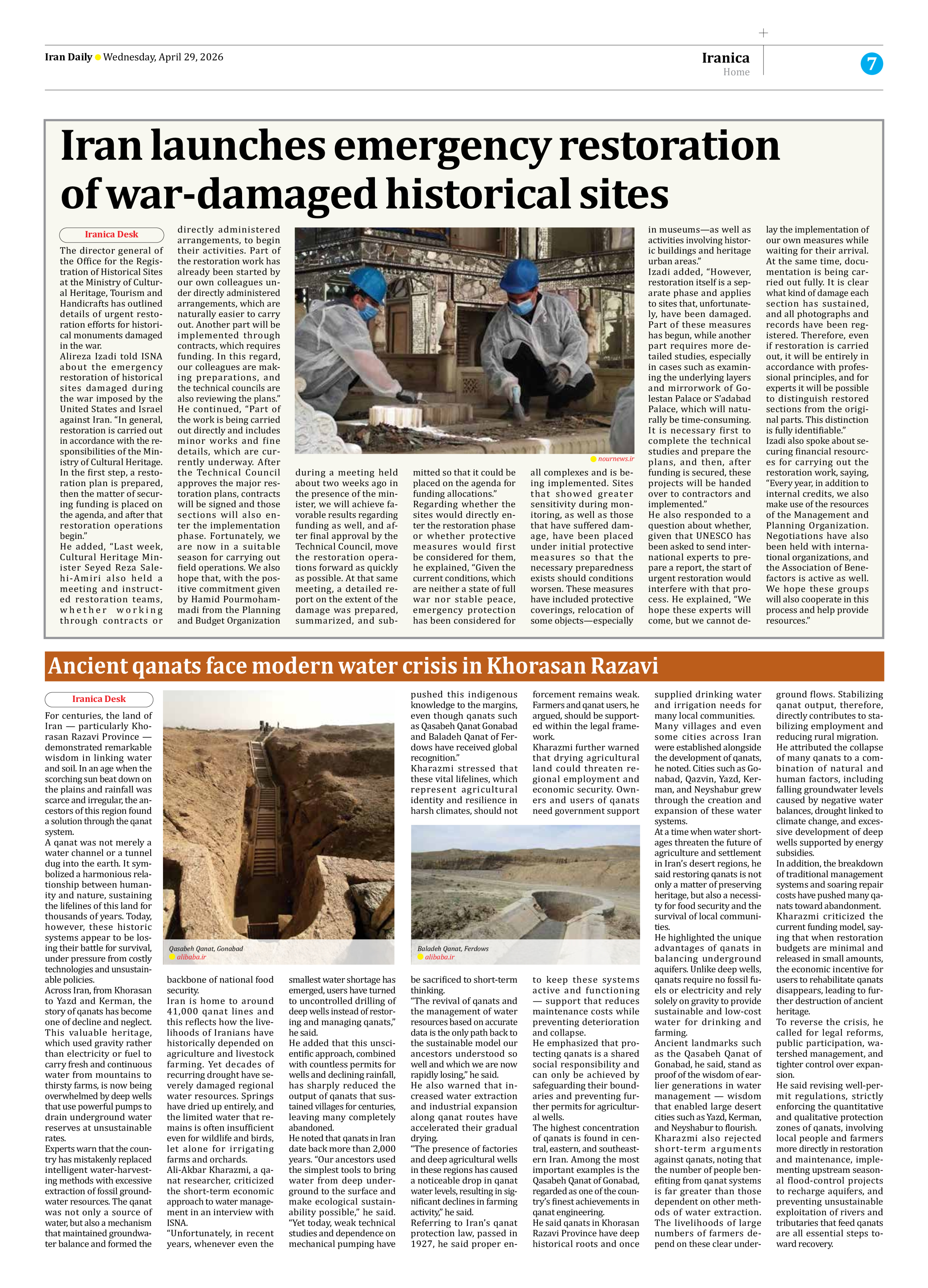


Iran launches emergency restoration of war-damaged historical sites
The director general of the Office for the Registration of Historical Sites at the Ministry of Cultural Heritage, Tourism and Handicrafts has outlined details of urgent restoration efforts for historical monuments damaged in the war.
Alireza Izadi told ISNA about the emergency restoration of historical sites damaged during the war imposed by the United States and Israel against Iran. “In general, restoration is carried out in accordance with the responsibilities of the Ministry of Cultural Heritage. In the first step, a restoration plan is prepared, then the matter of securing funding is placed on the agenda, and after that restoration operations begin.”
He added, “Last week, Cultural Heritage Minister Seyed Reza Salehi-Amiri also held a meeting and instructed restoration teams, whether working through contracts or directly administered arrangements, to begin their activities. Part of the restoration work has already been started by our own colleagues under directly administered arrangements, which are naturally easier to carry out. Another part will be implemented through contracts, which requires funding. In this regard, our colleagues are making preparations, and the technical councils are also reviewing the plans.”
He continued, “Part of the work is being carried out directly and includes minor works and fine details, which are currently underway. After the Technical Council approves the major restoration plans, contracts will be signed and those sections will also enter the implementation phase. Fortunately, we are now in a suitable season for carrying out field operations. We also hope that, with the positive commitment given by Hamid Pourmohammadi from the Planning and Budget Organization during a meeting held about two weeks ago in the presence of the minister, we will achieve favorable results regarding funding as well, and after final approval by the Technical Council, move the restoration operations forward as quickly as possible. At that same meeting, a detailed report on the extent of the damage was prepared, summarized, and submitted so that it could be placed on the agenda for funding allocations.”
Regarding whether the sites would directly enter the restoration phase or whether protective measures would first be considered for them, he explained, “Given the current conditions, which are neither a state of full war nor stable peace, emergency protection has been considered for all complexes and is being implemented. Sites that showed greater sensitivity during monitoring, as well as those that have suffered damage, have been placed under initial protective measures so that the necessary preparedness exists should conditions worsen. These measures have included protective coverings, relocation of some objects—especially in museums—as well as activities involving historic buildings and heritage urban areas.”
Izadi added, “However, restoration itself is a separate phase and applies to sites that, unfortunately, have been damaged. Part of these measures has begun, while another part requires more detailed studies, especially in cases such as examining the underlying layers and mirrorwork of Golestan Palace or S’adabad Palace, which will naturally be time-consuming. It is necessary first to complete the technical studies and prepare the plans, and then, after funding is secured, these projects will be handed over to contractors and implemented.”
He also responded to a question about whether, given that UNESCO has been asked to send international experts to prepare a report, the start of urgent restoration would interfere with that process. He explained, “We hope these experts will come, but we cannot delay the implementation of our own measures while waiting for their arrival. At the same time, documentation is being carried out fully. It is clear what kind of damage each section has sustained, and all photographs and records have been registered. Therefore, even if restoration is carried out, it will be entirely in accordance with professional principles, and for experts it will be possible to distinguish restored sections from the original parts. This distinction is fully identifiable.”
Izadi also spoke about securing financial resources for carrying out the restoration work, saying, “Every year, in addition to internal credits, we also make use of the resources of the Management and Planning Organization. Negotiations have also been held with international organizations, and the Association of Benefactors is active as well. We hope these groups will also cooperate in this process and help provide resources.”