





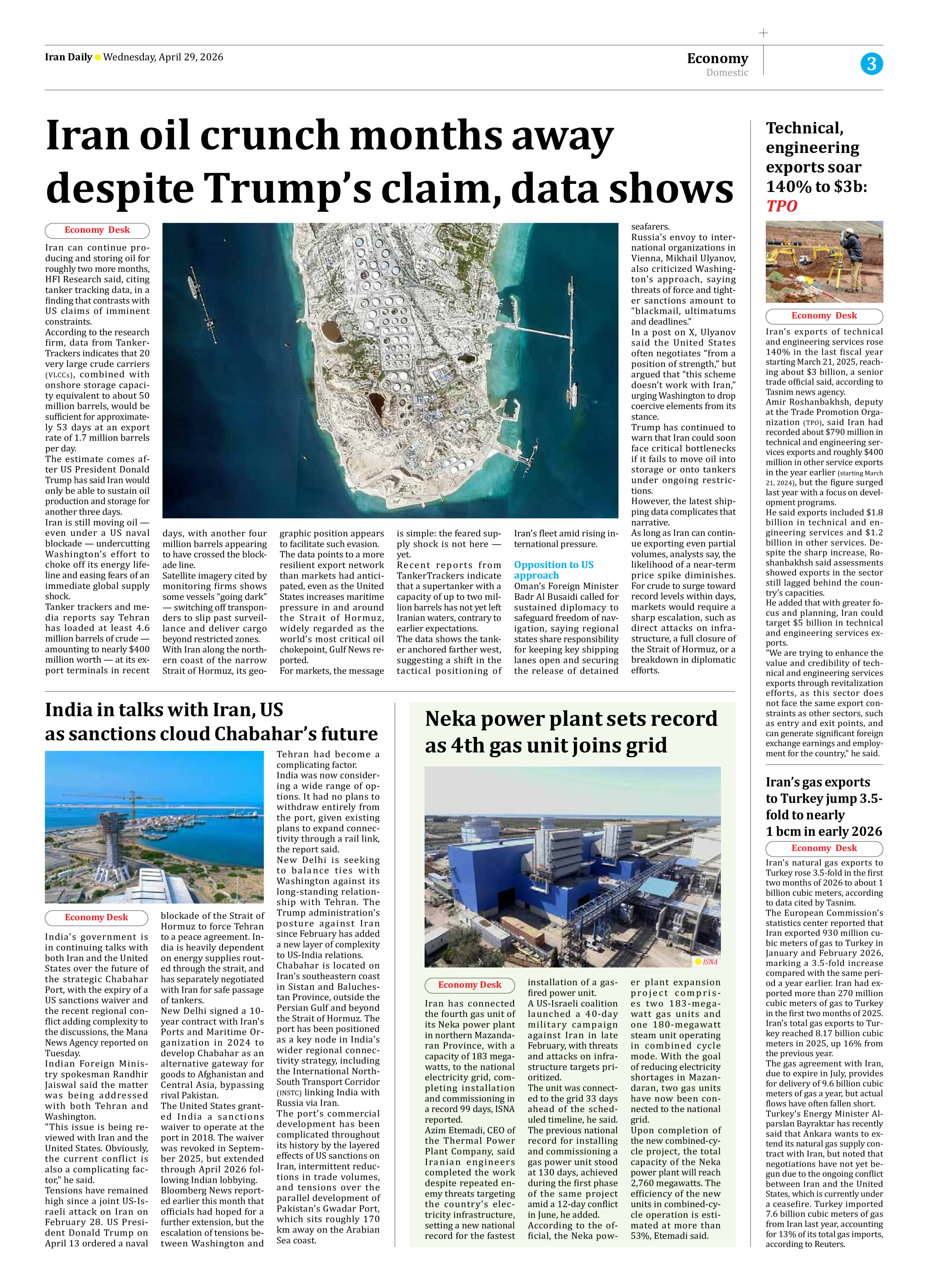


India in talks with Iran, US as sanctions cloud Chabahar’s future
India's government is in continuing talks with both Iran and the United States over the future of the strategic Chabahar Port, with the expiry of a US sanctions waiver and the recent regional conflict adding complexity to the discussions, the Mana News Agency reported on Tuesday.
Indian Foreign Ministry spokesman Randhir Jaiswal said the matter was being addressed with both Tehran and Washington.
"This issue is being reviewed with Iran and the United States. Obviously, the current conflict is also a complicating factor," he said.
Tensions have remained high since a joint US-Israeli attack on Iran on February 28. US President Donald Trump on April 13 ordered a naval blockade of the Strait of Hormuz to force Tehran to a peace agreement. India is heavily dependent on energy supplies routed through the strait, and has separately negotiated with Iran for safe passage of tankers.
New Delhi signed a 10-year contract with Iran's Ports and Maritime Organization in 2024 to develop Chabahar as an alternative gateway for goods to Afghanistan and Central Asia, bypassing rival Pakistan.
The United States granted India a sanctions waiver to operate at the port in 2018. The waiver was revoked in September 2025, but extended through April 2026 following Indian lobbying.
Bloomberg News reported earlier this month that officials had hoped for a further extension, but the escalation of tensions between Washington and Tehran had become a complicating factor.
India was now considering a wide range of options. It had no plans to withdraw entirely from the port, given existing plans to expand connectivity through a rail link, the report said.
New Delhi is seeking to balance ties with Washington against its long-standing relationship with Tehran. The Trump administration's posture against Iran since February has added a new layer of complexity to US-India relations.
Chabahar is located on Iran's southeastern coast in Sistan and Baluchestan Province, outside the Persian Gulf and beyond the Strait of Hormuz. The port has been positioned as a key node in India's wider regional connectivity strategy, including the International North-South Transport Corridor (INSTC) linking India with Russia via Iran.
The port's commercial development has been complicated throughout its history by the layered effects of US sanctions on Iran, intermittent reductions in trade volumes, and tensions over the parallel development of Pakistan's Gwadar Port, which sits roughly 170 km away on the Arabian Sea coast.