







Iran oil crunch months away despite Trump’s claim, data shows
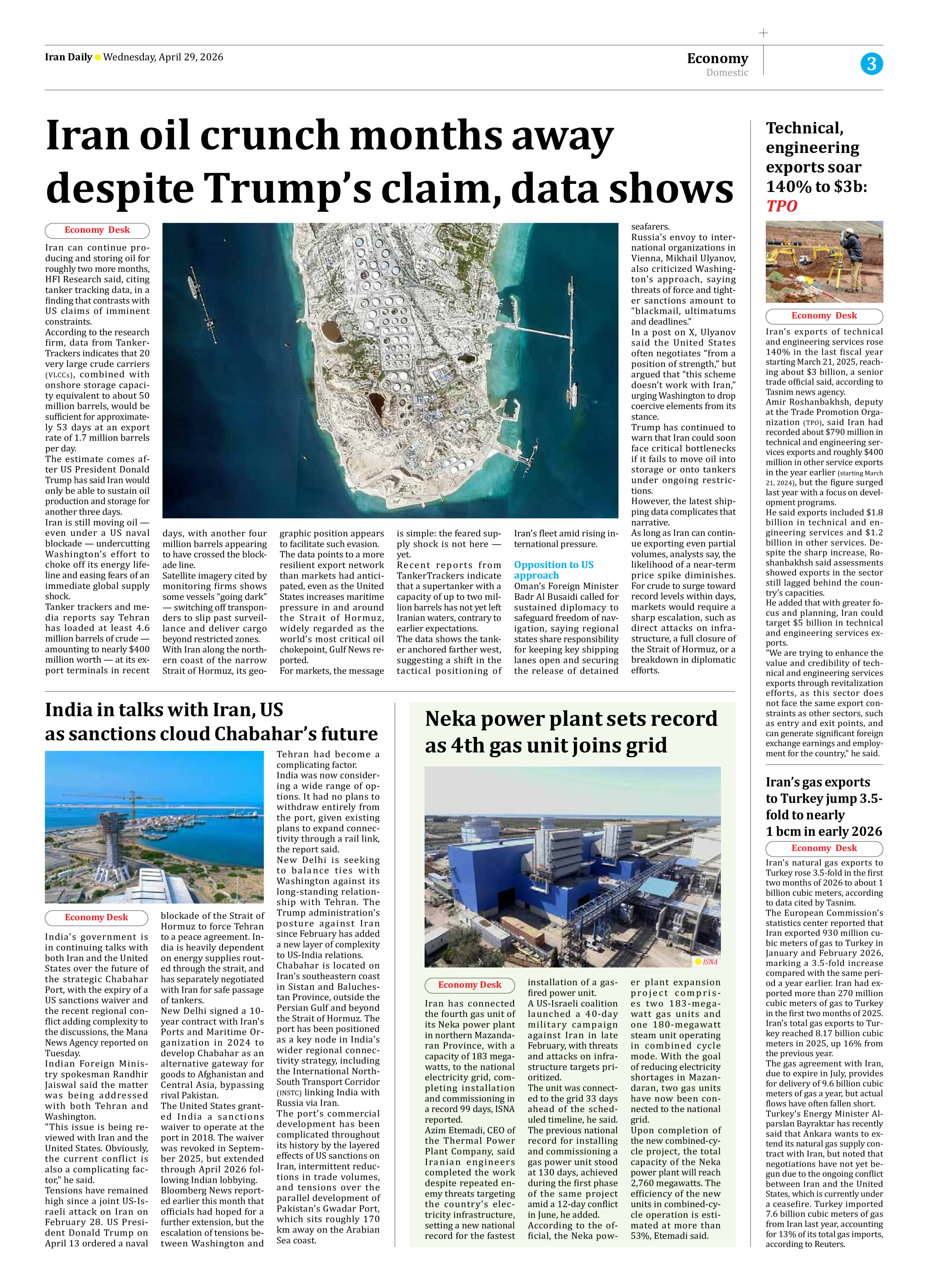
Iran can continue producing and storing oil for roughly two more months, HFI Research said, citing tanker tracking data, in a finding that contrasts with US claims of imminent constraints.
According to the research firm, data from TankerTrackers indicates that 20 very large crude carriers (VLCCs), combined with onshore storage capacity equivalent to about 50 million barrels, would be sufficient for approximately 53 days at an export rate of 1.7 million barrels per day.
The estimate comes after US President Donald Trump has said Iran would only be able to sustain oil production and storage for another three days.
Iran is still moving oil — even under a US naval blockade — undercutting Washington’s effort to choke off its energy lifeline and easing fears of an immediate global supply shock.
Tanker trackers and media reports say Tehran has loaded at least 4.6 million barrels of crude — amounting to nearly $400 million worth — at its export terminals in recent days, with another four million barrels appearing to have crossed the blockade line.
Satellite imagery cited by monitoring firms shows some vessels “going dark” — switching off transponders to slip past surveillance and deliver cargo beyond restricted zones.
With Iran along the northern coast of the narrow Strait of Hormuz, its geographic position appears to facilitate such evasion.
The data points to a more resilient export network than markets had anticipated, even as the United States increases maritime pressure in and around the Strait of Hormuz, widely regarded as the world’s most critical oil chokepoint, Gulf News reported.
For markets, the message is simple: the feared supply shock is not here — yet.
Recent reports from TankerTrackers indicate that a supertanker with a capacity of up to two million barrels has not yet left Iranian waters, contrary to earlier expectations.
The data shows the tanker anchored farther west, suggesting a shift in the tactical positioning of Iran’s fleet amid rising international pressure.
Opposition to US approach
Oman’s Foreign Minister Badr Al Busaidi called for sustained diplomacy to safeguard freedom of navigation, saying regional states share responsibility for keeping key shipping lanes open and securing the release of detained seafarers.
Russia’s envoy to international organizations in Vienna, Mikhail Ulyanov, also criticized Washington’s approach, saying threats of force and tighter sanctions amount to “blackmail, ultimatums and deadlines.”
In a post on X, Ulyanov said the United States often negotiates “from a position of strength,” but argued that “this scheme doesn’t work with Iran,” urging Washington to drop coercive elements from its stance.
Trump has continued to warn that Iran could soon face critical bottlenecks if it fails to move oil into storage or onto tankers under ongoing restrictions.
However, the latest shipping data complicates that narrative.
As long as Iran can continue exporting even partial volumes, analysts say, the likelihood of a near-term price spike diminishes. For crude to surge toward record levels within days, markets would require a sharp escalation, such as direct attacks on infrastructure, a full closure of the Strait of Hormuz, or a breakdown in diplomatic efforts.