







Reading Room
Foundation of Iranian identity
By Mahshid
Razavi Rezvani
Director of Mahshide Kherad Institute
In a time when Iran’s confrontation with the US and Israel and the country’s resilience have become central topics in global media coverage, drawing widespread international attention, it is more important than ever to understand Iran and its people more deeply.
The study of Iranian society and civilization over centuries has long fascinated scholars and travelers alike, appealing to a wide range of interests. Such a comprehensive understanding requires a proper grasp of Iran’s geography, its history shaped by that geography, and its climatic and environmental conditions — all of which have influenced the formation of Iranian identity.
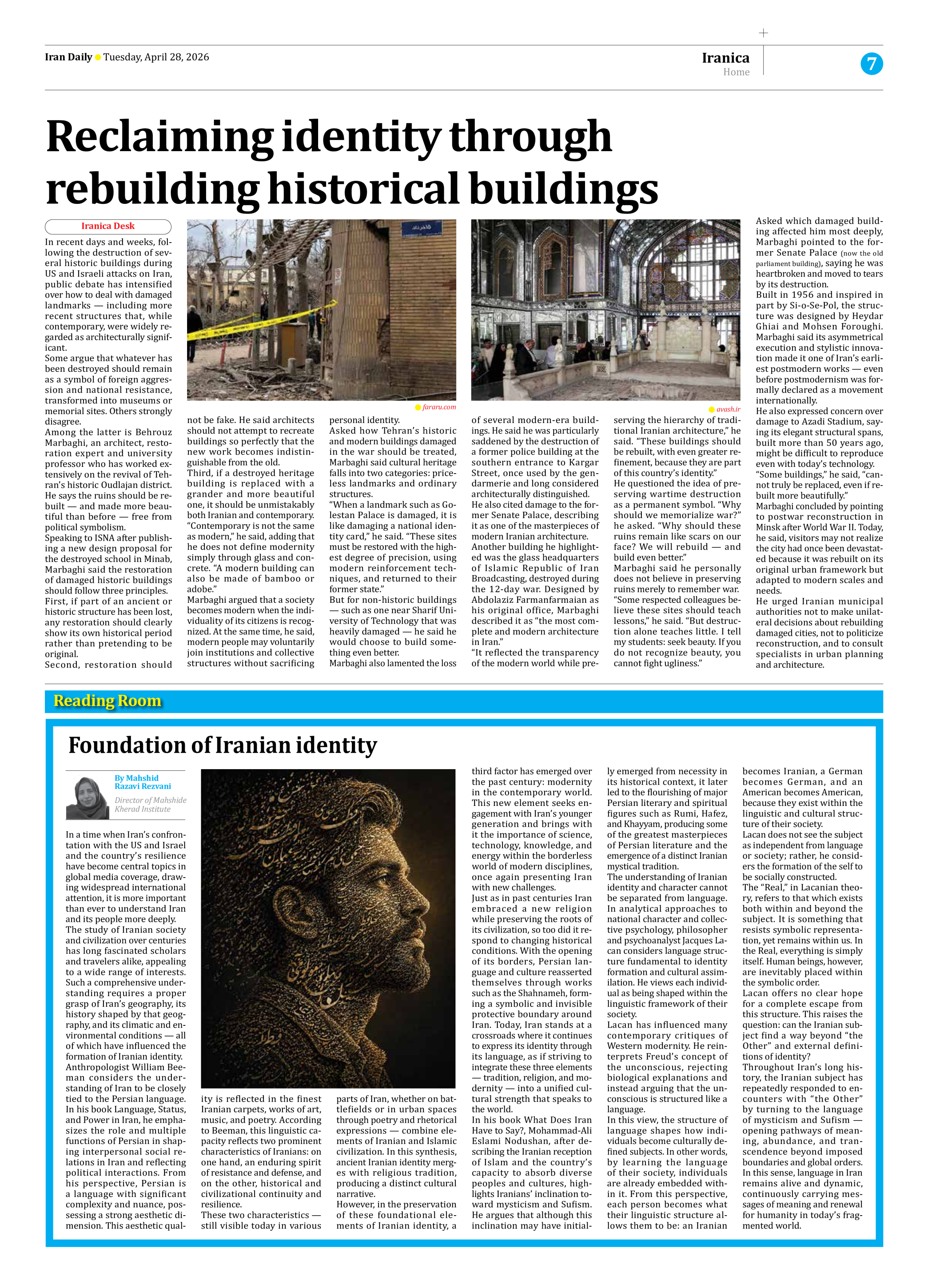
Anthropologist William Beeman considers the understanding of Iran to be closely tied to the Persian language. In his book Language, Status, and Power in Iran, he emphasizes the role and multiple functions of Persian in shaping interpersonal social relations in Iran and reflecting political interactions. From his perspective, Persian is a language with significant complexity and nuance, possessing a strong aesthetic dimension. This aesthetic quality is reflected in the finest Iranian carpets, works of art, music, and poetry. According to Beeman, this linguistic capacity reflects two prominent characteristics of Iranians: on one hand, an enduring spirit of resistance and defense, and on the other, historical and civilizational continuity and resilience.
These two characteristics — still visible today in various parts of Iran, whether on battlefields or in urban spaces through poetry and rhetorical expressions — combine elements of Iranian and Islamic civilization. In this synthesis, ancient Iranian identity merges with religious tradition, producing a distinct cultural narrative.
However, in the preservation of these foundational elements of Iranian identity, a third factor has emerged over the past century: modernity in the contemporary world. This new element seeks engagement with Iran’s younger generation and brings with it the importance of science, technology, knowledge, and energy within the borderless world of modern disciplines, once again presenting Iran with new challenges.
Just as in past centuries Iran embraced a new religion while preserving the roots of its civilization, so too did it respond to changing historical conditions. With the opening of its borders, Persian language and culture reasserted themselves through works such as the Shahnameh, forming a symbolic and invisible protective boundary around Iran. Today, Iran stands at a crossroads where it continues to express its identity through its language, as if striving to integrate these three elements — tradition, religion, and modernity — into a unified cultural strength that speaks to the world.
In his book What Does Iran Have to Say?, Mohammad-Ali Eslami Nodushan, after describing the Iranian reception of Islam and the country’s capacity to absorb diverse peoples and cultures, highlights Iranians’ inclination toward mysticism and Sufism. He argues that although this inclination may have initially emerged from necessity in its historical context, it later led to the flourishing of major Persian literary and spiritual figures such as Rumi, Hafez, and Khayyam, producing some of the greatest masterpieces of Persian literature and the emergence of a distinct Iranian mystical tradition.
The understanding of Iranian identity and character cannot be separated from language. In analytical approaches to national character and collective psychology, philosopher and psychoanalyst Jacques Lacan considers language structure fundamental to identity formation and cultural assimilation. He views each individual as being shaped within the linguistic framework of their society.
Lacan has influenced many contemporary critiques of Western modernity. He reinterprets Freud’s concept of the unconscious, rejecting biological explanations and instead arguing that the unconscious is structured like a language.
In this view, the structure of language shapes how individuals become culturally defined subjects. In other words, by learning the language of their society, individuals are already embedded within it. From this perspective, each person becomes what their linguistic structure allows them to be: an Iranian becomes Iranian, a German becomes German, and an American becomes American, because they exist within the linguistic and cultural structure of their society.
Lacan does not see the subject as independent from language or society; rather, he considers the formation of the self to be socially constructed.
The “Real,” in Lacanian theory, refers to that which exists both within and beyond the subject. It is something that resists symbolic representation, yet remains within us. In the Real, everything is simply itself. Human beings, however, are inevitably placed within the symbolic order.
Lacan offers no clear hope for a complete escape from this structure. This raises the question: can the Iranian subject find a way beyond “the Other” and external definitions of identity?
Throughout Iran’s long history, the Iranian subject has repeatedly responded to encounters with “the Other” by turning to the language of mysticism and Sufism — opening pathways of meaning, abundance, and transcendence beyond imposed boundaries and global orders.
In this sense, language in Iran remains alive and dynamic, continuously carrying messages of meaning and renewal for humanity in today’s fragmented world.