







Reclaiming identity through rebuilding historical buildings
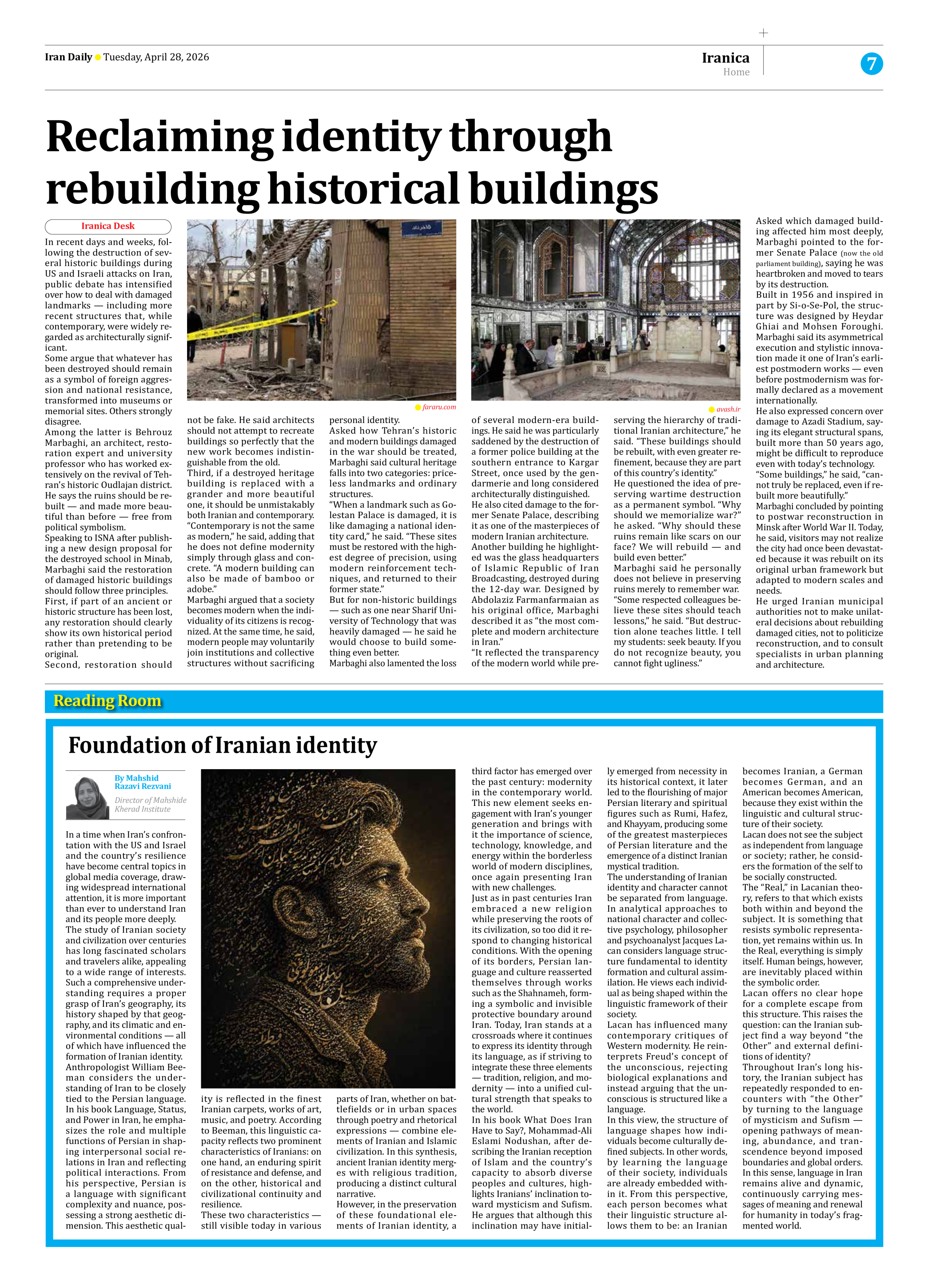
In recent days and weeks, following the destruction of several historic buildings during US and Israeli attacks on Iran, public debate has intensified over how to deal with damaged landmarks — including more recent structures that, while contemporary, were widely regarded as architecturally significant.
Some argue that whatever has been destroyed should remain as a symbol of foreign aggression and national resistance, transformed into museums or memorial sites. Others strongly disagree.
Among the latter is Behrouz Marbaghi, an architect, restoration expert and university professor who has worked extensively on the revival of Tehran’s historic Oudlajan district. He says the ruins should be rebuilt — and made more beautiful than before — free from political symbolism.
Speaking to ISNA after publishing a new design proposal for the destroyed school in Minab, Marbaghi said the restoration of damaged historic buildings should follow three principles.
First, if part of an ancient or historic structure has been lost, any restoration should clearly show its own historical period rather than pretending to be original.
Second, restoration should not be fake. He said architects should not attempt to recreate buildings so perfectly that the new work becomes indistinguishable from the old.
Third, if a destroyed heritage building is replaced with a grander and more beautiful one, it should be unmistakably both Iranian and contemporary. “Contemporary is not the same as modern,” he said, adding that he does not define modernity simply through glass and concrete. “A modern building can also be made of bamboo or adobe.”
Marbaghi argued that a society becomes modern when the individuality of its citizens is recognized. At the same time, he said, modern people may voluntarily join institutions and collective structures without sacrificing personal identity.
Asked how Tehran’s historic and modern buildings damaged in the war should be treated, Marbaghi said cultural heritage falls into two categories: priceless landmarks and ordinary structures.
“When a landmark such as Golestan Palace is damaged, it is like damaging a national identity card,” he said. “These sites must be restored with the highest degree of precision, using modern reinforcement techniques, and returned to their former state.”
But for non-historic buildings — such as one near Sharif University of Technology that was heavily damaged — he said he would choose to build something even better.
Marbaghi also lamented the loss of several modern-era buildings. He said he was particularly saddened by the destruction of a former police building at the southern entrance to Kargar Street, once used by the gendarmerie and long considered architecturally distinguished.
He also cited damage to the former Senate Palace, describing it as one of the masterpieces of modern Iranian architecture.
Another building he highlighted was the glass headquarters of Islamic Republic of Iran Broadcasting, destroyed during the 12-day war. Designed by Abdolaziz Farmanfarmaian as his original office, Marbaghi described it as “the most complete and modern architecture in Iran.”
“It reflected the transparency of the modern world while preserving the hierarchy of traditional Iranian architecture,” he said. “These buildings should be rebuilt, with even greater refinement, because they are part of this country’s identity.”
He questioned the idea of preserving wartime destruction as a permanent symbol. “Why should we memorialize war?” he asked. “Why should these ruins remain like scars on our face? We will rebuild — and build even better.”
Marbaghi said he personally does not believe in preserving ruins merely to remember war.
“Some respected colleagues believe these sites should teach lessons,” he said. “But destruction alone teaches little. I tell my students: seek beauty. If you do not recognize beauty, you cannot fight ugliness.”
Asked which damaged building affected him most deeply, Marbaghi pointed to the former Senate Palace (now the old parliament building), saying he was heartbroken and moved to tears by its destruction.
Built in 1956 and inspired in part by Si-o-Se-Pol, the structure was designed by Heydar Ghiai and Mohsen Foroughi. Marbaghi said its asymmetrical execution and stylistic innovation made it one of Iran’s earliest postmodern works — even before postmodernism was formally declared as a movement internationally.
He also expressed concern over damage to Azadi Stadium, saying its elegant structural spans, built more than 50 years ago, might be difficult to reproduce even with today’s technology.
“Some buildings,” he said, “cannot truly be replaced, even if rebuilt more beautifully.”
Marbaghi concluded by pointing to postwar reconstruction in Minsk after World War II. Today, he said, visitors may not realize the city had once been devastated because it was rebuilt on its original urban framework but adapted to modern scales and needs.
He urged Iranian municipal authorities not to make unilateral decisions about rebuilding damaged cities, not to politicize reconstruction, and to consult specialists in urban planning and architecture.