







Copy in clipboard...
Putin hails Iranians’ heroic fight for independence
Araghchi calls Tehran-Moscow relations ‘strategic partnership’
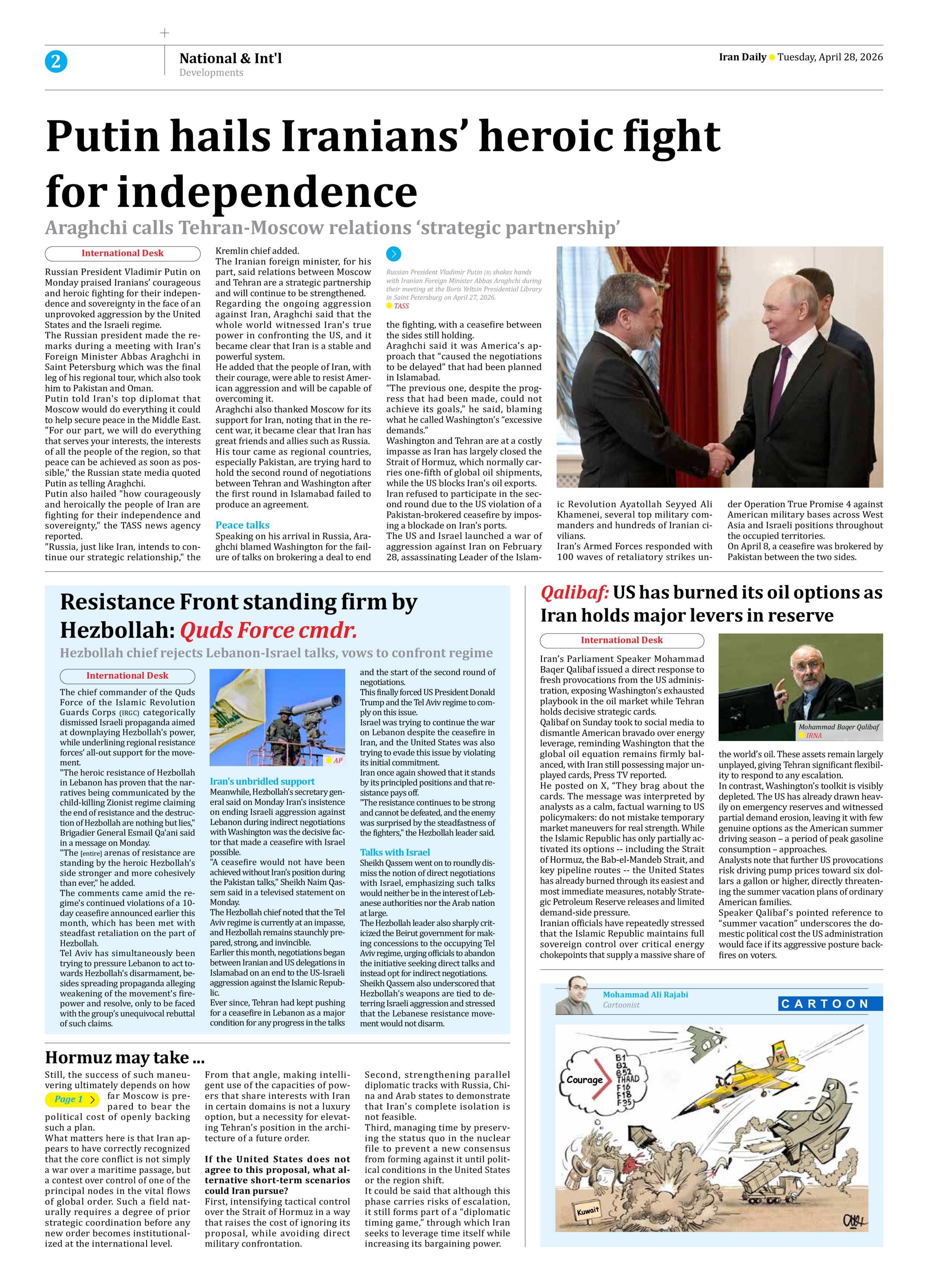
Russian President Vladimir Putin on Monday praised Iranians’ courageous and heroic fighting for their independence and sovereignty in the face of an unprovoked aggression by the United States and the Israeli regime.
The Russian president made the remarks during a meeting with Iran’s Foreign Minister Abbas Araghchi in Saint Petersburg which was the final leg of his regional tour, which also took him to Pakistan and Oman.
Putin told Iran's top diplomat that Moscow would do everything it could to help secure peace in the Middle East.
"For our part, we will do everything that serves your interests, the interests of all the people of the region, so that peace can be achieved as soon as possible," the Russian state media quoted Putin as telling Araghchi.
Putin also hailed "how courageously and heroically the people of Iran are fighting for their independence and sovereignty," the TASS news agency reported.
"Russia, just like Iran, intends to continue our strategic relationship," the Kremlin chief added.
The Iranian foreign minister, for his part, said relations between Moscow and Tehran are a strategic partnership and will continue to be strengthened.
Regarding the ongoing aggression against Iran, Araghchi said that the whole world witnessed Iran's true power in confronting the US, and it became clear that Iran is a stable and powerful system.
He added that the people of Iran, with their courage, were able to resist American aggression and will be capable of overcoming it.
Araghchi also thanked Moscow for its support for Iran, noting that in the recent war, it became clear that Iran has great friends and allies such as Russia.
His tour came as regional countries, especially Pakistan, are trying hard to hold the second round of negotiations between Tehran and Washington after the first round in Islamabad failed to produce an agreement.
Peace talks
Speaking on his arrival in Russia, Araghchi blamed Washington for the failure of talks on brokering a deal to end the fighting, with a ceasefire between the sides still holding.
Araghchi said it was America’s approach that “caused the negotiations to be delayed” that had been planned in Islamabad.
“The previous one, despite the progress that had been made, could not achieve its goals,” he said, blaming what he called Washington’s “excessive demands.”
Washington and Tehran are at a costly impasse as Iran has largely closed the Strait of Hormuz, which normally carries one-fifth of global oil shipments, while the US blocks Iran's oil exports.
Iran refused to participate in the second round due to the US violation of a Pakistan-brokered ceasefire by imposing a blockade on Iran’s ports.
The US and Israel launched a war of aggression against Iran on February 28, assassinating Leader of the Islamic Revolution Ayatollah Seyyed Ali Khamenei, several top military commanders and hundreds of Iranian civilians.
Iran’s Armed Forces responded with 100 waves of retaliatory strikes under Operation True Promise 4 against American military bases across West Asia and Israeli positions throughout the occupied territories.
On April 8, a ceasefire was brokered by Pakistan between the two sides.