







Iqbal’s school can dynamize global peace dialogue
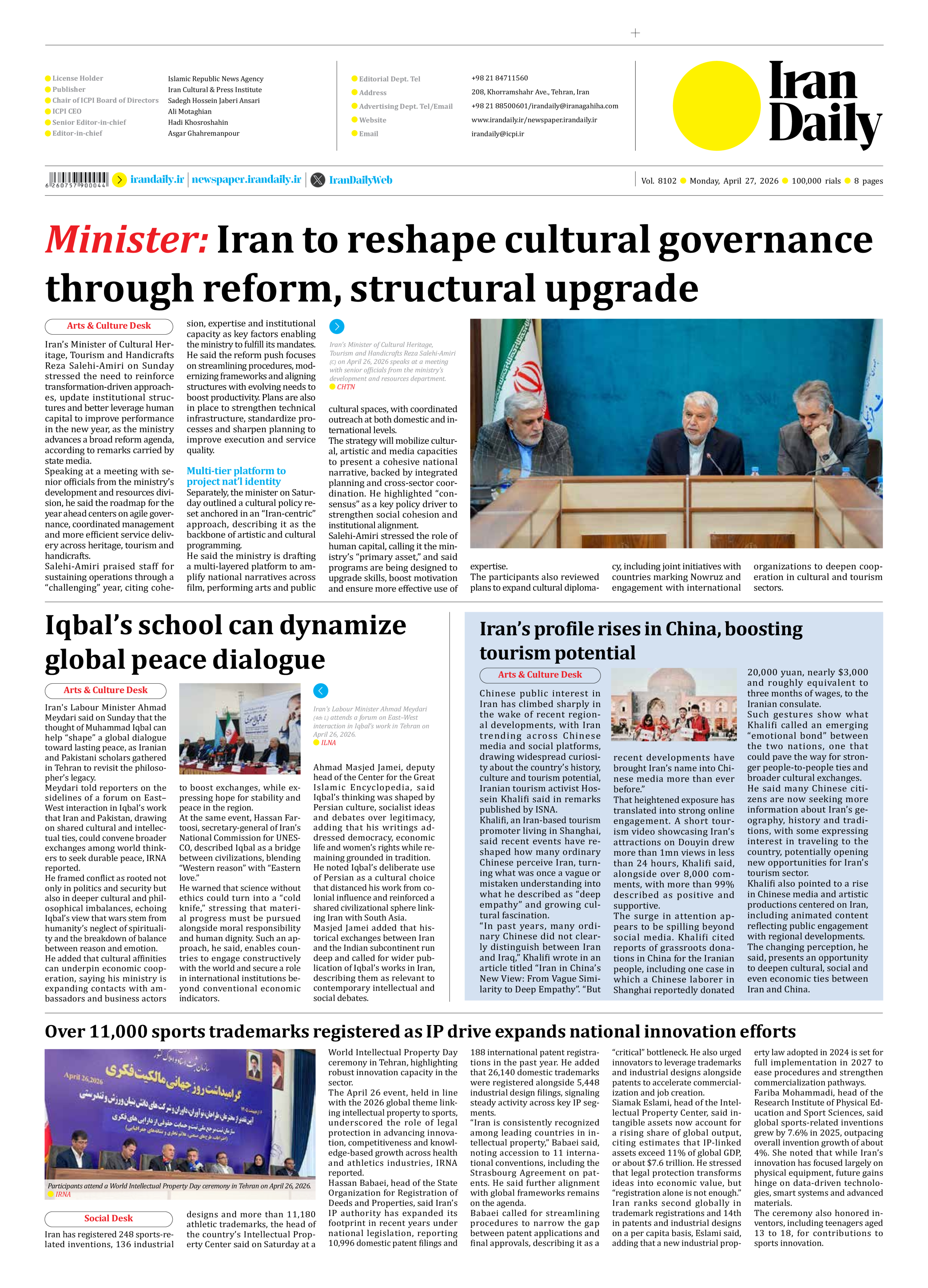
Iran's Labour Minister Ahmad Meydari said on Sunday that the thought of Muhammad Iqbal can help “shape” a global dialogue toward lasting peace, as Iranian and Pakistani scholars gathered in Tehran to revisit the philosopher’s legacy.
Meydari told reporters on the sidelines of a forum on East–West interaction in Iqbal’s work that Iran and Pakistan, drawing on shared cultural and intellectual ties, could convene broader exchanges among world thinkers to seek durable peace, IRNA reported.
He framed conflict as rooted not only in politics and security but also in deeper cultural and philosophical imbalances, echoing Iqbal’s view that wars stem from humanity’s neglect of spirituality and the breakdown of balance between reason and emotion.
He added that cultural affinities can underpin economic cooperation, saying his ministry is expanding contacts with ambassadors and business actors to boost exchanges, while expressing hope for stability and peace in the region.
At the same event, Hassan Fartoosi, secretary-general of Iran’s National Commission for UNESCO, described Iqbal as a bridge between civilizations, blending “Western reason” with “Eastern love.”
He warned that science without ethics could turn into a “cold knife,” stressing that material progress must be pursued alongside moral responsibility and human dignity. Such an approach, he said, enables countries to engage constructively with the world and secure a role in international institutions beyond conventional economic indicators.
Ahmad Masjed Jamei, deputy head of the Center for the Great Islamic Encyclopedia, said Iqbal’s thinking was shaped by Persian culture, socialist ideas and debates over legitimacy, adding that his writings addressed democracy, economic life and women’s rights while remaining grounded in tradition.
He noted Iqbal’s deliberate use of Persian as a cultural choice that distanced his work from colonial influence and reinforced a shared civilizational sphere linking Iran with South Asia.
Masjed Jamei added that historical exchanges between Iran and the Indian subcontinent run deep and called for wider publication of Iqbal’s works in Iran, describing them as relevant to contemporary intellectual and social debates.