







Chamber offers roadmap to rebuild steel sector after attacks
Industry plans hot-rolled coil supply for this week
The Tehran Chamber of Commerce proposed 11 policy measures to repair and reorganize Iran’s steel industry following recent US-Israeli attacks, while industry officials said plans are in place to supply hot-rolled steel sheets this week.
According to Mehr news agency, the chamber said in an analytical report that Iran’s steel industry, with annual production of about 31.9 million tons and ranking tenth globally, is one of the main pillars of the country’s industrial economy. However, it has faced structural challenges in recent years, including imbalances in the value chain, shortages of raw materials, outdated technology, energy and infrastructure constraints, weak exploration, inefficient pricing mechanisms and government intervention.
International sanctions, followed by damage caused by military attacks on production infrastructure, have further intensified such challenges, the report said.
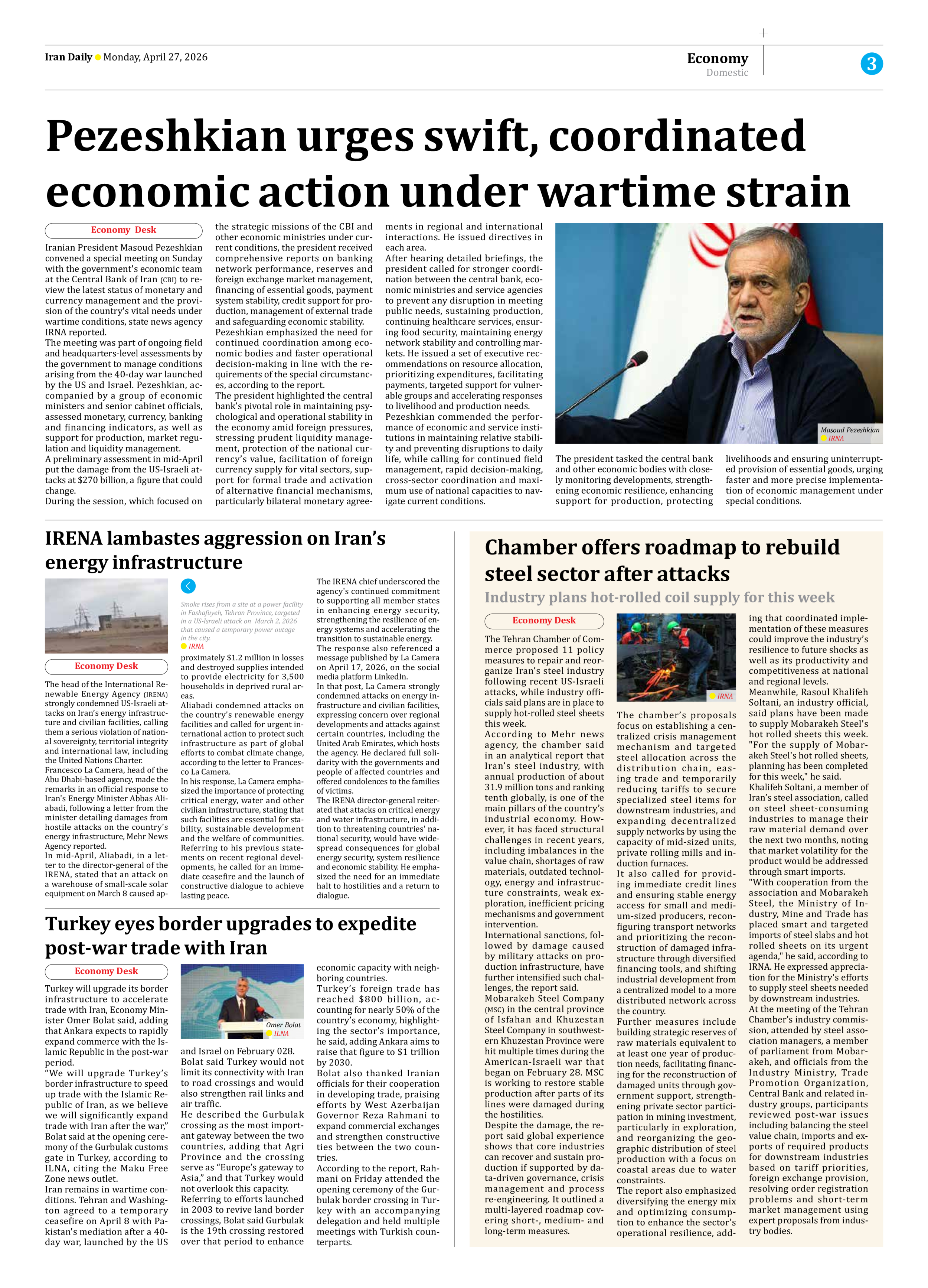
Mobarakeh Steel Company (MSC) in the central province of Isfahan and Khuzestan Steel Company in southwestern Khuzestan Province were hit multiple times during the American-Israeli war that began on February 28. MSC is working to restore stable production after parts of its lines were damaged during the hostilities.
Despite the damage, the report said global experience shows that core industries can recover and sustain production if supported by data-driven governance, crisis management and process re-engineering. It outlined a multi-layered roadmap covering short-, medium- and long-term measures.
The chamber’s proposals focus on establishing a centralized crisis management mechanism and targeted steel allocation across the distribution chain, easing trade and temporarily reducing tariffs to secure specialized steel items for downstream industries, and expanding decentralized supply networks by using the capacity of mid-sized units, private rolling mills and induction furnaces.
It also called for providing immediate credit lines and ensuring stable energy access for small and medium-sized producers, reconfiguring transport networks and prioritizing the reconstruction of damaged infrastructure through diversified financing tools, and shifting industrial development from a centralized model to a more distributed network across the country.
Further measures include building strategic reserves of raw materials equivalent to at least one year of production needs, facilitating financing for the reconstruction of damaged units through government support, strengthening private sector participation in mining investment, particularly in exploration, and reorganizing the geographic distribution of steel production with a focus on coastal areas due to water constraints.
The report also emphasized diversifying the energy mix and optimizing consumption to enhance the sector’s operational resilience, adding that coordinated implementation of these measures could improve the industry’s resilience to future shocks as well as its productivity and competitiveness at national and regional levels.
Meanwhile, Rasoul Khalifeh Soltani, an industry official, said plans have been made to supply Mobarakeh Steel's hot rolled sheets this week. "For the supply of Mobarakeh Steel's hot rolled sheets, planning has been completed for this week," he said.
Khalifeh Soltani, a member of Iran’s steel association, called on steel sheet-consuming industries to manage their raw material demand over the next two months, noting that market volatility for the product would be addressed through smart imports.
"With cooperation from the association and Mobarakeh Steel, the Ministry of Industry, Mine and Trade has placed smart and targeted imports of steel slabs and hot rolled sheets on its urgent agenda," he said, according to IRNA. He expressed appreciation for the Ministry's efforts to supply steel sheets needed by downstream industries.
At the meeting of the Tehran Chamber’s industry commission, attended by steel association managers, a member of parliament from Mobarakeh, and officials from the Industry Ministry, Trade Promotion Organization, Central Bank and related industry groups, participants reviewed post-war issues including balancing the steel value chain, imports and exports of required products for downstream industries based on tariff priorities, foreign exchange provision, resolving order registration problems and short-term market management using expert proposals from industry bodies.