







Pezeshkian urges swift, coordinated economic action under wartime strain
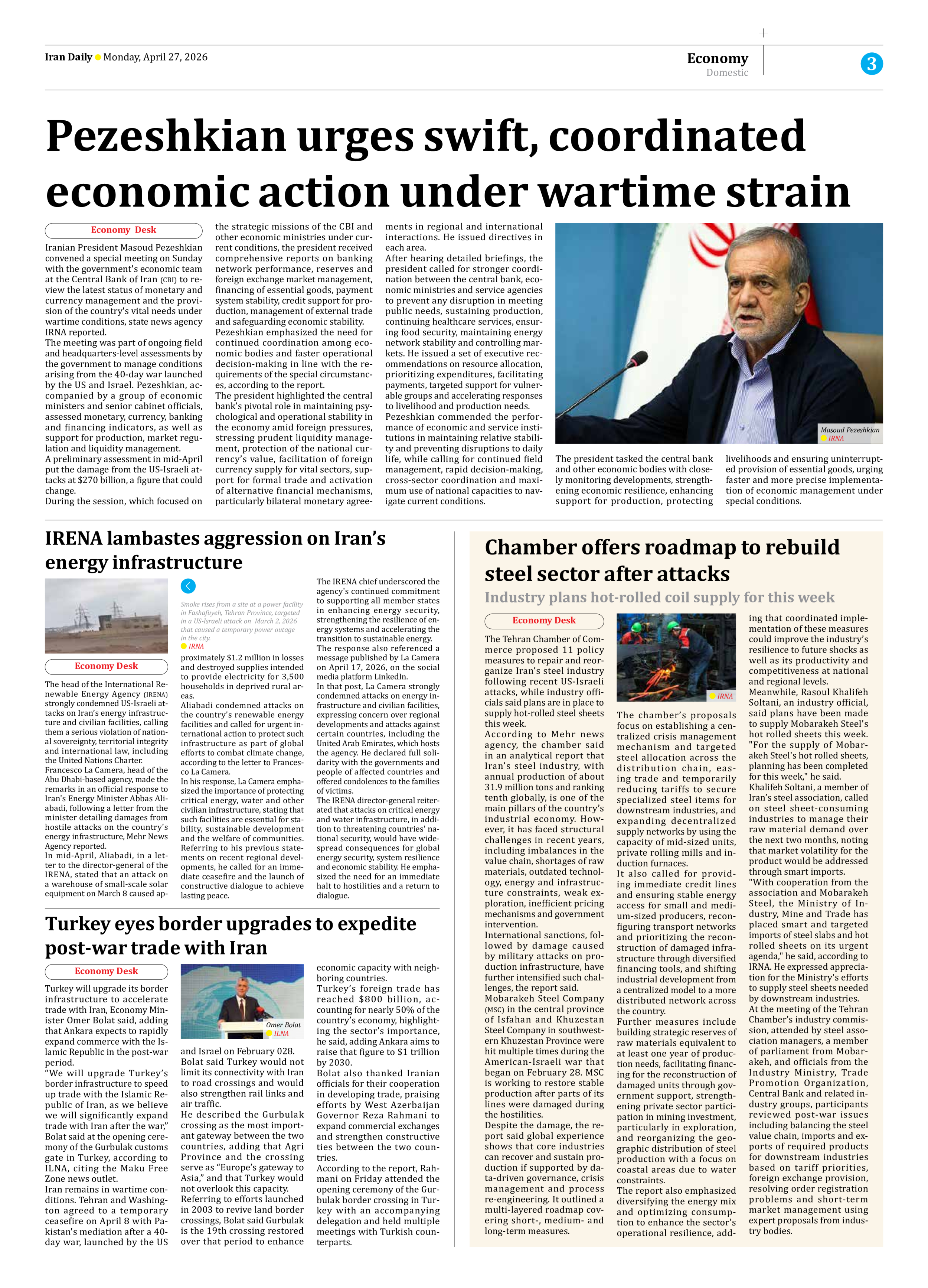
Iranian President Masoud Pezeshkian convened a special meeting on Sunday with the government's economic team at the Central Bank of Iran (CBI) to review the latest status of monetary and currency management and the provision of the country's vital needs under wartime conditions, state news agency IRNA reported.
The meeting was part of ongoing field and headquarters-level assessments by the government to manage conditions arising from the 40-day war launched by the US and Israel. Pezeshkian, accompanied by a group of economic ministers and senior cabinet officials, assessed monetary, currency, banking and financing indicators, as well as support for production, market regulation and liquidity management.
A preliminary assessment in mid-April put the damage from the US-Israeli attacks at $270 billion, a figure that could change.
During the session, which focused on the strategic missions of the CBI and other economic ministries under current conditions, the president received comprehensive reports on banking network performance, reserves and foreign exchange market management, financing of essential goods, payment system stability, credit support for production, management of external trade and safeguarding economic stability.
Pezeshkian emphasized the need for continued coordination among economic bodies and faster operational decision-making in line with the requirements of the special circumstances, according to the report.
The president highlighted the central bank’s pivotal role in maintaining psychological and operational stability in the economy amid foreign pressures, stressing prudent liquidity management, protection of the national currency’s value, facilitation of foreign currency supply for vital sectors, support for formal trade and activation of alternative financial mechanisms, particularly bilateral monetary agreements in regional and international interactions. He issued directives in each area.
After hearing detailed briefings, the president called for stronger coordination between the central bank, economic ministries and service agencies to prevent any disruption in meeting public needs, sustaining production, continuing healthcare services, ensuring food security, maintaining energy network stability and controlling markets. He issued a set of executive recommendations on resource allocation, prioritizing expenditures, facilitating payments, targeted support for vulnerable groups and accelerating responses to livelihood and production needs.
Pezeshkian commended the performance of economic and service institutions in maintaining relative stability and preventing disruptions to daily life, while calling for continued field management, rapid decision-making, cross-sector coordination and maximum use of national capacities to navigate current conditions.
The president tasked the central bank and other economic bodies with closely monitoring developments, strengthening economic resilience, enhancing support for production, protecting livelihoods and ensuring uninterrupted provision of essential goods, urging faster and more precise implementation of economic management under special conditions.