







Blast waves vs. blue domes
Iran’s heritage endures cracks, yet St. Stepanos Church rises as a Nowruz beacon
By Sadeq Dehqan
Staff writer
The US and the Zionist regime’s aggression against Iran, beyond inflicting human and infrastructure losses, did not spare the country’s cultural heritage, with a number of historic sites and cultural landmarks sustaining damage in the strikes.
East Azarbaijan Province, one of Iran’s key tourism hubs, home to a wealth of valuable historical monuments and sites, was no exception. While reports indicate no direct hits on the province’s heritage assets to date, blasts in close proximity to several sites have raised red flags about the vulnerability of this invaluable legacy.
Meanwhile, this year’s Nowruz, coinciding with wartime conditions alongside continued domestic travel, shaped a distinct tourism landscape, with some of East Azarbaijan’s flagship destinations, including St. Stepanos Church, landing on the list of the country’s most-visited attractions.
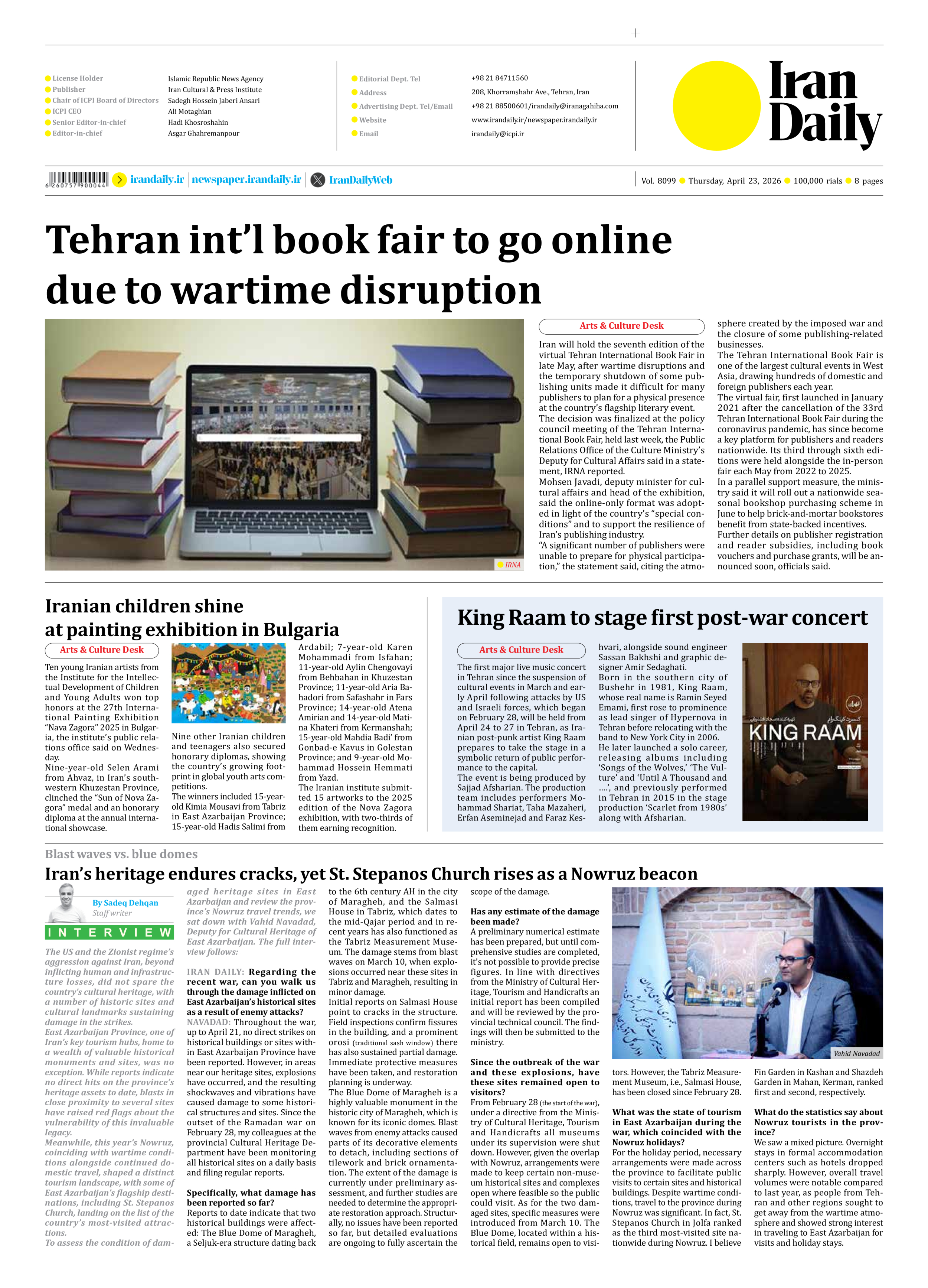
To assess the condition of damaged heritage sites in East Azarbaijan and review the province’s Nowruz travel trends, we sat down with Vahid Navadad, Deputy for Cultural Heritage of East Azarbaijan. The full interview follows:
IRAN DAILY: Regarding the recent war, can you walk us through the damage inflicted on East Azarbaijan’s historical sites as a result of enemy attacks?
NAVADAD: Throughout the war, up to April 21, no direct strikes on historical buildings or sites within East Azarbaijan Province have been reported. However, in areas near our heritage sites, explosions have occurred, and the resulting shockwaves and vibrations have caused damage to some historical structures and sites. Since the outset of the Ramadan war on February 28, my colleagues at the provincial Cultural Heritage Department have been monitoring all historical sites on a daily basis and filing regular reports.
Specifically, what damage has been reported so far?
Reports to date indicate that two historical buildings were affected: The Blue Dome of Maragheh, a Seljuk-era structure dating back to the 6th century AH in the city of Maragheh, and the Salmasi House in Tabriz, which dates to the mid-Qajar period and in recent years has also functioned as the Tabriz Measurement Museum. The damage stems from blast waves on March 10, when explosions occurred near these sites in Tabriz and Maragheh, resulting in minor damage.
Initial reports on Salmasi House point to cracks in the structure. Field inspections confirm fissures in the building, and a prominent orosi (traditional sash window) there has also sustained partial damage. Immediate protective measures have been taken, and restoration planning is underway.
The Blue Dome of Maragheh is a highly valuable monument in the historic city of Maragheh, which is known for its iconic domes. Blast waves from enemy attacks caused parts of its decorative elements to detach, including sections of tilework and brick ornamentation. The extent of the damage is currently under preliminary assessment, and further studies are needed to determine the appropriate restoration approach. Structurally, no issues have been reported so far, but detailed evaluations are ongoing to fully ascertain the scope of the damage.
Has any estimate of the damage been made?
A preliminary numerical estimate has been prepared, but until comprehensive studies are completed, it’s not possible to provide precise figures. In line with directives from the Ministry of Cultural Heritage, Tourism and Handicrafts an initial report has been compiled and will be reviewed by the provincial technical council. The findings will then be submitted to the ministry.
Since the outbreak of the war and these explosions, have these sites remained open to visitors?
From February 28 (the start of the war), under a directive from the Ministry of Cultural Heritage, Tourism and Handicrafts all museums under its supervision were shut down. However, given the overlap with Nowruz, arrangements were made to keep certain non-museum historical sites and complexes open where feasible so the public could visit. As for the two damaged sites, specific measures were introduced from March 10. The Blue Dome, located within a historical field, remains open to visitors. However, the Tabriz Measurement Museum, i.e., Salmasi House, has been closed since February 28.
What was the state of tourism in East Azarbaijan during the war, which coincided with the Nowruz holidays?
For the holiday period, necessary arrangements were made across the province to facilitate public visits to certain sites and historical buildings. Despite wartime conditions, travel to the province during Nowruz was significant. In fact, St. Stepanos Church in Jolfa ranked as the third most-visited site nationwide during Nowruz. I believe Fin Garden in Kashan and Shazdeh Garden in Mahan, Kerman, ranked first and second, respectively.
What do the statistics say about Nowruz tourists in the province?
We saw a mixed picture. Overnight stays in formal accommodation centers such as hotels dropped sharply. However, overall travel volumes were notable compared to last year, as people from Tehran and other regions sought to get away from the wartime atmosphere and showed strong interest in traveling to East Azarbaijan for visits and holiday stays.