







Siba; ancient city buried beneath modern Kukherd
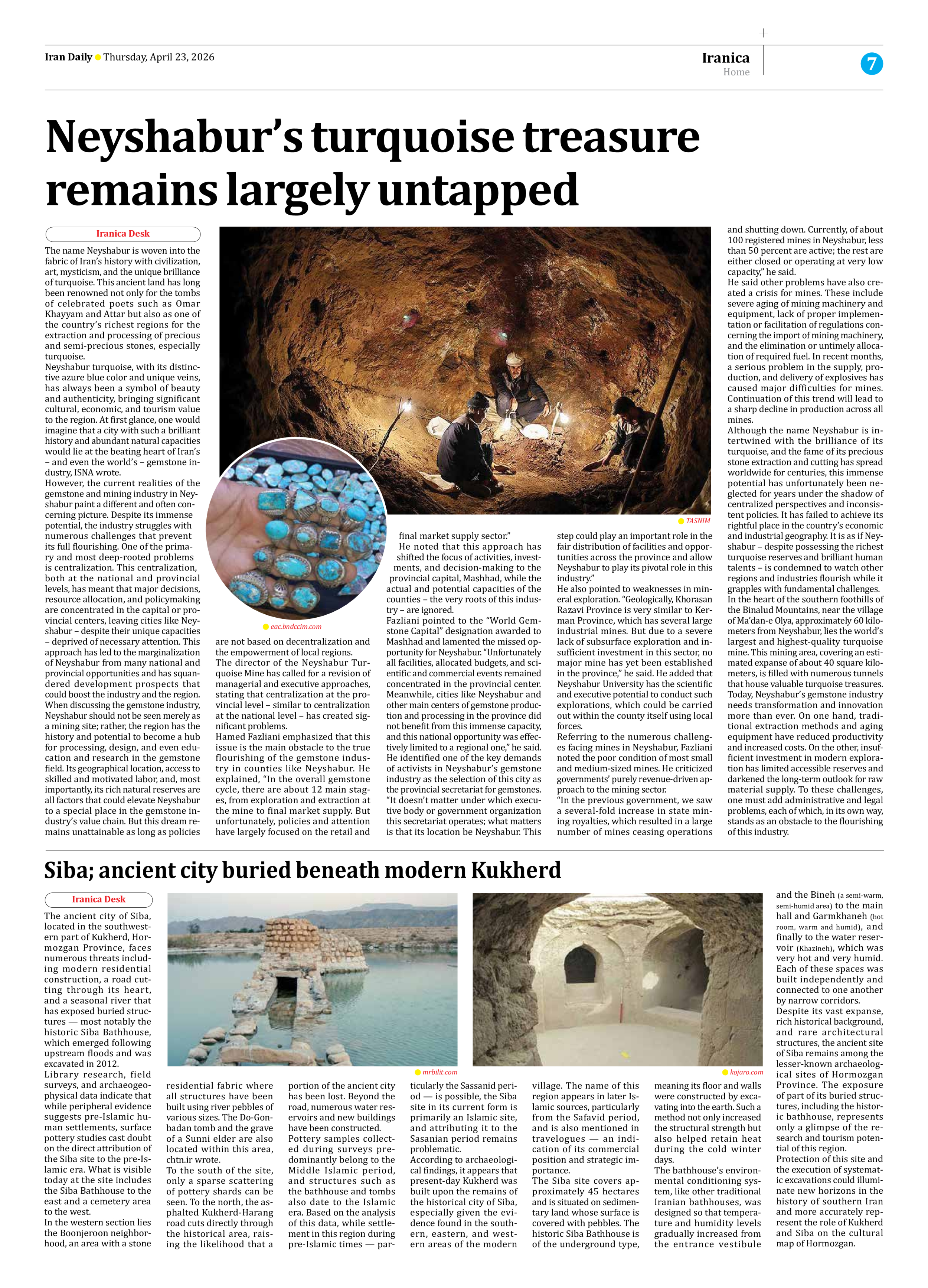
The ancient city of Siba, located in the southwestern part of Kukherd, Hormozgan Province, faces numerous threats including modern residential construction, a road cutting through its heart, and a seasonal river that has exposed buried structures — most notably the historic Siba Bathhouse, which emerged following upstream floods and was excavated in 2012.
Library research, field surveys, and archaeogeophysical data indicate that while peripheral evidence suggests pre-Islamic human settlements, surface pottery studies cast doubt on the direct attribution of the Siba site to the pre-Islamic era. What is visible today at the site includes the Siba Bathhouse to the east and a cemetery area to the west.
In the western section lies the Boonjeroon neighborhood, an area with a stone residential fabric where all structures have been built using river pebbles of various sizes. The Do-Gonbadan tomb and the grave of a Sunni elder are also located within this area, chtn.ir wrote.
To the south of the site, only a sparse scattering of pottery shards can be seen. To the north, the asphalted Kukherd-Harang road cuts directly through the historical area, raising the likelihood that a portion of the ancient city has been lost. Beyond the road, numerous water reservoirs and new buildings have been constructed.
Pottery samples collected during surveys predominantly belong to the Middle Islamic period, and structures such as the bathhouse and tombs also date to the Islamic era. Based on the analysis of this data, while settlement in this region during pre-Islamic times — particularly the Sassanid period — is possible, the Siba site in its current form is primarily an Islamic site, and attributing it to the Sasanian period remains problematic.
According to archaeological findings, it appears that present-day Kukherd was built upon the remains of the historical city of Siba, especially given the evidence found in the southern, eastern, and western areas of the modern village. The name of this region appears in later Islamic sources, particularly from the Safavid period, and is also mentioned in travelogues — an indication of its commercial position and strategic importance.
The Siba site covers approximately 45 hectares and is situated on sedimentary land whose surface is covered with pebbles. The historic Siba Bathhouse is of the underground type, meaning its floor and walls were constructed by excavating into the earth. Such a method not only increased the structural strength but also helped retain heat during the cold winter days.
The bathhouse’s environmental conditioning system, like other traditional Iranian bathhouses, was designed so that temperature and humidity levels gradually increased from the entrance vestibule and the Bineh (a semi-warm, semi-humid area) to the main hall and Garmkhaneh (hot room, warm and humid), and finally to the water reservoir (Khazineh), which was very hot and very humid. Each of these spaces was built independently and connected to one another by narrow corridors.
Despite its vast expanse, rich historical background, and rare architectural structures, the ancient site of Siba remains among the lesser-known archaeological sites of Hormozgan Province. The exposure of part of its buried structures, including the historic bathhouse, represents only a glimpse of the research and tourism potential of this region.
Protection of this site and the execution of systematic excavations could illuminate new horizons in the history of southern Iran and more accurately represent the role of Kukherd and Siba on the cultural map of Hormozgan.