







Neyshabur’s turquoise treasure remains largely untapped
The name Neyshabur is woven into the fabric of Iran’s history with civilization, art, mysticism, and the unique brilliance of turquoise. This ancient land has long been renowned not only for the tombs of celebrated poets such as Omar Khayyam and Attar but also as one of the country’s richest regions for the extraction and processing of precious and semi-precious stones, especially turquoise.
Neyshabur turquoise, with its distinctive azure blue color and unique veins, has always been a symbol of beauty and authenticity, bringing significant cultural, economic, and tourism value to the region. At first glance, one would imagine that a city with such a brilliant history and abundant natural capacities would lie at the beating heart of Iran’s – and even the world’s – gemstone industry, ISNA wrote.
However, the current realities of the gemstone and mining industry in Neyshabur paint a different and often concerning picture. Despite its immense potential, the industry struggles with numerous challenges that prevent its full flourishing. One of the primary and most deep-rooted problems is centralization. This centralization, both at the national and provincial levels, has meant that major decisions, resource allocation, and policymaking are concentrated in the capital or provincial centers, leaving cities like Neyshabur – despite their unique capacities – deprived of necessary attention. This approach has led to the marginalization of Neyshabur from many national and provincial opportunities and has squandered development prospects that could boost the industry and the region.
When discussing the gemstone industry, Neyshabur should not be seen merely as a mining site; rather, the region has the history and potential to become a hub for processing, design, and even education and research in the gemstone field. Its geographical location, access to skilled and motivated labor, and, most importantly, its rich natural reserves are all factors that could elevate Neyshabur to a special place in the gemstone industry’s value chain. But this dream remains unattainable as long as policies are not based on decentralization and the empowerment of local regions.
The director of the Neyshabur Turquoise Mine has called for a revision of managerial and executive approaches, stating that centralization at the provincial level – similar to centralization at the national level – has created significant problems.
Hamed Fazliani emphasized that this issue is the main obstacle to the true flourishing of the gemstone industry in counties like Neyshabur. He explained, “In the overall gemstone cycle, there are about 12 main stages, from exploration and extraction at the mine to final market supply. But unfortunately, policies and attention have largely focused on the retail and final market supply sector.”
He noted that this approach has shifted the focus of activities, investments, and decision-making to the provincial capital, Mashhad, while the actual and potential capacities of the counties – the very roots of this industry – are ignored.
Fazliani pointed to the “World Gemstone Capital” designation awarded to Mashhad and lamented the missed opportunity for Neyshabur. “Unfortunately all facilities, allocated budgets, and scientific and commercial events remained concentrated in the provincial center. Meanwhile, cities like Neyshabur and other main centers of gemstone production and processing in the province did not benefit from this immense capacity, and this national opportunity was effectively limited to a regional one,” he said.
He identified one of the key demands of activists in Neyshabur’s gemstone industry as the selection of this city as the provincial secretariat for gemstones. “It doesn’t matter under which executive body or government organization this secretariat operates; what matters is that its location be Neyshabur. This step could play an important role in the fair distribution of facilities and opportunities across the province and allow Neyshabur to play its pivotal role in this industry.”
He also pointed to weaknesses in mineral exploration. “Geologically, Khorasan Razavi Province is very similar to Kerman Province, which has several large industrial mines. But due to a severe lack of subsurface exploration and insufficient investment in this sector, no major mine has yet been established in the province,” he said. He added that Neyshabur University has the scientific and executive potential to conduct such explorations, which could be carried out within the county itself using local forces.
Referring to the numerous challenges facing mines in Neyshabur, Fazliani noted the poor condition of most small and medium-sized mines. He criticized governments’ purely revenue-driven approach to the mining sector.
“In the previous government, we saw a several-fold increase in state mining royalties, which resulted in a large number of mines ceasing operations and shutting down. Currently, of about 100 registered mines in Neyshabur, less than 50 percent are active; the rest are either closed or operating at very low capacity,” he said.
He said other problems have also created a crisis for mines. These include severe aging of mining machinery and equipment, lack of proper implementation or facilitation of regulations concerning the import of mining machinery, and the elimination or untimely allocation of required fuel. In recent months, a serious problem in the supply, production, and delivery of explosives has caused major difficulties for mines. Continuation of this trend will lead to a sharp decline in production across all mines.
Although the name Neyshabur is intertwined with the brilliance of its turquoise, and the fame of its precious stone extraction and cutting has spread worldwide for centuries, this immense potential has unfortunately been neglected for years under the shadow of centralized perspectives and inconsistent policies. It has failed to achieve its rightful place in the country’s economic and industrial geography. It is as if Neyshabur – despite possessing the richest turquoise reserves and brilliant human talents – is condemned to watch other regions and industries flourish while it grapples with fundamental challenges.
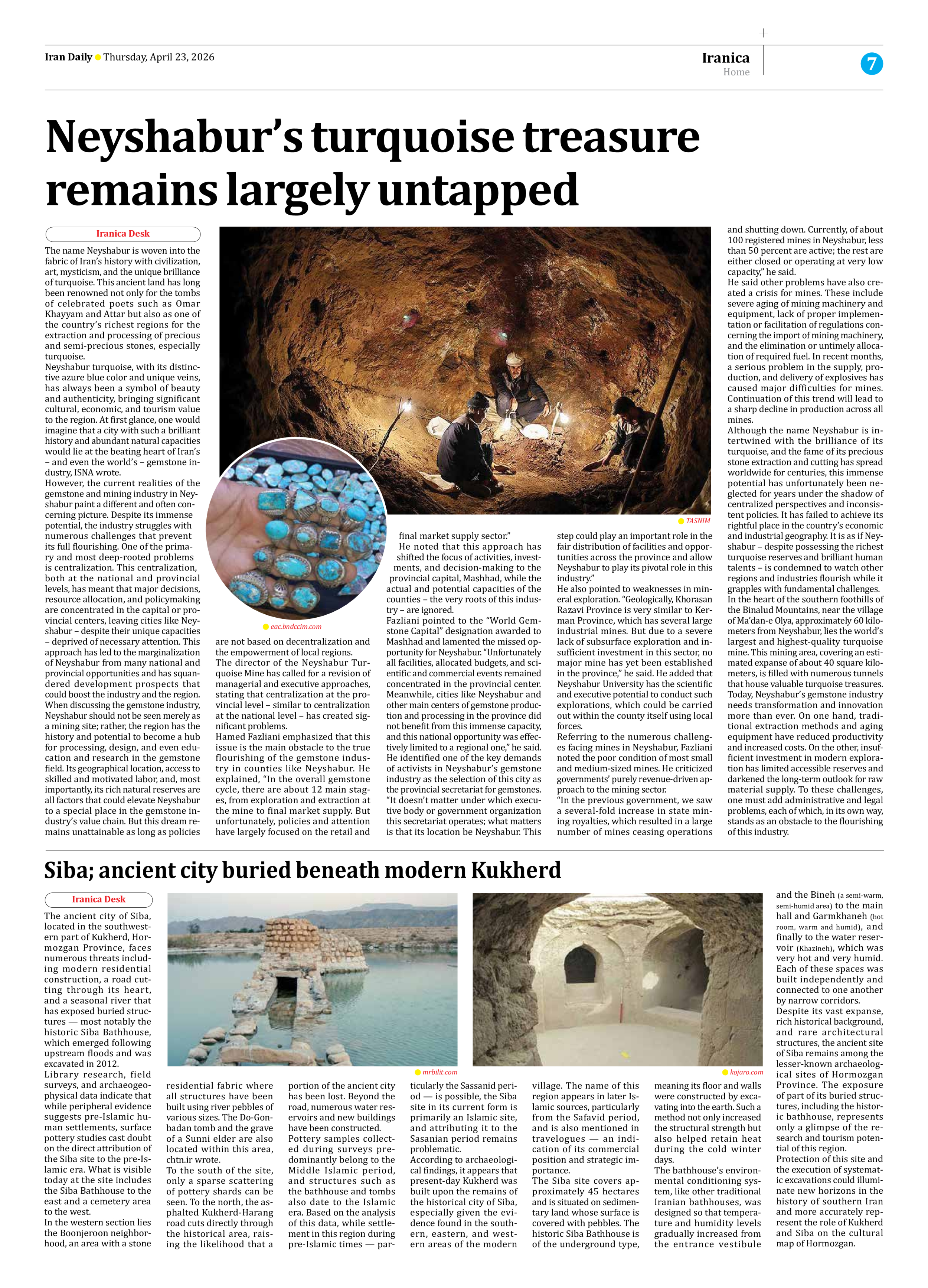
In the heart of the southern foothills of the Binalud Mountains, near the village of Ma’dan-e Olya, approximately 60 kilometers from Neyshabur, lies the world’s largest and highest-quality turquoise mine. This mining area, covering an estimated expanse of about 40 square kilometers, is filled with numerous tunnels that house valuable turquoise treasures.
Today, Neyshabur’s gemstone industry needs transformation and innovation more than ever. On one hand, traditional extraction methods and aging equipment have reduced productivity and increased costs. On the other, insufficient investment in modern exploration has limited accessible reserves and darkened the long-term outlook for raw material supply. To these challenges, one must add administrative and legal problems, each of which, in its own way, stands as an obstacle to the flourishing of this industry.