







Iran snubs US blockade with $910m oil exports, data shows
At least 34 tankers linked to Iran have been able to bypass the blockade by the US Navy, the Financial Times reported, citing data from Vortexa, an analytical company that tracks cargo shipments.
As Vortexa reported, at least 19 tankers linked to Iran have broken the blockade and left the Persian Gulf. At least 15 more entered the gulf from the Arabian Sea, bound for Iran.
Of the tankers that left the Persian Gulf, at least six were confirmed to be carrying a combined 10.7 million barrels of Iranian oil. Iranian oil is usually sold at a discount to benchmark Brent because of sanctions. At a discount of $10, such a volume would have brought about $910 million in revenue, the FT writes.
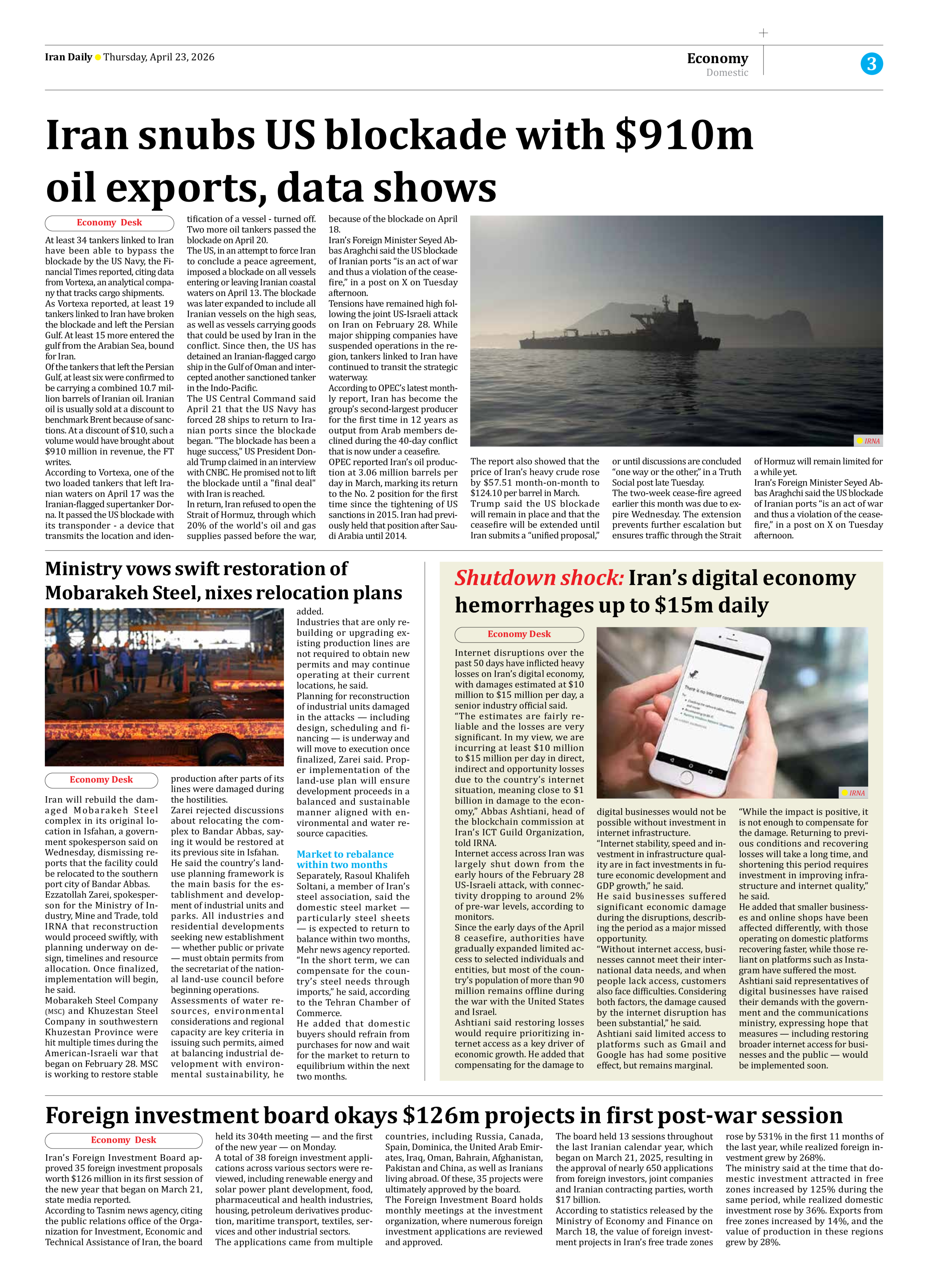
According to Vortexa, one of the two loaded tankers that left Iranian waters on April 17 was the Iranian-flagged supertanker Dorna. It passed the US blockade with its transponder - a device that transmits the location and identification of a vessel - turned off. Two more oil tankers passed the blockade on April 20.
The US, in an attempt to force Iran to conclude a peace agreement, imposed a blockade on all vessels entering or leaving Iranian coastal waters on April 13. The blockade was later expanded to include all Iranian vessels on the high seas, as well as vessels carrying goods that could be used by Iran in the conflict. Since then, the US has detained an Iranian-flagged cargo ship in the Gulf of Oman and intercepted another sanctioned tanker in the Indo-Pacific.
The US Central Command said April 21 that the US Navy has forced 28 ships to return to Iranian ports since the blockade began. "The blockade has been a huge success," US President Donald Trump claimed in an interview with CNBC. He promised not to lift the blockade until a "final deal" with Iran is reached.
In return, Iran refused to open the Strait of Hormuz, through which 20% of the world's oil and gas supplies passed before the war, because of the blockade on April 18.
Iran’s Foreign Minister Seyed Abbas Araghchi said the US blockade of Iranian ports “is an act of war and thus a violation of the ceasefire,” in a post on X on Tuesday afternoon.
Tensions have remained high following the joint US-Israeli attack on Iran on February 28. While major shipping companies have suspended operations in the region, tankers linked to Iran have continued to transit the strategic waterway.
According to OPEC’s latest monthly report, Iran has become the group’s second-largest producer for the first time in 12 years as output from Arab members declined during the 40-day conflict that is now under a ceasefire.
OPEC reported Iran’s oil production at 3.06 million barrels per day in March, marking its return to the No. 2 position for the first time since the tightening of US sanctions in 2015. Iran had previously held that position after Saudi Arabia until 2014.
The report also showed that the price of Iran’s heavy crude rose by $57.51 month-on-month to $124.10 per barrel in March.
Trump said the US blockade will remain in place and that the ceasefire will be extended until Iran submits a “unified proposal,” or until discussions are concluded “one way or the other,” in a Truth Social post late Tuesday.
The two-week cease-fire agreed earlier this month was due to expire Wednesday. The extension prevents further escalation but ensures traffic through the Strait of Hormuz will remain limited for a while yet.
Iran’s Foreign Minister Seyed Abbas Araghchi said the US blockade of Iranian ports “is an act of war and thus a violation of the ceasefire,” in a post on X on Tuesday afternoon.