







UN under fire for silence over environmental destruction
The deputy of international law affairs at the Legal Office of Iran’s Department of Environment, referring to documentation of damages caused by US and Israeli military attacks on the country’s environment, said it is “astonishing that the United Nations, and particularly its Environment Programme (UNEP), which serves as the global guardian of environmental protection, has remained silent in the face of the environmental devastation inflicted on Iran during this aggression”.
In an interview with ISNA, Adel Mohammadi stated that the hostile entities, disregarding fundamental principles of international law — such as the prohibition of using environmental destruction or alteration as a weapon, and the ban on causing widespread and long‑term, irreparable harm — have attacked Iran’s forests, mountainous regions, and water, mineral, and oil resources.
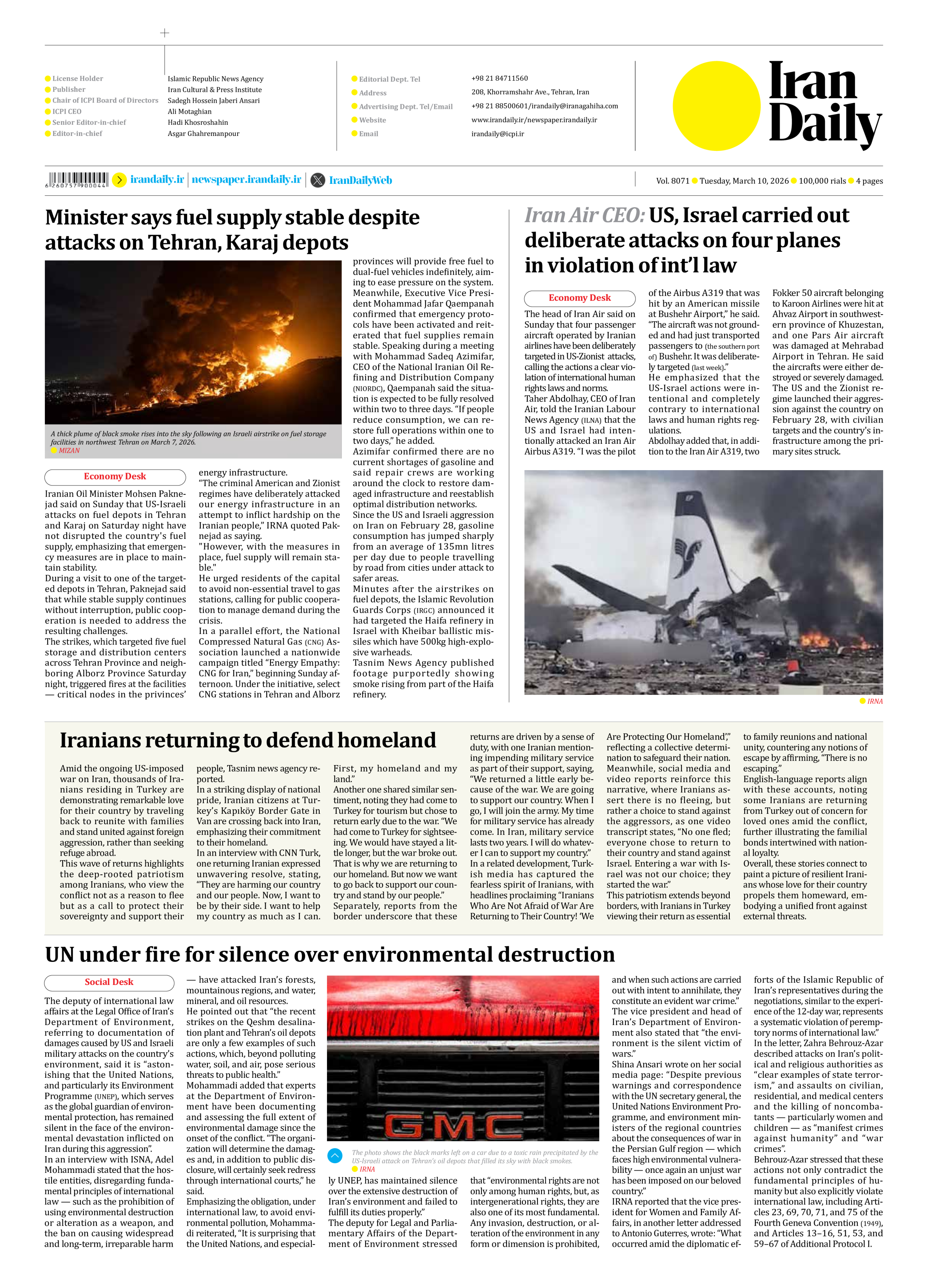
He pointed out that “the recent strikes on the Qeshm desalination plant and Tehran’s oil depots are only a few examples of such actions, which, beyond polluting water, soil, and air, pose serious threats to public health.”
Mohammadi added that experts at the Department of Environment have been documenting and assessing the full extent of environmental damage since the onset of the conflict. “The organization will determine the damages and, in addition to public disclosure, will certainly seek redress through international courts,” he said.
Emphasizing the obligation, under international law, to avoid environmental pollution, Mohammadi reiterated, “It is surprising that the United Nations, and especially UNEP, has maintained silence over the extensive destruction of Iran’s environment and failed to fulfill its duties properly.”
The deputy for Legal and Parliamentary Affairs of the Department of Environment stressed that “environmental rights are not only among human rights, but, as intergenerational rights, they are also one of its most fundamental. Any invasion, destruction, or alteration of the environment in any form or dimension is prohibited, and when such actions are carried out with intent to annihilate, they constitute an evident war crime.”
The vice president and head of Iran’s Department of Environment also stated that “the environment is the silent victim of wars.”
Shina Ansari wrote on her social media page: “Despite previous warnings and correspondence with the UN secretary general, the United Nations Environment Programme, and environment ministers of the regional countries about the consequences of war in the Persian Gulf region — which faces high environmental vulnerability — once again an unjust war has been imposed on our beloved country.”
IRNA reported that the vice president for Women and Family Affairs, in another letter addressed to Antonio Guterres, wrote: “What occurred amid the diplomatic efforts of the Islamic Republic of Iran’s representatives during the negotiations, similar to the experience of the 12‑day war, represents a systematic violation of peremptory norms of international law.”
In the letter, Zahra Behrouz-Azar described attacks on Iran’s political and religious authorities as “clear examples of state terrorism,” and assaults on civilian, residential, and medical centers and the killing of noncombatants — particularly women and children — as “manifest crimes against humanity” and “war crimes”.
Behrouz-Azar stressed that these actions not only contradict the fundamental principles of humanity but also explicitly violate international law, including Articles 23, 69, 70, 71, and 75 of the Fourth Geneva Convention (1949), and Articles 13–16, 51, 53, and 59–67 of Additional Protocol I.