





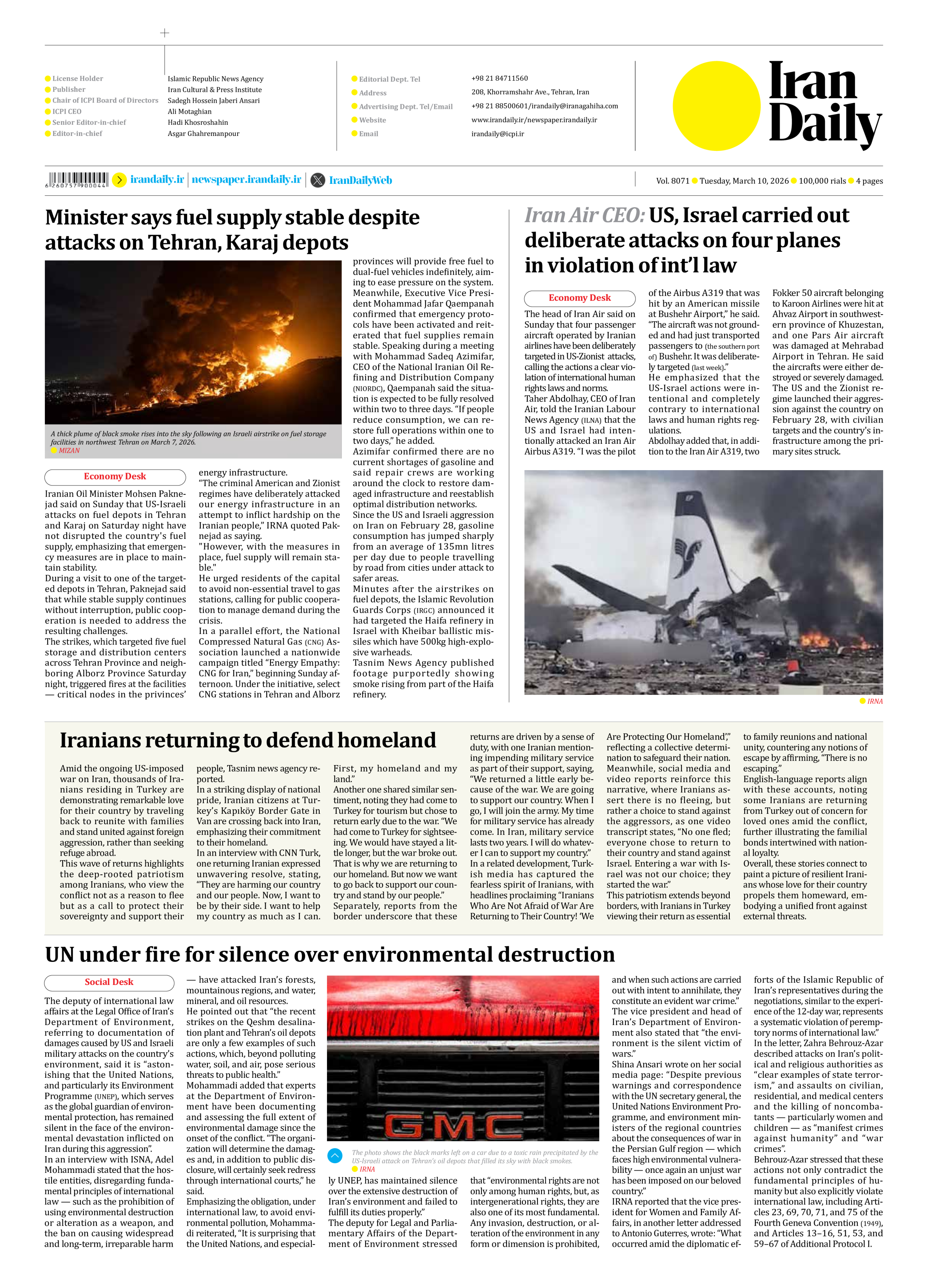


Minister says fuel supply stable despite attacks on Tehran, Karaj depots
Iranian Oil Minister Mohsen Paknejad said on Sunday that US-Israeli attacks on fuel depots in Tehran and Karaj on Saturday night have not disrupted the country's fuel supply, emphasizing that emergency measures are in place to maintain stability.
During a visit to one of the targeted depots in Tehran, Paknejad said that while stable supply continues without interruption, public cooperation is needed to address the resulting challenges.
The strikes, which targeted five fuel storage and distribution centers across Tehran Province and neighboring Alborz Province Saturday night, triggered fires at the facilities — critical nodes in the privinces’ energy infrastructure.
“The criminal American and Zionist regimes have deliberately attacked our energy infrastructure in an attempt to inflict hardship on the Iranian people,” IRNA quoted Paknejad as saying.
"However, with the measures in place, fuel supply will remain stable."
He urged residents of the capital to avoid non-essential travel to gas stations, calling for public cooperation to manage demand during the crisis.
In a parallel effort, the National Compressed Natural Gas (CNG) Association launched a nationwide campaign titled “Energy Empathy: CNG for Iran,” beginning Sunday afternoon. Under the initiative, select CNG stations in Tehran and Alborz provinces will provide free fuel to dual-fuel vehicles indefinitely, aiming to ease pressure on the system.
Meanwhile, Executive Vice President Mohammad Jafar Qaempanah confirmed that emergency protocols have been activated and reiterated that fuel supplies remain stable. Speaking during a meeting with Mohammad Sadeq Azimifar, CEO of the National Iranian Oil Refining and Distribution Company (NIORDC), Qaempanah said the situation is expected to be fully resolved within two to three days. “If people reduce consumption, we can restore full operations within one to two days,” he added.
Azimifar confirmed there are no current shortages of gasoline and said repair crews are working around the clock to restore damaged infrastructure and reestablish optimal distribution networks.
Since the US and Israeli aggression on Iran on February 28, gasoline consumption has jumped sharply from an average of 135mn litres per day due to people travelling by road from cities under attack to safer areas.
Minutes after the airstrikes on fuel depots, the Islamic Revolution Guards Corps (IRGC) announced it had targeted the Haifa refinery in Israel with Kheibar ballistic missiles which have 500kg high-explosive warheads.
Tasnim News Agency published footage purportedly showing smoke rising from part of the Haifa refinery.