







Iran destroys US command center in Bahrain
US embassy in Riyadh hit as Israeli casualties mount
Iran on Tuesday, March 3, delivered its most decisive strike yet against American military infrastructure in the region, destroying the main command and control center at Sheikh Isa Air Base in Bahrain during the fifteenth wave of Operation True Promise 4.
The operation by the naval arm of the Islamic Revolution Guards Corps (IRGC), targeted 10 strategic sites inside the US-run base. Iranian military authorities confirmed that the primary command headquarters, air control facilities, fuel depots and buildings housing senior American officers were struck in precision missile attacks, IRIB News reported.
Field intelligence and satellite assessments indicate that the base’s core operational infrastructure has been rendered non-operational, dealing a major blow to the US command network in the Persian Gulf.
The strike followed an earlier large-scale barrage in the 14th phase of the operation, when 20 drones and three missiles hit the same facility before dawn, igniting major fuel reserves and demolishing the central administrative building. Tuesday’s assault effectively completed the neutralization of the installation’s command capacity.
Simultaneously, Iranian forces expanded missile and drone operations to additional US military positions across the region.
US military installations in Bahrain, Qatar, Kuwait, the UAE and Erbil came under attack in the expanded wave.
The IRGC Khatam-al Anbiya Central Headquarters said Iran is targeting only US and Israeli military assets and strategic infrastructure, stressing it has no hostility toward neighboring or Muslim countries and remains committed to regional security, while warning that Israel and the United States are seeking to strike regional diplomatic missions and interests to escape their strategic deadlock and blame Iran for escalation.
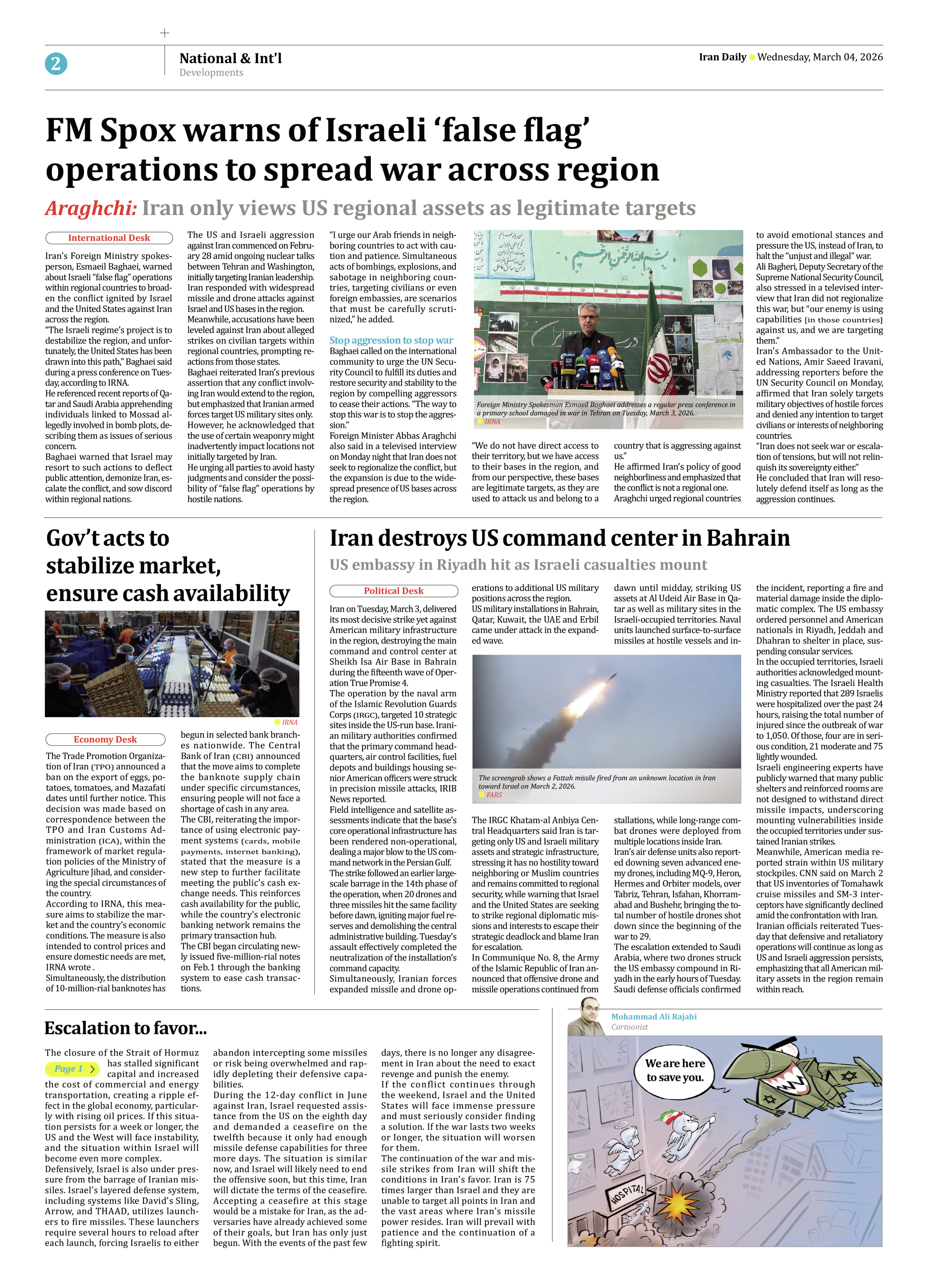
In Communique No. 8, the Army of the Islamic Republic of Iran announced that offensive drone and missile operations continued from dawn until midday, striking US assets at Al Udeid Air Base in Qatar as well as military sites in the Israeli-occupied territories. Naval units launched surface-to-surface missiles at hostile vessels and installations, while long-range combat drones were deployed from multiple locations inside Iran.
Iran’s air defense units also reported downing seven advanced enemy drones, including MQ-9, Heron, Hermes and Orbiter models, over Tabriz, Tehran, Isfahan, Khorramabad and Bushehr, bringing the total number of hostile drones shot down since the beginning of the war to 29.
The escalation extended to Saudi Arabia, where two drones struck the US embassy compound in Riyadh in the early hours of Tuesday. Saudi defense officials confirmed the incident, reporting a fire and material damage inside the diplomatic complex. The US embassy ordered personnel and American nationals in Riyadh, Jeddah and Dhahran to shelter in place, suspending consular services.
In the occupied territories, Israeli authorities acknowledged mounting casualties. The Israeli Health Ministry reported that 289 Israelis were hospitalized over the past 24 hours, raising the total number of injured since the outbreak of war to 1,050. Of those, four are in serious condition, 21 moderate and 75 lightly wounded.
Israeli engineering experts have publicly warned that many public shelters and reinforced rooms are not designed to withstand direct missile impacts, underscoring mounting vulnerabilities inside the occupied territories under sustained Iranian strikes.
Meanwhile, American media reported strain within US military stockpiles. CNN said on March 2 that US inventories of Tomahawk cruise missiles and SM-3 interceptors have significantly declined amid the confrontation with Iran.
Iranian officials reiterated Tuesday that defensive and retaliatory operations will continue as long as US and Israeli aggression persists, emphasizing that all American military assets in the region remain within reach.