







Nir to become major health tourism destination
The governor of Ardabil Province said that the establishment of health tourism village in Nir is a strategic step taken toward the development of health tourism in the country.
Masoud Emami-Yeganeh made the remarks during the signing ceremony of an agreement for the construction of the Nir health tourism village. He said that with the implementation of this project, Nir will be transformed into one of the country’s major health tourism destinations and will play an effective role in boosting the regional economy, chtn.ir wrote.
Referring to the features of the project, he added that the tourism village will be developed by modeling modern hydrotherapy practices in Tajikistan, noting that this complex will be constructed for the first time at the national level.
He further pointed out that Nir, due to its rich natural resources, mild mountain climate, and proximity to major tourism hubs such as Sareyn and Ardabil, enjoys significant potential for the development of health-oriented tourism. The city is home to several mineral hot springs and natural attractions that have long attracted visitors seeking therapeutic and wellness services, making it a suitable location for the implementation of large-scale health tourism projects.
Recalling that Ardabil Province introduced five flagship tourism projects during the International Investment Conference held in November 2025, Emami-Yeganeh said the projects include two health tourism villages in Nir and Sareyn counties, two five-star hotels in Ardabil and Namin counties, and one large-scale tourism complex.
One of these projects is the health tourism village of Nir, for which a four-party memorandum of understanding has been signed with one of the country’s large and active tourism holding companies.
Pointing to Ardabil Province’s extensive tourism plans, Emami-Yeganeh said that at present, 89 tourism projects in various sectors are under implementation across the province, with physical progress ranging between 60 and 70 percent.
Emphasizing that a major portion of these projects will become operational in the coming months, the Ardabil governor said efforts are being made to activate tourism capacities and bring Ardabil Province’s unique opportunities to the stage of implementation and operation.
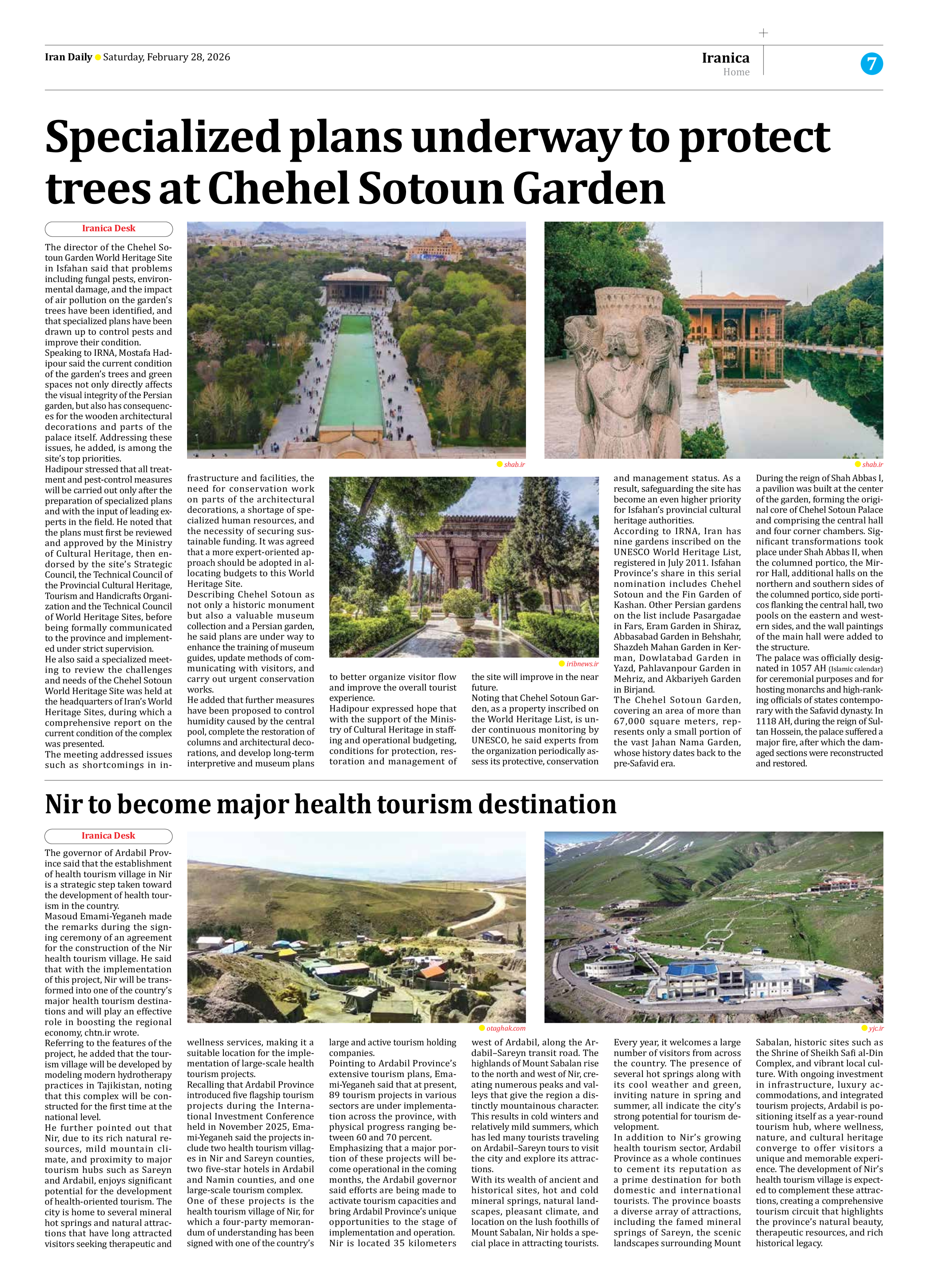
Nir is located 35 kilometers west of Ardabil, along the Ardabil–Sareyn transit road. The highlands of Mount Sabalan rise to the north and west of Nir, creating numerous peaks and valleys that give the region a distinctly mountainous character. This results in cold winters and relatively mild summers, which has led many tourists traveling on Ardabil–Sareyn tours to visit the city and explore its attractions.
With its wealth of ancient and historical sites, hot and cold mineral springs, natural landscapes, pleasant climate, and location on the lush foothills of Mount Sabalan, Nir holds a special place in attracting tourists. Every year, it welcomes a large number of visitors from across the country. The presence of several hot springs along with its cool weather and green, inviting nature in spring and summer, all indicate the city’s strong potential for tourism development.
In addition to Nir’s growing health tourism sector, Ardabil Province as a whole continues to cement its reputation as a prime destination for both domestic and international tourists. The province boasts a diverse array of attractions, including the famed mineral springs of Sareyn, the scenic landscapes surrounding Mount Sabalan, historic sites such as the Shrine of Sheikh Safi al-Din Complex, and vibrant local culture. With ongoing investment in infrastructure, luxury accommodations, and integrated tourism projects, Ardabil is positioning itself as a year-round tourism hub, where wellness, nature, and cultural heritage converge to offer visitors a unique and memorable experience. The development of Nir’s health tourism village is expected to complement these attractions, creating a comprehensive tourism circuit that highlights the province’s natural beauty, therapeutic resources, and rich historical legacy.