







Specialized plans underway to protect trees at Chehel Sotoun Garden
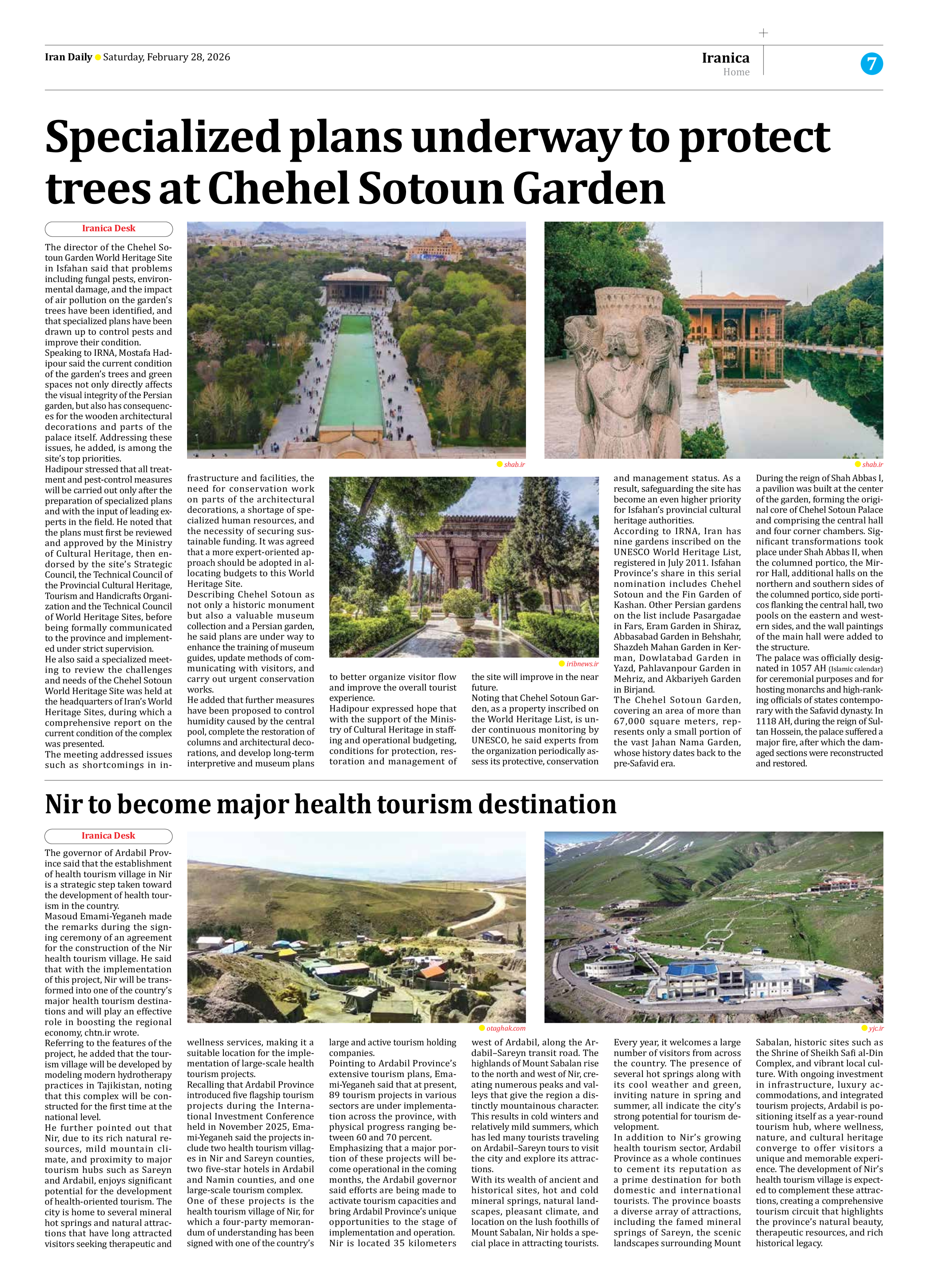
The director of the Chehel Sotoun Garden World Heritage Site in Isfahan said that problems including fungal pests, environmental damage, and the impact of air pollution on the garden’s trees have been identified, and that specialized plans have been drawn up to control pests and improve their condition.
Speaking to IRNA, Mostafa Hadipour said the current condition of the garden’s trees and green spaces not only directly affects the visual integrity of the Persian garden, but also has consequences for the wooden architectural decorations and parts of the palace itself. Addressing these issues, he added, is among the site’s top priorities.
Hadipour stressed that all treatment and pest-control measures will be carried out only after the preparation of specialized plans and with the input of leading experts in the field. He noted that the plans must first be reviewed and approved by the Ministry of Cultural Heritage, then endorsed by the site’s Strategic Council, the Technical Council of the Provincial Cultural Heritage, Tourism and Handicrafts Organization and the Technical Council of World Heritage Sites, before being formally communicated to the province and implemented under strict supervision.
He also said a specialized meeting to review the challenges and needs of the Chehel Sotoun World Heritage Site was held at the headquarters of Iran’s World Heritage Sites, during which a comprehensive report on the current condition of the complex was presented.
The meeting addressed issues such as shortcomings in infrastructure and facilities, the need for conservation work on parts of the architectural decorations, a shortage of specialized human resources, and the necessity of securing sustainable funding. It was agreed that a more expert-oriented approach should be adopted in allocating budgets to this World Heritage Site.
Describing Chehel Sotoun as not only a historic monument but also a valuable museum collection and a Persian garden, he said plans are under way to enhance the training of museum guides, update methods of communicating with visitors, and carry out urgent conservation works.
He added that further measures have been proposed to control humidity caused by the central pool, complete the restoration of columns and architectural decorations, and develop long-term interpretive and museum plans to better organize visitor flow and improve the overall tourist experience.
Hadipour expressed hope that with the support of the Ministry of Cultural Heritage in staffing and operational budgeting, conditions for protection, restoration and management of the site will improve in the near future.
Noting that Chehel Sotoun Garden, as a property inscribed on the World Heritage List, is under continuous monitoring by UNESCO, he said experts from the organization periodically assess its protective, conservation and management status. As a result, safeguarding the site has become an even higher priority for Isfahan’s provincial cultural heritage authorities.
According to IRNA, Iran has nine gardens inscribed on the UNESCO World Heritage List, registered in July 2011. Isfahan Province’s share in this serial nomination includes Chehel Sotoun and the Fin Garden of Kashan. Other Persian gardens on the list include Pasargadae in Fars, Eram Garden in Shiraz, Abbasabad Garden in Behshahr, Shazdeh Mahan Garden in Kerman, Dowlatabad Garden in Yazd, Pahlavanpour Garden in Mehriz, and Akbariyeh Garden in Birjand.
The Chehel Sotoun Garden, covering an area of more than 67,000 square meters, represents only a small portion of the vast Jahan Nama Garden, whose history dates back to the pre-Safavid era.
During the reign of Shah Abbas I, a pavilion was built at the center of the garden, forming the original core of Chehel Sotoun Palace and comprising the central hall and four corner chambers. Significant transformations took place under Shah Abbas II, when the columned portico, the Mirror Hall, additional halls on the northern and southern sides of the columned portico, side porticos flanking the central hall, two pools on the eastern and western sides, and the wall paintings of the main hall were added to the structure.
The palace was officially designated in 1057 AH (Islamic calendar) for ceremonial purposes and for hosting monarchs and high-ranking officials of states contemporary with the Safavid dynasty. In 1118 AH, during the reign of Sultan Hossein, the palace suffered a major fire, after which the damaged sections were reconstructed and restored.