







Copy in clipboard...
Araghchi touts ‘significant progress’ in Iran-US talks in Geneva
Technical teams to begin detailed expert reviews in Vienna
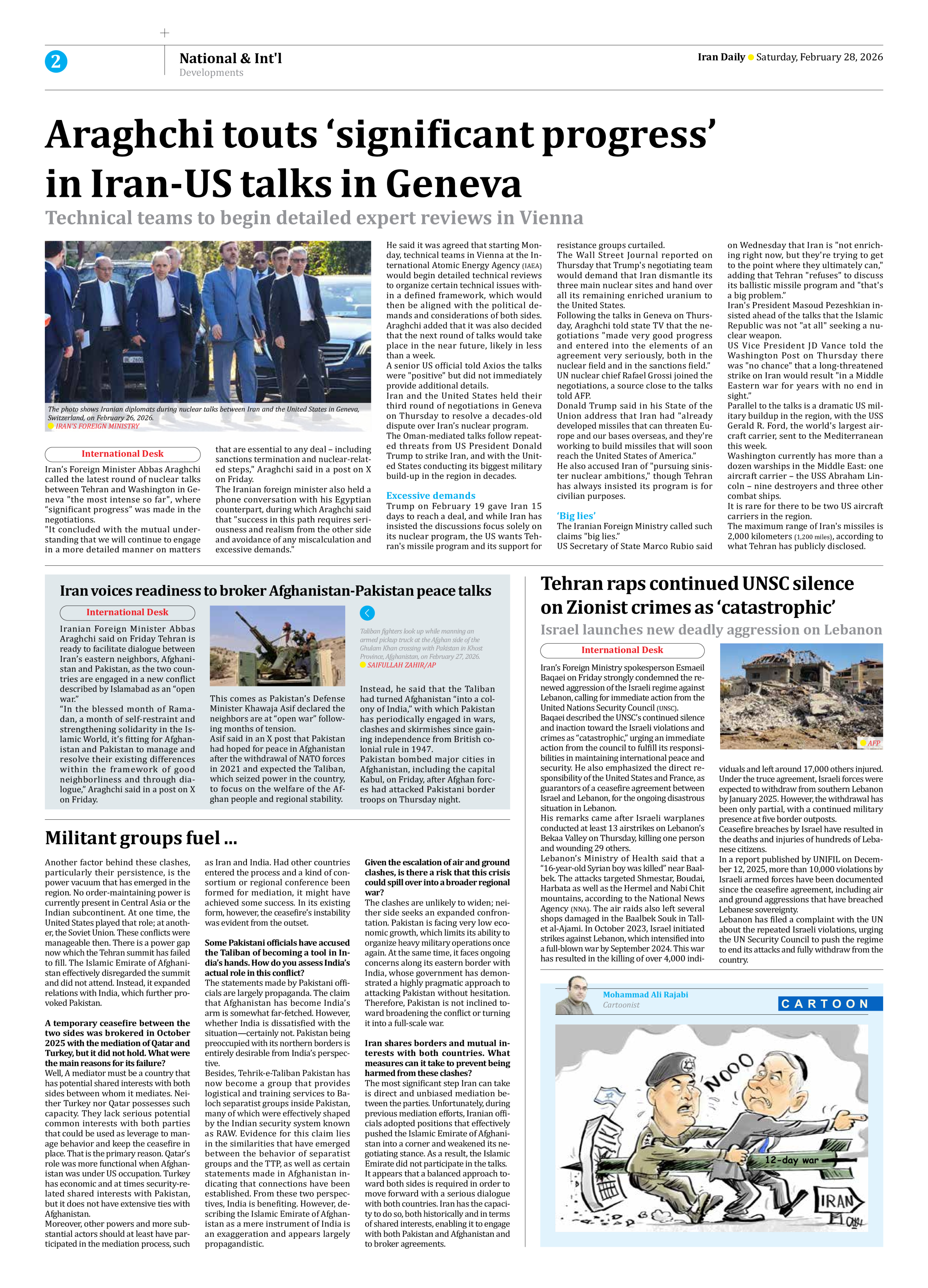
Iran’s Foreign Minister Abbas Araghchi called the latest round of nuclear talks between Tehran and Washington in Geneva "the most intense so far", where “significant progress” was made in the negotiations.
"It concluded with the mutual understanding that we will continue to engage in a more detailed manner on matters that are essential to any deal – including sanctions termination and nuclear-related steps," Araghchi said in a post on X on Friday.
The Iranian foreign minister also held a phone conversation with his Egyptian counterpart, during which Araghchi said that "success in this path requires seriousness and realism from the other side and avoidance of any miscalculation and excessive demands."
He said it was agreed that starting Monday, technical teams in Vienna at the International Atomic Energy Agency (IAEA) would begin detailed technical reviews to organize certain technical issues within a defined framework, which would then be aligned with the political demands and considerations of both sides.
Araghchi added that it was also decided that the next round of talks would take place in the near future, likely in less than a week.
A senior US official told Axios the talks were "positive" but did not immediately provide additional details.
Iran and the United States held their third round of negotiations in Geneva on Thursday to resolve a decades-old dispute over Iran’s nuclear program.
The Oman-mediated talks follow repeated threats from US President Donald Trump to strike Iran, and with the United States conducting its biggest military build-up in the region in decades.
Excessive demands
Trump on February 19 gave Iran 15 days to reach a deal, and while Iran has insisted the discussions focus solely on its nuclear program, the US wants Tehran's missile program and its support for resistance groups curtailed.
The Wall Street Journal reported on Thursday that Trump's negotiating team would demand that Iran dismantle its three main nuclear sites and hand over all its remaining enriched uranium to the United States.
Following the talks in Geneva on Thursday, Araghchi told state TV that the negotiations "made very good progress and entered into the elements of an agreement very seriously, both in the nuclear field and in the sanctions field.”
UN nuclear chief Rafael Grossi joined the negotiations, a source close to the talks told AFP.
Donald Trump said in his State of the Union address that Iran had "already developed missiles that can threaten Europe and our bases overseas, and they're working to build missiles that will soon reach the United States of America.”
He also accused Iran of "pursuing sinister nuclear ambitions," though Tehran has always insisted its program is for civilian purposes.
‘Big lies’
The Iranian Foreign Ministry called such claims "big lies.”
US Secretary of State Marco Rubio said on Wednesday that Iran is "not enriching right now, but they're trying to get to the point where they ultimately can," adding that Tehran "refuses" to discuss its ballistic missile program and "that's a big problem.”
Iran's President Masoud Pezeshkian insisted ahead of the talks that the Islamic Republic was not "at all" seeking a nuclear weapon.
US Vice President JD Vance told the Washington Post on Thursday there was "no chance" that a long-threatened strike on Iran would result "in a Middle Eastern war for years with no end in sight.”
Parallel to the talks is a dramatic US military buildup in the region, with the USS Gerald R. Ford, the world's largest aircraft carrier, sent to the Mediterranean this week.
Washington currently has more than a dozen warships in the Middle East: one aircraft carrier – the USS Abraham Lincoln – nine destroyers and three other combat ships.
It is rare for there to be two US aircraft carriers in the region.
The maximum range of Iran's missiles is 2,000 kilometers (1,200 miles), according to what Tehran has publicly disclosed.