







‘Recidivism of Blood’
No curtain falls on hunger for power
Great theatrical adaptations rarely succeed by retelling a story; they endure by interrogating it. Mehdi Salahi’s ‘Recidivism of Blood,’ a reinterpretation of ‘Macbeth,’ does not concern itself with whether Macbeth is evil, guilty, or tragic. Instead, it zeroes in on something far less comfortable: The unsettling proposition that Macbeth is not an aberration of history or literature, but a mirror of humanity’s compulsive appetite for power.
This conceptual pivot is what makes Salahi’s production noteworthy beyond the usual sphere of theatrical experimentation. By stripping away narrative ornamentation and leaning into physical theater, ensemble movement, and visual abstraction, the play effectively reframes Shakespeare’s world not as medieval Scotland, but as an allegorical ecosystem of ambition. In this framing, blood is not merely the residue of murder; it becomes a cyclical condition, a stain humanity repeatedly steps into, washes off, and then returns to.
The original tragedy by William Shakespeare has often been staged as a morality tale about vaulting ambition. Salahi’s vision pushes further, implying that ambition is not the disease, it is the default setting. The disease lies in our inability to recognize its insatiability. Power, once tasted, recalibrates desire rather than satisfying it. The production’s emphasis on repetition, choreographed movement, and collective embodiment of violence visually reinforces this thesis: tyranny is never a solitary act; it is a system perpetuated by participants who rarely perceive themselves as complicit.
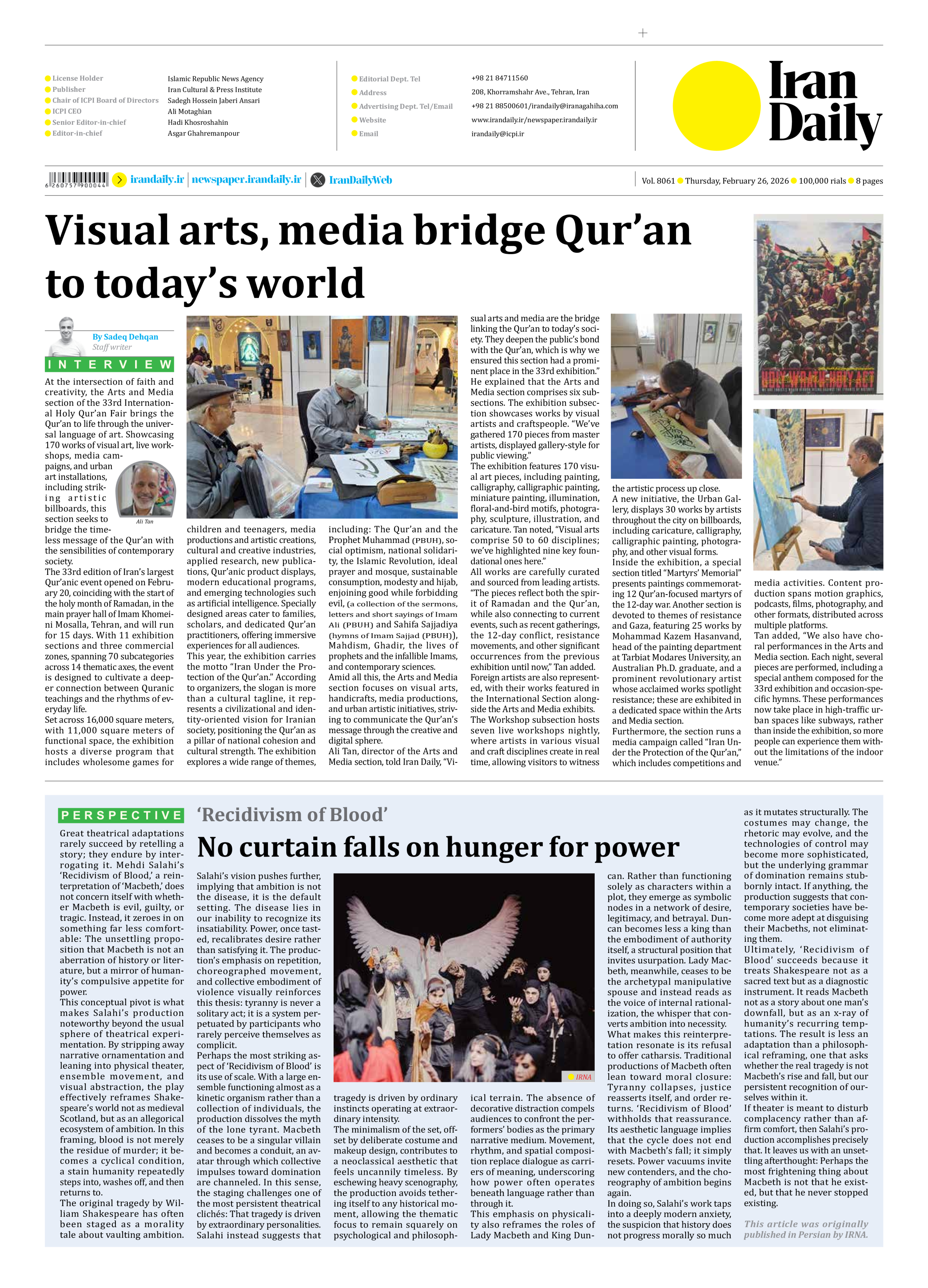
Perhaps the most striking aspect of ‘Recidivism of Blood’ is its use of scale. With a large ensemble functioning almost as a kinetic organism rather than a collection of individuals, the production dissolves the myth of the lone tyrant. Macbeth ceases to be a singular villain and becomes a conduit, an avatar through which collective impulses toward domination are channeled. In this sense, the staging challenges one of the most persistent theatrical clichés: That tragedy is driven by extraordinary personalities. Salahi instead suggests that tragedy is driven by ordinary instincts operating at extraordinary intensity.
The minimalism of the set, offset by deliberate costume and makeup design, contributes to a neoclassical aesthetic that feels uncannily timeless. By eschewing heavy scenography, the production avoids tethering itself to any historical moment, allowing the thematic focus to remain squarely on psychological and philosophical terrain. The absence of decorative distraction compels audiences to confront the performers’ bodies as the primary narrative medium. Movement, rhythm, and spatial composition replace dialogue as carriers of meaning, underscoring how power often operates beneath language rather than through it.
This emphasis on physicality also reframes the roles of Lady Macbeth and King Duncan. Rather than functioning solely as characters within a plot, they emerge as symbolic nodes in a network of desire, legitimacy, and betrayal. Duncan becomes less a king than the embodiment of authority itself, a structural position that invites usurpation. Lady Macbeth, meanwhile, ceases to be the archetypal manipulative spouse and instead reads as the voice of internal rationalization, the whisper that converts ambition into necessity.
What makes this reinterpretation resonate is its refusal to offer catharsis. Traditional productions of Macbeth often lean toward moral closure: Tyranny collapses, justice reasserts itself, and order returns. ‘Recidivism of Blood’ withholds that reassurance. Its aesthetic language implies that the cycle does not end with Macbeth’s fall; it simply resets. Power vacuums invite new contenders, and the choreography of ambition begins again.
In doing so, Salahi’s work taps into a deeply modern anxiety, the suspicion that history does not progress morally so much as it mutates structurally. The costumes may change, the rhetoric may evolve, and the technologies of control may become more sophisticated, but the underlying grammar of domination remains stubbornly intact. If anything, the production suggests that contemporary societies have become more adept at disguising their Macbeths, not eliminating them.
Ultimately, ‘Recidivism of Blood’ succeeds because it treats Shakespeare not as a sacred text but as a diagnostic instrument. It reads Macbeth not as a story about one man’s downfall, but as an x-ray of humanity’s recurring temptations. The result is less an adaptation than a philosophical reframing, one that asks whether the real tragedy is not Macbeth’s rise and fall, but our persistent recognition of ourselves within it.
If theater is meant to disturb complacency rather than affirm comfort, then Salahi’s production accomplishes precisely that. It leaves us with an unsettling afterthought: Perhaps the most frightening thing about Macbeth is not that he existed, but that he never stopped existing.
This article was originally published in Persian by IRNA.