







Visual arts, media bridge Qur’an to today’s world
By Sadeq Dehqan
Staff writer
At the intersection of faith and creativity, the Arts and Media section of the 33rd International Holy Qur’an Fair brings the Qur’an to life through the universal language of art. Showcasing 170 works of visual art, live workshops, media campaigns, and urban art installations, including striking artistic billboards, this section seeks to bridge the timeless message of the Qur’an with the sensibilities of contemporary society.
The 33rd edition of Iran’s largest Qur’anic event opened on February 20, coinciding with the start of the holy month of Ramadan, in the main prayer hall of Imam Khomeini Mosalla, Tehran, and will run for 15 days. With 11 exhibition sections and three commercial zones, spanning 70 subcategories across 14 thematic axes, the event is designed to cultivate a deeper connection between Quranic teachings and the rhythms of everyday life.
Set across 16,000 square meters, with 11,000 square meters of functional space, the exhibition hosts a diverse program that includes wholesome games for children and teenagers, media productions and artistic creations, cultural and creative industries, applied research, new publications, Qur’anic product displays, modern educational programs, and emerging technologies such as artificial intelligence. Specially designed areas cater to families, scholars, and dedicated Qur’an practitioners, offering immersive experiences for all audiences.
This year, the exhibition carries the motto “Iran Under the Protection of the Qur’an.” According to organizers, the slogan is more than a cultural tagline, it represents a civilizational and identity-oriented vision for Iranian society, positioning the Qur’an as a pillar of national cohesion and cultural strength. The exhibition explores a wide range of themes, including: The Qur’an and the Prophet Muhammad (PBUH), social optimism, national solidarity, the Islamic Revolution, ideal prayer and mosque, sustainable consumption, modesty and hijab, enjoining good while forbidding evil, (a collection of the sermons, letters and short sayings of Imam Ali (PBUH) and Sahifa Sajjadiya (hymns of Imam Sajjad (PBUH)), Mahdism, Ghadir, the lives of prophets and the infallible Imams, and contemporary sciences.
Amid all this, the Arts and Media section focuses on visual arts, handicrafts, media productions, and urban artistic initiatives, striving to communicate the Qur’an’s message through the creative and digital sphere.
Ali Tan, director of the Arts and Media section, told Iran Daily, “Visual arts and media are the bridge linking the Qur’an to today’s society. They deepen the public’s bond with the Qur’an, which is why we ensured this section had a prominent place in the 33rd exhibition.”
He explained that the Arts and Media section comprises six subsections. The exhibition subsection showcases works by visual artists and craftspeople. “We’ve gathered 170 pieces from master artists, displayed gallery-style for public viewing.”
The exhibition features 170 visual art pieces, including painting, calligraphy, calligraphic painting, miniature painting, illumination, floral-and-bird motifs, photography, sculpture, illustration, and caricature. Tan noted, “Visual arts comprise 50 to 60 disciplines; we’ve highlighted nine key foundational ones here.”
All works are carefully curated and sourced from leading artists. “The pieces reflect both the spirit of Ramadan and the Qur’an, while also connecting to current events, such as recent gatherings, the 12-day conflict, resistance movements, and other significant occurrences from the previous exhibition until now,” Tan added.
Foreign artists are also represented, with their works featured in the International Section alongside the Arts and Media exhibits.
The Workshop subsection hosts seven live workshops nightly, where artists in various visual and craft disciplines create in real time, allowing visitors to witness the artistic process up close.
A new initiative, the Urban Gallery, displays 30 works by artists throughout the city on billboards, including caricature, calligraphy, calligraphic painting, photography, and other visual forms.
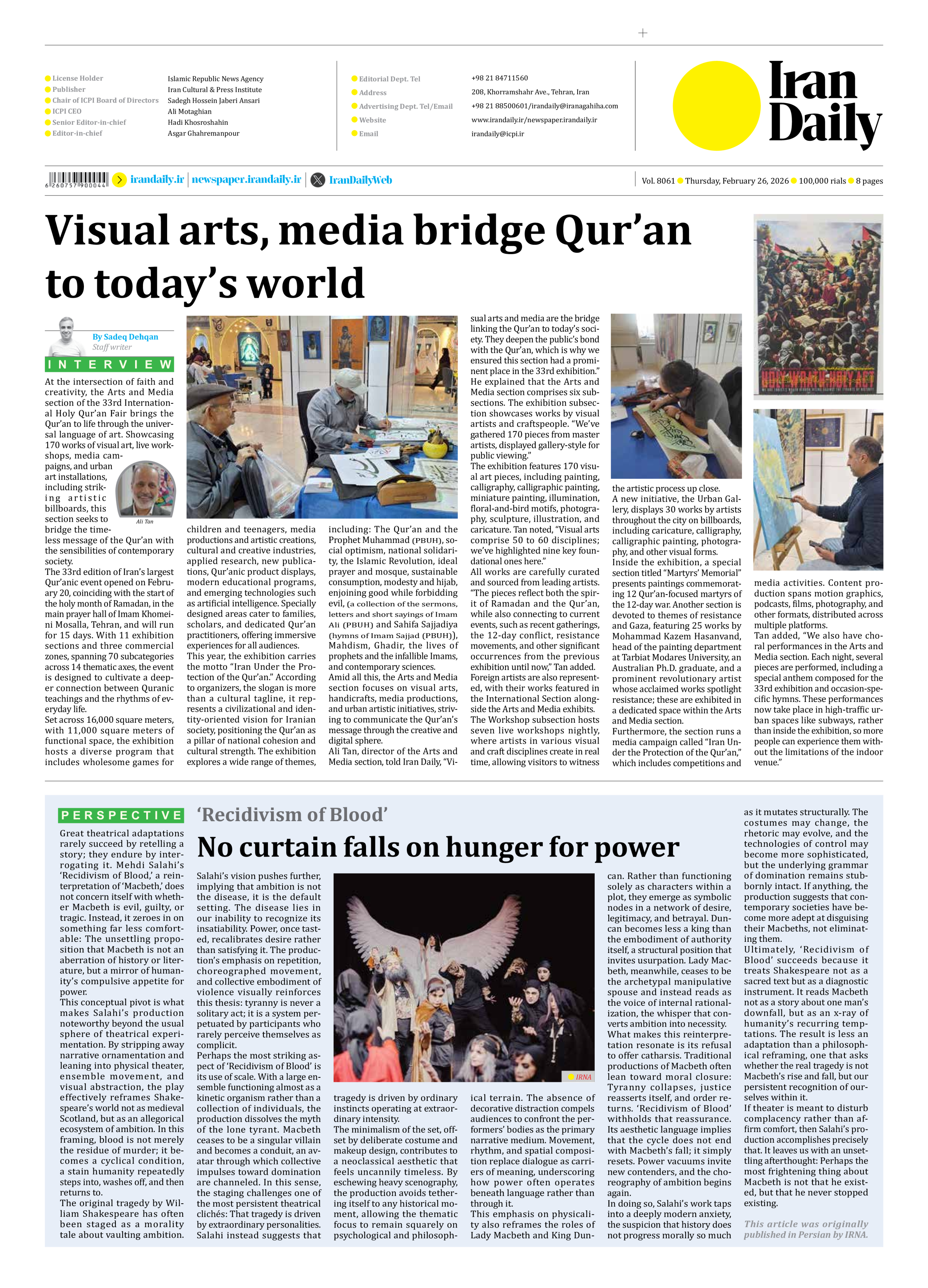
Inside the exhibition, a special section titled “Martyrs’ Memorial” presents paintings commemorating 12 Qur’an-focused martyrs of the 12-day war. Another section is devoted to themes of resistance and Gaza, featuring 25 works by Mohammad Kazem Hasanvand, head of the painting department at Tarbiat Modares University, an Australian Ph.D. graduate, and a prominent revolutionary artist whose acclaimed works spotlight resistance; these are exhibited in a dedicated space within the Arts and Media section.
Furthermore, the section runs a media campaign called “Iran Under the Protection of the Qur’an,” which includes competitions and media activities. Content production spans motion graphics, podcasts, films, photography, and other formats, distributed across multiple platforms.
Tan added, “We also have choral performances in the Arts and Media section. Each night, several pieces are performed, including a special anthem composed for the 33rd exhibition and occasion-specific hymns. These performances now take place in high-traffic urban spaces like subways, rather than inside the exhibition, so more people can experience them without the limitations of the indoor venue.”