







Research begins to define legal boundaries of Asirabad Hill in Saveh
The Director General of Markazi Province’s Cultural Heritage, Tourism and Handicrafts Organization has announced the commencement of research excavations aimed at defining the legal boundaries and protection zones of Asirabad Hill in Saveh, know also as Asiaabad.
Hossein Mahmoudi highlighted the historical and cultural importance of the site, noting that the hill, located near the sacred tomb of Imamzadeh Seyed Es’haq in the southeast of Saveh, is a nationally registered monument, added to Iran’s National Heritage List in 1974. He emphasized that the site is now in urgent need of precise boundary delineation and protective regulations, according to chtn.ir.
“Determining the legal boundaries of historical sites is a fundamental legal measure to prevent potential encroachments, ensure the optimal management of surrounding urban development, and safeguard the historical identity of regions,” Mahmoudi explained. “As a first step, research excavations have begun to accurately identify the site’s extent, examine its cultural layers, and document findings scientifically, providing the essential basis for proposing formal legal protection.”
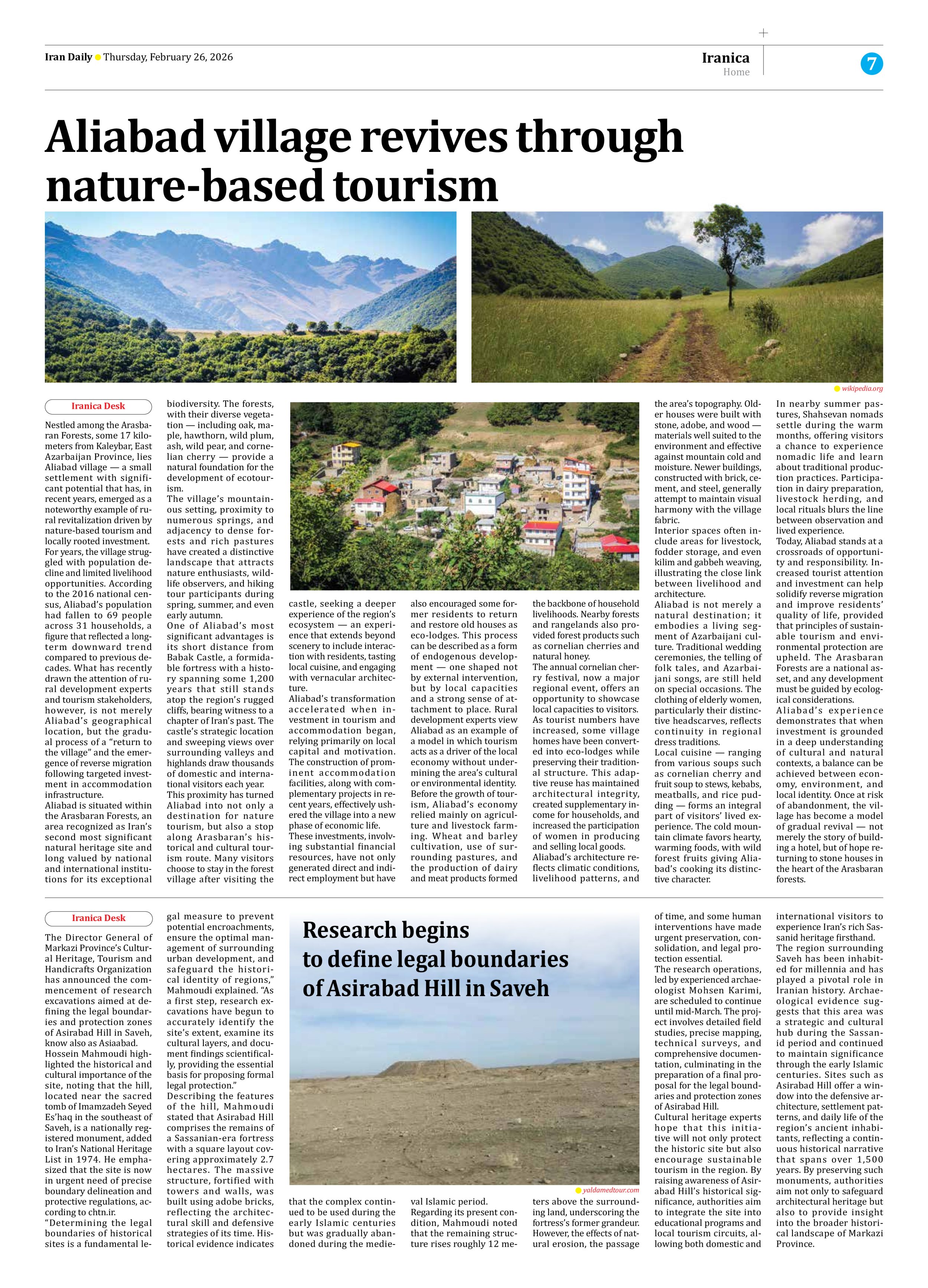
Describing the features of the hill, Mahmoudi stated that Asirabad Hill comprises the remains of a Sassanian-era fortress with a square layout covering approximately 2.7 hectares. The massive structure, fortified with towers and walls, was built using adobe bricks, reflecting the architectural skill and defensive strategies of its time. Historical evidence indicates that the complex continued to be used during the early Islamic centuries but was gradually abandoned during the medieval Islamic period.
Regarding its present condition, Mahmoudi noted that the remaining structure rises roughly 12 meters above the surrounding land, underscoring the fortress’s former grandeur. However, the effects of natural erosion, the passage of time, and some human interventions have made urgent preservation, consolidation, and legal protection essential.
The research operations, led by experienced archaeologist Mohsen Karimi, are scheduled to continue until mid-March. The project involves detailed field studies, precise mapping, technical surveys, and comprehensive documentation, culminating in the preparation of a final proposal for the legal boundaries and protection zones of Asirabad Hill.
Cultural heritage experts hope that this initiative will not only protect the historic site but also encourage sustainable tourism in the region. By raising awareness of Asirabad Hill’s historical significance, authorities aim to integrate the site into educational programs and local tourism circuits, allowing both domestic and international visitors to experience Iran’s rich Sassanid heritage firsthand.
The region surrounding Saveh has been inhabited for millennia and has played a pivotal role in Iranian history. Archaeological evidence suggests that this area was a strategic and cultural hub during the Sassanid period and continued to maintain significance through the early Islamic centuries. Sites such as Asirabad Hill offer a window into the defensive architecture, settlement patterns, and daily life of the region’s ancient inhabitants, reflecting a continuous historical narrative that spans over 1,500 years. By preserving such monuments, authorities aim not only to safeguard architectural heritage but also to provide insight into the broader historical landscape of Markazi Province.