







Aliabad village revives through nature-based tourism
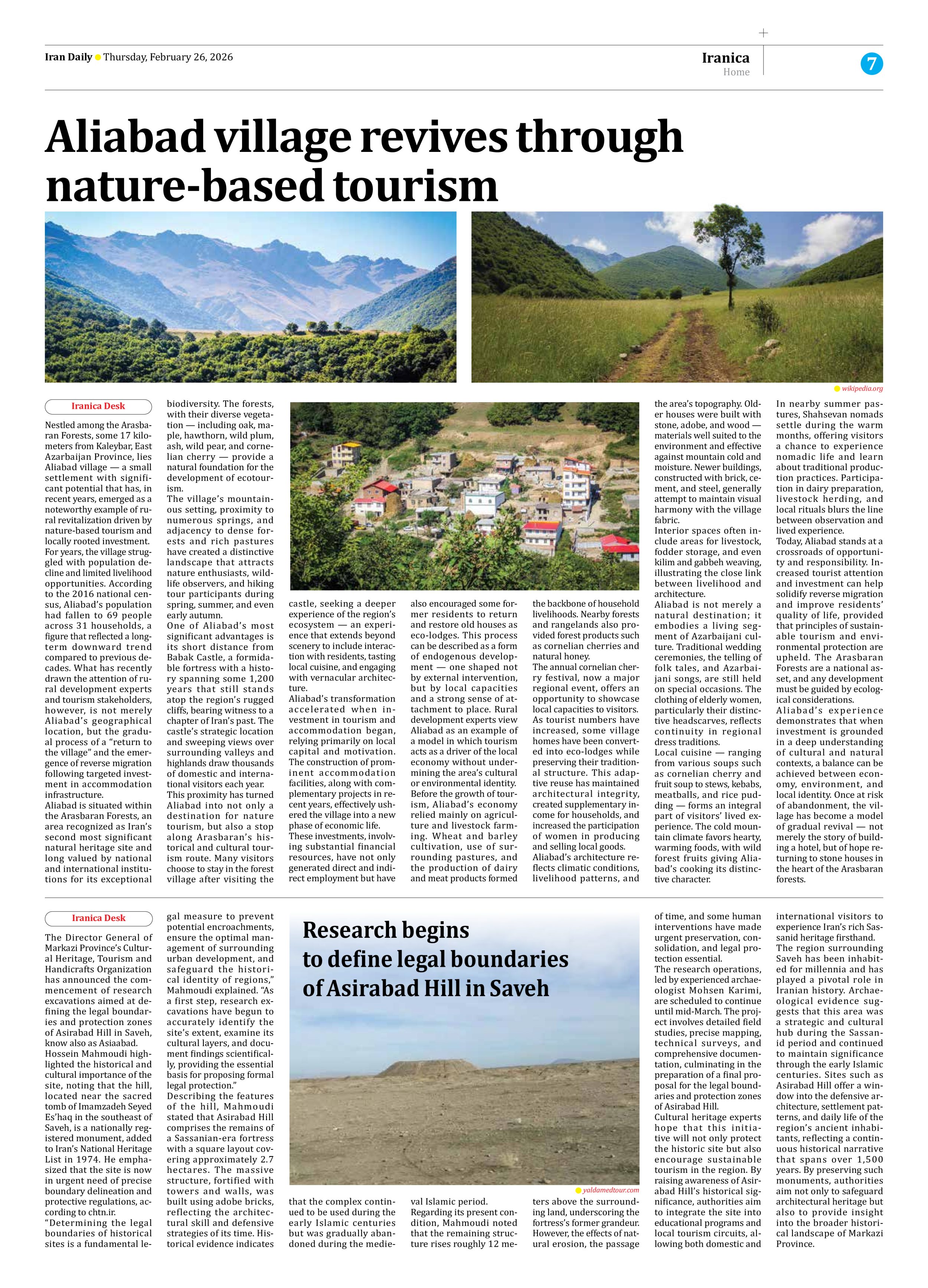
Nestled among the Arasbaran Forests, some 17 kilometers from Kaleybar, East Azarbaijan Province, lies Aliabad village — a small settlement with significant potential that has, in recent years, emerged as a noteworthy example of rural revitalization driven by nature-based tourism and locally rooted investment.
For years, the village struggled with population decline and limited livelihood opportunities. According to the 2016 national census, Aliabad’s population had fallen to 69 people across 31 households, a figure that reflected a long-term downward trend compared to previous decades. What has recently drawn the attention of rural development experts and tourism stakeholders, however, is not merely Aliabad’s geographical location, but the gradual process of a “return to the village” and the emergence of reverse migration following targeted investment in accommodation infrastructure.
Aliabad is situated within the Arasbaran Forests, an area recognized as Iran’s second most significant natural heritage site and long valued by national and international institutions for its exceptional biodiversity. The forests, with their diverse vegetation — including oak, maple, hawthorn, wild plum, ash, wild pear, and cornelian cherry — provide a natural foundation for the development of ecotourism.
The village’s mountainous setting, proximity to numerous springs, and adjacency to dense forests and rich pastures have created a distinctive landscape that attracts nature enthusiasts, wildlife observers, and hiking tour participants during spring, summer, and even early autumn.
One of Aliabad’s most significant advantages is its short distance from Babak Castle, a formidable fortress with a history spanning some 1,200 years that still stands atop the region’s rugged cliffs, bearing witness to a chapter of Iran’s past. The castle’s strategic location and sweeping views over surrounding valleys and highlands draw thousands of domestic and international visitors each year.
This proximity has turned Aliabad into not only a destination for nature tourism, but also a stop along Arasbaran’s historical and cultural tourism route. Many visitors choose to stay in the forest village after visiting the castle, seeking a deeper experience of the region’s ecosystem — an experience that extends beyond scenery to include interaction with residents, tasting local cuisine, and engaging with vernacular architecture.
Aliabad’s transformation accelerated when investment in tourism and accommodation began, relying primarily on local capital and motivation. The construction of prominent accommodation facilities, along with complementary projects in recent years, effectively ushered the village into a new phase of economic life.
These investments, involving substantial financial resources, have not only generated direct and indirect employment but have also encouraged some former residents to return and restore old houses as eco-lodges. This process can be described as a form of endogenous development — one shaped not by external intervention, but by local capacities and a strong sense of attachment to place. Rural development experts view Aliabad as an example of a model in which tourism acts as a driver of the local economy without undermining the area’s cultural or environmental identity.
Before the growth of tourism, Aliabad’s economy relied mainly on agriculture and livestock farming. Wheat and barley cultivation, use of surrounding pastures, and the production of dairy and meat products formed the backbone of household livelihoods. Nearby forests and rangelands also provided forest products such as cornelian cherries and natural honey.
The annual cornelian cherry festival, now a major regional event, offers an opportunity to showcase local capacities to visitors.
As tourist numbers have increased, some village homes have been converted into eco-lodges while preserving their traditional structure. This adaptive reuse has maintained architectural integrity, created supplementary income for households, and increased the participation of women in producing and selling local goods.
Aliabad’s architecture reflects climatic conditions, livelihood patterns, and the area’s topography. Older houses were built with stone, adobe, and wood — materials well suited to the environment and effective against mountain cold and moisture. Newer buildings, constructed with brick, cement, and steel, generally attempt to maintain visual harmony with the village fabric.
Interior spaces often include areas for livestock, fodder storage, and even kilim and gabbeh weaving, illustrating the close link between livelihood and architecture.
Aliabad is not merely a natural destination; it embodies a living segment of Azarbaijani culture. Traditional wedding ceremonies, the telling of folk tales, and Azarbaijani songs, are still held on special occasions. The clothing of elderly women, particularly their distinctive headscarves, reflects continuity in regional dress traditions.
Local cuisine — ranging from various soups such as cornelian cherry and fruit soup to stews, kebabs, meatballs, and rice pudding — forms an integral part of visitors’ lived experience. The cold mountain climate favors hearty, warming foods, with wild forest fruits giving Aliabad’s cooking its distinctive character.
In nearby summer pastures, Shahsevan nomads settle during the warm months, offering visitors a chance to experience nomadic life and learn about traditional production practices. Participation in dairy preparation, livestock herding, and local rituals blurs the line between observation and lived experience.
Today, Aliabad stands at a crossroads of opportunity and responsibility. Increased tourist attention and investment can help solidify reverse migration and improve residents’ quality of life, provided that principles of sustainable tourism and environmental protection are upheld. The Arasbaran Forests are a national asset, and any development must be guided by ecological considerations.
Aliabad’s experience demonstrates that when investment is grounded in a deep understanding of cultural and natural contexts, a balance can be achieved between economy, environment, and local identity. Once at risk of abandonment, the village has become a model of gradual revival — not merely the story of building a hotel, but of hope returning to stone houses in the heart of the Arasbaran forests.