







A journey through time, love in Qasr-e Shirin
In the westernmost part of Iran, where palm trees whisper in the wind and stones still remember tales of love, stands Qasr-e Shirin — a city where history, nature, and legend intertwine. From the silent grandeur of Khosrow Palace to the gentle murmur of water in Sassanid-era channels and the mysterious stillness of the Chaharghapi Fire Temple, Qasr-e Shirin invites every traveler on a journey through love, power, and beauty.
Milad Ataei, a journalist from Kermanshah Province, wrote in a recent column in chtn.ir that visiting Qasr-e Shirin is not merely a passage through geography; it is an entry into a story that began thousands of years ago and continues to this day. Situated at the border of Iran and Mesopotamia, the city has long served as a vital gateway for civilizations — a place where caravans paused, kings took residence, and love immortalized its name.
Khosrow Palace
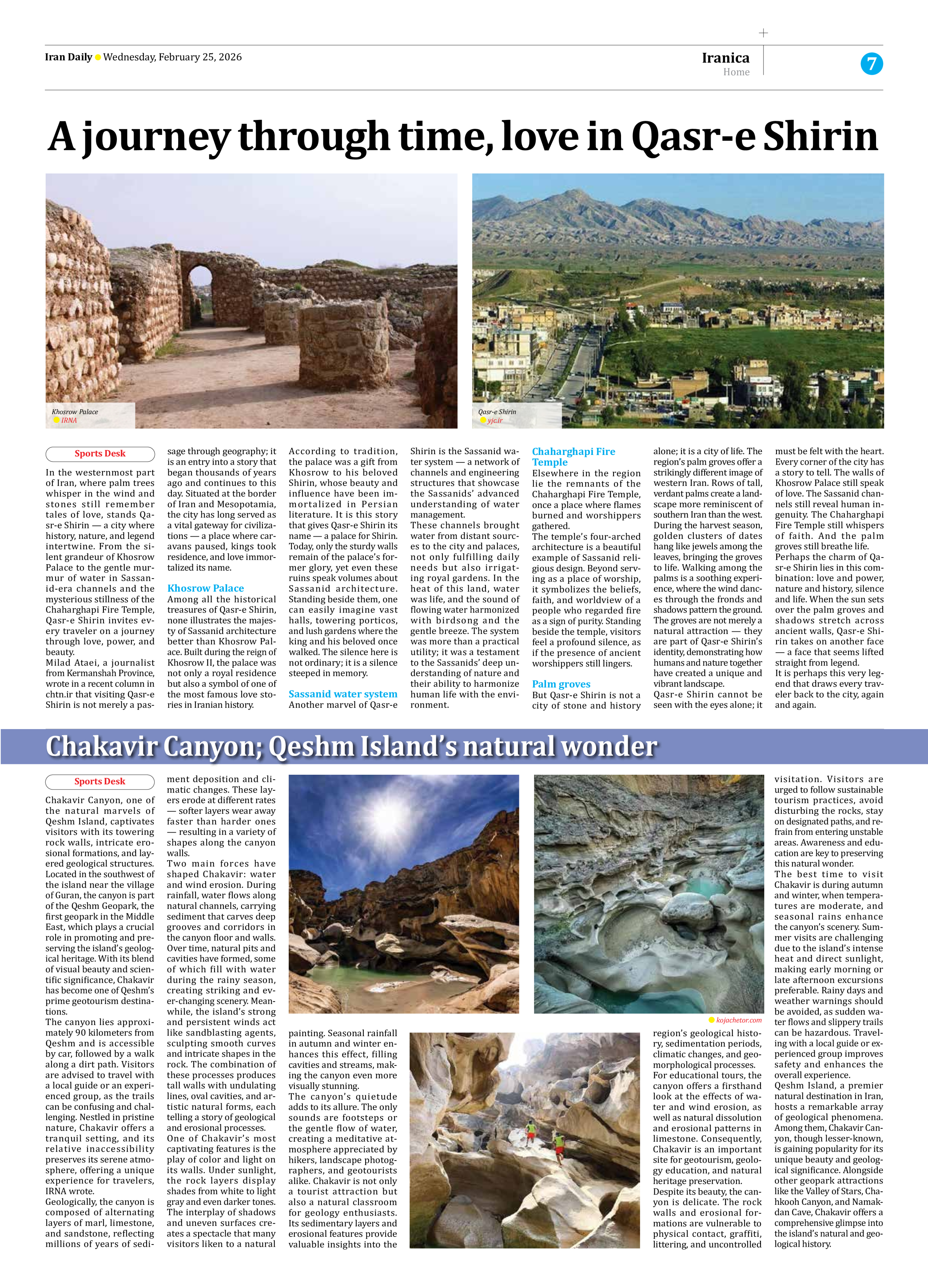
Among all the historical treasures of Qasr-e Shirin, none illustrates the majesty of Sassanid architecture better than Khosrow Palace. Built during the reign of Khosrow II, the palace was not only a royal residence but also a symbol of one of the most famous love stories in Iranian history.
According to tradition, the palace was a gift from Khosrow to his beloved Shirin, whose beauty and influence have been immortalized in Persian literature. It is this story that gives Qasr-e Shirin its name — a palace for Shirin.
Today, only the sturdy walls remain of the palace’s former glory, yet even these ruins speak volumes about Sassanid architecture. Standing beside them, one can easily imagine vast halls, towering porticos, and lush gardens where the king and his beloved once walked. The silence here is not ordinary; it is a silence steeped in memory.
Sassanid water system
Another marvel of Qasr-e Shirin is the Sassanid water system — a network of channels and engineering structures that showcase the Sassanids’ advanced understanding of water management.
These channels brought water from distant sources to the city and palaces, not only fulfilling daily needs but also irrigating royal gardens. In the heat of this land, water was life, and the sound of flowing water harmonized with birdsong and the gentle breeze. The system was more than a practical utility; it was a testament to the Sassanids’ deep understanding of nature and their ability to harmonize human life with the environment.
Chaharghapi Fire Temple
Elsewhere in the region lie the remnants of the Chaharghapi Fire Temple, once a place where flames burned and worshippers gathered.
The temple’s four-arched architecture is a beautiful example of Sassanid religious design. Beyond serving as a place of worship, it symbolizes the beliefs, faith, and worldview of a people who regarded fire as a sign of purity. Standing beside the temple, visitors feel a profound silence, as if the presence of ancient worshippers still lingers.
Palm groves
But Qasr-e Shirin is not a city of stone and history alone; it is a city of life. The region’s palm groves offer a strikingly different image of western Iran. Rows of tall, verdant palms create a landscape more reminiscent of southern Iran than the west.
During the harvest season, golden clusters of dates hang like jewels among the leaves, bringing the groves to life. Walking among the palms is a soothing experience, where the wind dances through the fronds and shadows pattern the ground. The groves are not merely a natural attraction — they are part of Qasr-e Shirin’s identity, demonstrating how humans and nature together have created a unique and vibrant landscape.
Qasr-e Shirin cannot be seen with the eyes alone; it must be felt with the heart. Every corner of the city has a story to tell. The walls of Khosrow Palace still speak of love. The Sassanid channels still reveal human ingenuity. The Chaharghapi Fire Temple still whispers of faith. And the palm groves still breathe life.
Perhaps the charm of Qasr-e Shirin lies in this combination: love and power, nature and history, silence and life. When the sun sets over the palm groves and shadows stretch across ancient walls, Qasr-e Shirin takes on another face — a face that seems lifted straight from legend.
It is perhaps this very legend that draws every traveler back to the city, again and again.