







Legacy of Nomadi Bartaia; bridging Persian and Georgian cultures
By Ehsan Houshmand
Researcher in Ethnic Studies in Iran
Nomadi Bartaia, one of the renowned Iranologists of Georgia and the Caucasus region, passed away after several decades of scholarly activity that significantly advanced Iranian studies in the region. Over nearly six decades, Professor Bartaia played a key role in educating new generations of scholars and in highlighting the linguistic and cultural connections between Persian and Georgian through his teaching and research on Iranian studies and the Persian language.
Nomadi Bartaia was born in 1944 in western Georgia. In the 1960s, he officially began his academic career in departments of Oriental Studies, focusing on the Persian language and the cultural and literary ties between Iran and Georgia.
Over nearly six decades of research and teaching, he trained many students who later became prominent Iranologists. Bartaia held professorships in Oriental Studies and Iranian Studies at Tbilisi State University and Kutaisi University, and he also studied at several universities in Iran. This combination of advanced academic education in Iran, fieldwork, documentary research, and library studies in Georgia enabled him to pursue Iranian studies with notable breadth and depth.
In addition to teaching and research, he served as editor-in-chief of several publications, thereby contributing to the strengthening of cultural relations between Iran and Georgia in the public sphere. One of his notable works, Persian Vocabulary in the Georgian Language According to Yosseb Grishashvili’s “Urban Folk Culture”, was published with the cooperation of the Cultural Office of the Iranian Embassy in Georgia.
The historical and civilizational ties between Iran and Georgia constitute one of the most significant areas of Iranian studies. The presence of Iranian heritage from ancient to later periods — including inscriptions, stone carvings, manuscripts, buildings, palaces, fortresses, jewelry, and coins — clearly demonstrates these deep connections. The influence of Shahnameh-based names among Georgians, as well as the role of Georgian elites in Iran’s military and administrative structures, particularly during the Safavid era, are also key subjects of scholarly research.
Iranian mosques represent another enduring sign of shared Iranian-Georgian heritage. The influence of the Shahnameh on Georgian narratives and epics — especially The Knight in the Panther’s Skin, Georgia’s most celebrated literary work — has attracted considerable scholarly attention. Notably, some of the earliest translations of the Shahnameh and other Persian literary works over the past eight centuries were carried out in Georgia, highlighting the resilience of cultural ties despite political fluctuations.
The shared historical and cultural foundations between Iran and Georgia contributed to the growth of Iranian studies in Georgia over the past century. However, in recent decades, Iran’s institutional support for Iranian studies and the Persian language in the Caucasus has faced neglect. Over the last century, Iranian studies benefited from the work of major scholars such as Yuri Nikolaevich Marr, Ivane Javakhishvili, and Jamshid Giunashvili, alongside dedicated figures like Professor Nomadi Bartaia.
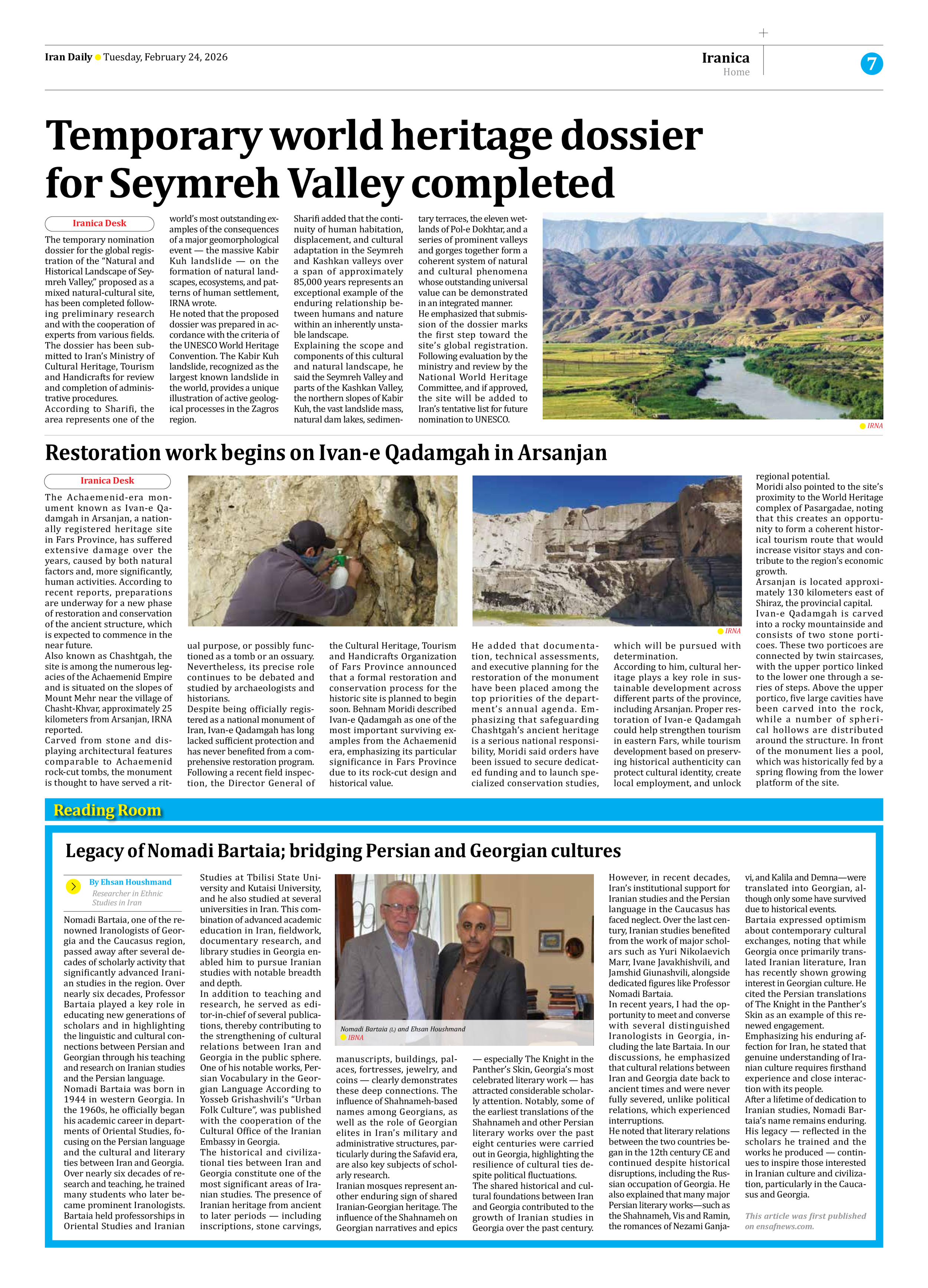
In recent years, I had the opportunity to meet and converse with several distinguished Iranologists in Georgia, including the late Bartaia. In our discussions, he emphasized that cultural relations between Iran and Georgia date back to ancient times and were never fully severed, unlike political relations, which experienced interruptions.
He noted that literary relations between the two countries began in the 12th century CE and continued despite historical disruptions, including the Russian occupation of Georgia. He also explained that many major Persian literary works—such as the Shahnameh, Vis and Ramin, the romances of Nezami Ganjavi, and Kalila and Demna—were translated into Georgian, although only some have survived due to historical events.
Bartaia expressed optimism about contemporary cultural exchanges, noting that while Georgia once primarily translated Iranian literature, Iran has recently shown growing interest in Georgian culture. He cited the Persian translations of The Knight in the Panther’s Skin as an example of this renewed engagement.
Emphasizing his enduring affection for Iran, he stated that genuine understanding of Iranian culture requires firsthand experience and close interaction with its people.
After a lifetime of dedication to Iranian studies, Nomadi Bartaia’s name remains enduring. His legacy — reflected in the scholars he trained and the works he produced — continues to inspire those interested in Iranian culture and civilization, particularly in the Caucasus and Georgia.
This article was first published on ensafnews.com.