





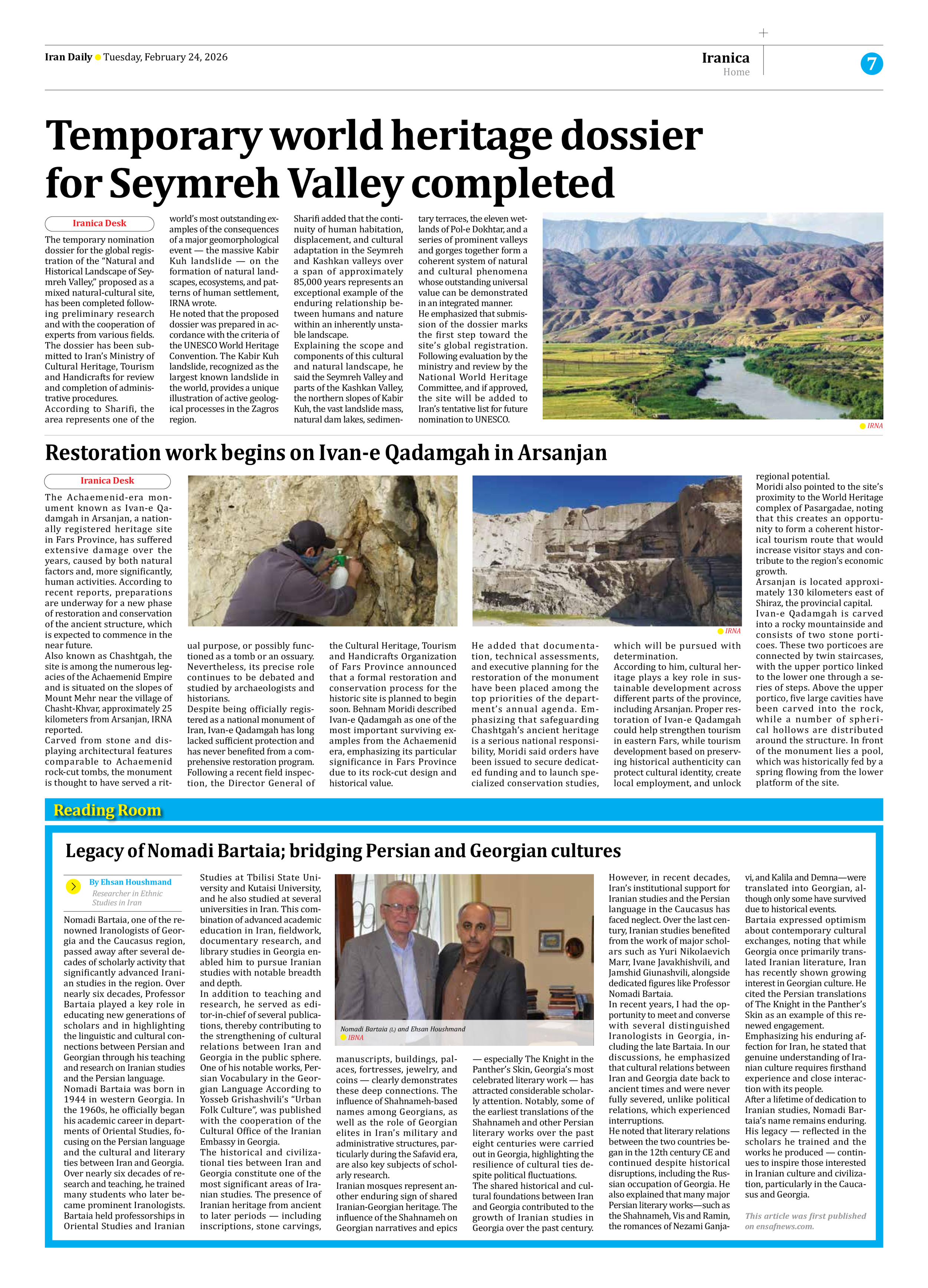


Restoration work begins on Ivan-e Qadamgah in Arsanjan
The Achaemenid-era monument known as Ivan-e Qadamgah in Arsanjan, a nationally registered heritage site in Fars Province, has suffered extensive damage over the years, caused by both natural factors and, more significantly, human activities. According to recent reports, preparations are underway for a new phase of restoration and conservation of the ancient structure, which is expected to commence in the near future.
Also known as Chashtgah, the site is among the numerous legacies of the Achaemenid Empire and is situated on the slopes of Mount Mehr near the village of Chasht-Khvar, approximately 25 kilometers from Arsanjan, IRNA reported.
Carved from stone and displaying architectural features comparable to Achaemenid rock-cut tombs, the monument is thought to have served a ritual purpose, or possibly functioned as a tomb or an ossuary. Nevertheless, its precise role continues to be debated and studied by archaeologists and historians.
Despite being officially registered as a national monument of Iran, Ivan-e Qadamgah has long lacked sufficient protection and has never benefited from a comprehensive restoration program.
Following a recent field inspection, the Director General of the Cultural Heritage, Tourism and Handicrafts Organization of Fars Province announced that a formal restoration and conservation process for the historic site is planned to begin soon. Behnam Moridi described Ivan-e Qadamgah as one of the most important surviving examples from the Achaemenid era, emphasizing its particular significance in Fars Province due to its rock-cut design and historical value.
He added that documentation, technical assessments, and executive planning for the restoration of the monument have been placed among the top priorities of the department’s annual agenda. Emphasizing that safeguarding Chashtgah’s ancient heritage is a serious national responsibility, Moridi said orders have been issued to secure dedicated funding and to launch specialized conservation studies, which will be pursued with determination.
According to him, cultural heritage plays a key role in sustainable development across different parts of the province, including Arsanjan. Proper restoration of Ivan-e Qadamgah could help strengthen tourism in eastern Fars, while tourism development based on preserving historical authenticity can protect cultural identity, create local employment, and unlock regional potential.
Moridi also pointed to the site’s proximity to the World Heritage complex of Pasargadae, noting that this creates an opportunity to form a coherent historical tourism route that would increase visitor stays and contribute to the region’s economic growth.
Arsanjan is located approximately 130 kilometers east of Shiraz, the provincial capital.
Ivan-e Qadamgah is carved into a rocky mountainside and consists of two stone porticoes. These two porticoes are connected by twin staircases, with the upper portico linked to the lower one through a series of steps. Above the upper portico, five large cavities have been carved into the rock, while a number of spherical hollows are distributed around the structure. In front of the monument lies a pool, which was historically fed by a spring flowing from the lower platform of the site.