





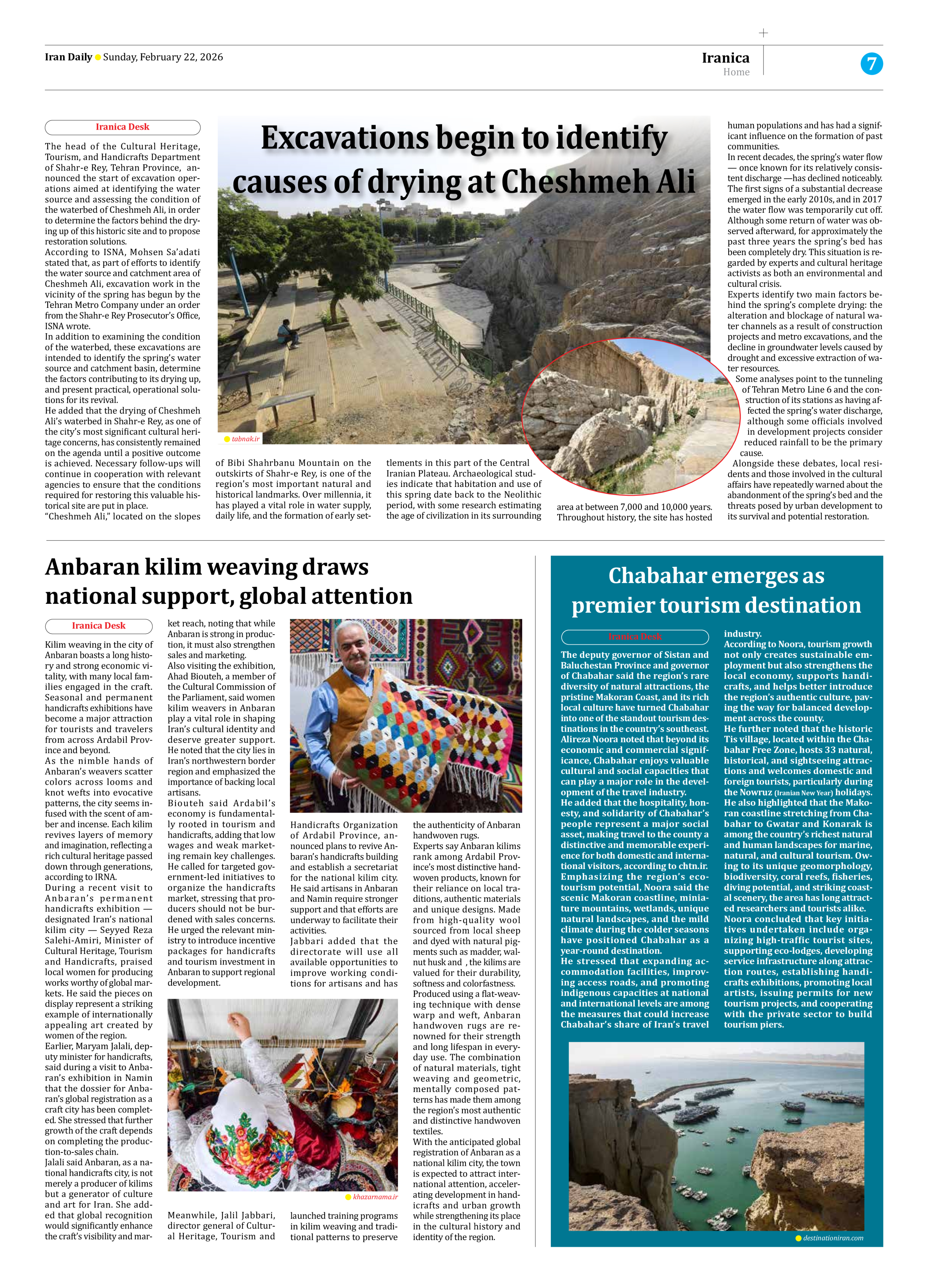


Excavations begin to identify causes of drying at Cheshmeh Ali
The head of the Cultural Heritage, Tourism, and Handicrafts Department of Shahr-e Rey, Tehran Province, announced the start of excavation operations aimed at identifying the water source and assessing the condition of the waterbed of Cheshmeh Ali, in order to determine the factors behind the drying up of this historic site and to propose restoration solutions.
According to ISNA, Mohsen Sa’adati stated that, as part of efforts to identify the water source and catchment area of Cheshmeh Ali, excavation work in the vicinity of the spring has begun by the Tehran Metro Company under an order from the Shahr-e Rey Prosecutor’s Office, ISNA wrote.
In addition to examining the condition of the waterbed, these excavations are intended to identify the spring’s water source and catchment basin, determine the factors contributing to its drying up, and present practical, operational solutions for its revival.
He added that the drying of Cheshmeh Ali’s waterbed in Shahr-e Rey, as one of the city’s most significant cultural heritage concerns, has consistently remained on the agenda until a positive outcome is achieved. Necessary follow-ups will continue in cooperation with relevant agencies to ensure that the conditions required for restoring this valuable historical site are put in place.
“Cheshmeh Ali,” located on the slopes of Bibi Shahrbanu Mountain on the outskirts of Shahr-e Rey, is one of the region’s most important natural and historical landmarks. Over millennia, it has played a vital role in water supply, daily life, and the formation of early settlements in this part of the Central Iranian Plateau. Archaeological studies indicate that habitation and use of this spring date back to the Neolithic period, with some research estimating the age of civilization in its surrounding area at between 7,000 and 10,000 years. Throughout history, the site has hosted human populations and has had a significant influence on the formation of past communities.
In recent decades, the spring’s water flow — once known for its relatively consistent discharge —has declined noticeably. The first signs of a substantial decrease emerged in the early 2010s, and in 2017 the water flow was temporarily cut off. Although some return of water was observed afterward, for approximately the past three years the spring’s bed has been completely dry. This situation is regarded by experts and cultural heritage activists as both an environmental and cultural crisis.
Experts identify two main factors behind the spring’s complete drying: the alteration and blockage of natural water channels as a result of construction projects and metro excavations, and the decline in groundwater levels caused by drought and excessive extraction of water resources.
Some analyses point to the tunneling of Tehran Metro Line 6 and the construction of its stations as having affected the spring’s water discharge, although some officials involved in development projects consider reduced rainfall to be the primary cause.
Alongside these debates, local residents and those involved in the cultural affairs have repeatedly warned about the abandonment of the spring’s bed and the threats posed by urban development to its survival and potential restoration.