







Teymareh acknowledged as major rock art site
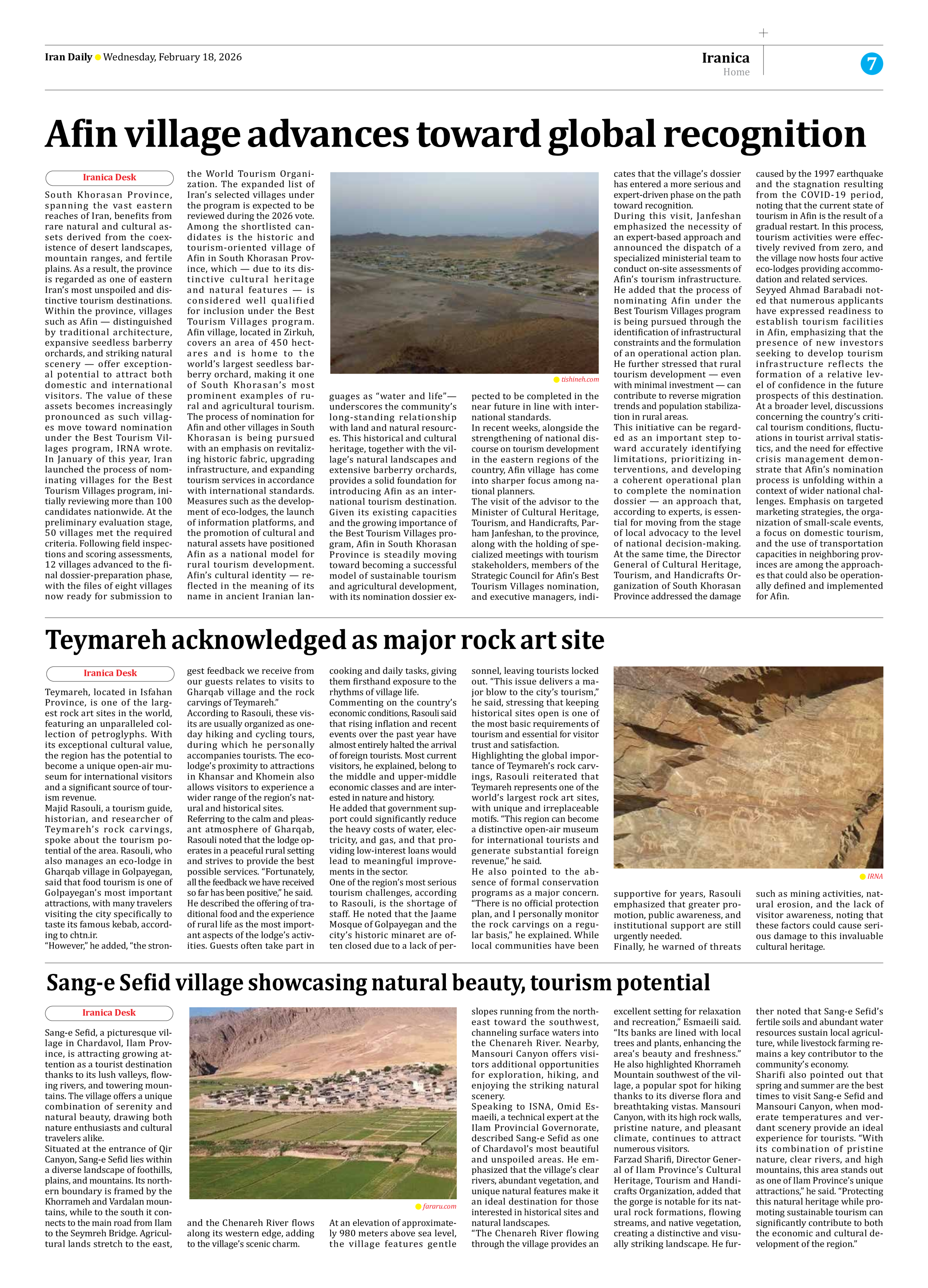
Teymareh, located in Isfahan Province, is one of the largest rock art sites in the world, featuring an unparalleled collection of petroglyphs. With its exceptional cultural value, the region has the potential to become a unique open-air museum for international visitors and a significant source of tourism revenue.
Majid Rasouli, a tourism guide, historian, and researcher of Teymareh’s rock carvings, spoke about the tourism potential of the area. Rasouli, who also manages an eco-lodge in Gharqab village in Golpayegan, said that food tourism is one of Golpayegan’s most important attractions, with many travelers visiting the city specifically to taste its famous kebab, according to chtn.ir.
“However,” he added, “the strongest feedback we receive from our guests relates to visits to Gharqab village and the rock carvings of Teymareh.”
According to Rasouli, these visits are usually organized as one-day hiking and cycling tours, during which he personally accompanies tourists. The eco-lodge’s proximity to attractions in Khansar and Khomein also allows visitors to experience a wider range of the region’s natural and historical sites.
Referring to the calm and pleasant atmosphere of Gharqab, Rasouli noted that the lodge operates in a peaceful rural setting and strives to provide the best possible services. “Fortunately, all the feedback we have received so far has been positive,” he said.
He described the offering of traditional food and the experience of rural life as the most important aspects of the lodge’s activities. Guests often take part in cooking and daily tasks, giving them firsthand exposure to the rhythms of village life.
Commenting on the country’s economic conditions, Rasouli said that rising inflation and recent events over the past year have almost entirely halted the arrival of foreign tourists. Most current visitors, he explained, belong to the middle and upper-middle economic classes and are interested in nature and history.
He added that government support could significantly reduce the heavy costs of water, electricity, and gas, and that providing low-interest loans would lead to meaningful improvements in the sector.
One of the region’s most serious tourism challenges, according to Rasouli, is the shortage of staff. He noted that the Jaame Mosque of Golpayegan and the city’s historic minaret are often closed due to a lack of personnel, leaving tourists locked out. “This issue delivers a major blow to the city’s tourism,” he said, stressing that keeping historical sites open is one of the most basic requirements of tourism and essential for visitor trust and satisfaction.
Highlighting the global importance of Teymareh’s rock carvings, Rasouli reiterated that Teymareh represents one of the world’s largest rock art sites, with unique and irreplaceable motifs. “This region can become a distinctive open-air museum for international tourists and generate substantial foreign revenue,” he said.
He also pointed to the absence of formal conservation programs as a major concern. “There is no official protection plan, and I personally monitor the rock carvings on a regular basis,” he explained. While local communities have been supportive for years, Rasouli emphasized that greater promotion, public awareness, and institutional support are still urgently needed.
Finally, he warned of threats such as mining activities, natural erosion, and the lack of visitor awareness, noting that these factors could cause serious damage to this invaluable cultural heritage.