







Copy in clipboard...
Persian calligraphy on display at Kazakh University
An exhibition and workshop on Persian calligraphy was held at the Iran Room of L.N. Gumilyov Eurasian National University in Kazakhstan, organized by the Iranian Cultural Center to promote cultural and artistic exchange.
In the first part of the program, a collection of Persian calligraphy works was displayed. The exhibition introduced participants to the aesthetic richness of Persian calligraphy while highlighting its deep connections with literature, poetry, and Islamic thought.
Visitors toured the exhibition and raised questions about writing techniques, as well as the tools and materials used in traditional Persian calligraphy.
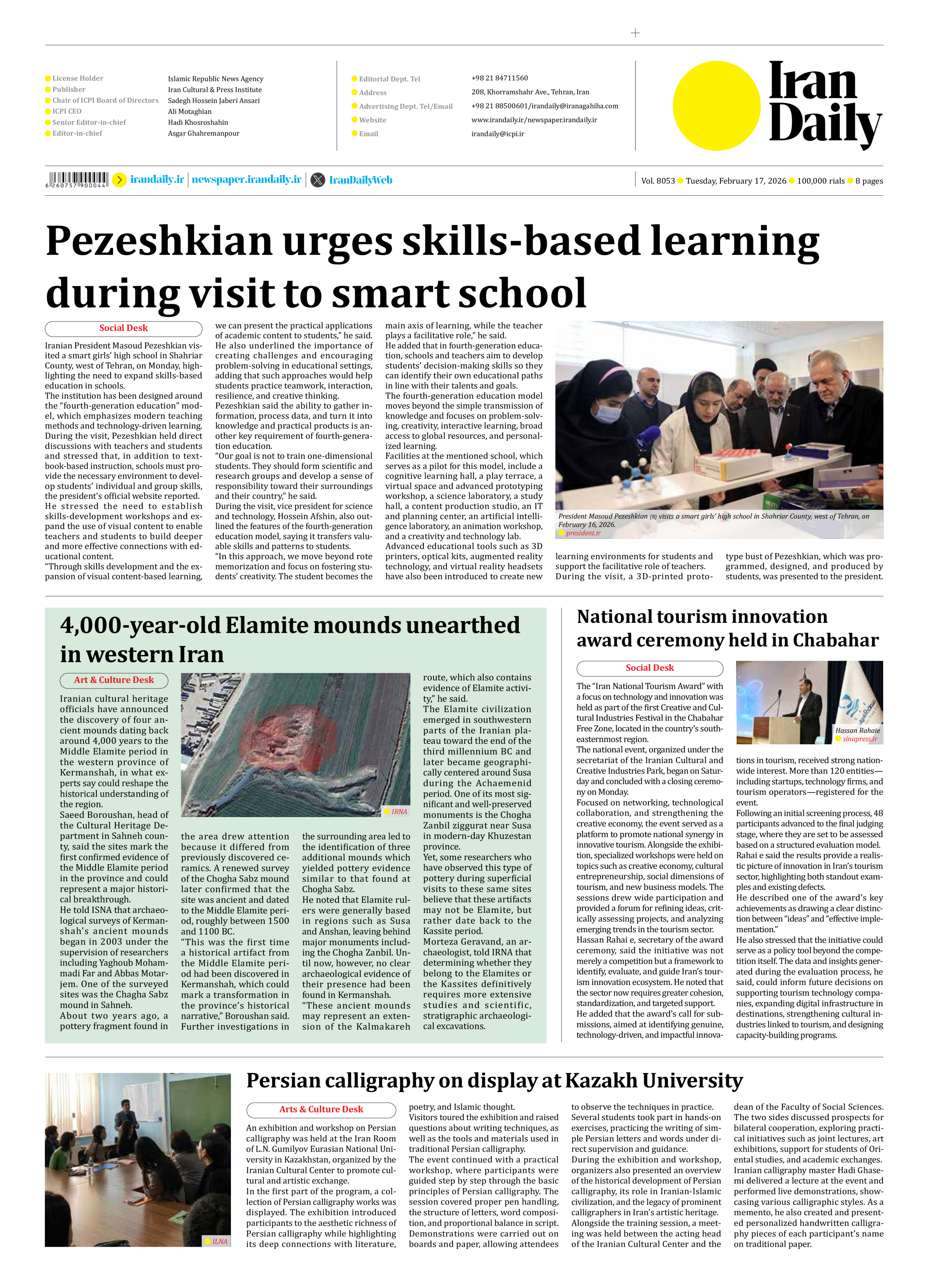
The event continued with a practical workshop, where participants were guided step by step through the basic principles of Persian calligraphy. The session covered proper pen handling, the structure of letters, word composition, and proportional balance in script. Demonstrations were carried out on boards and paper, allowing attendees to observe the techniques in practice.
Several students took part in hands-on exercises, practicing the writing of simple Persian letters and words under direct supervision and guidance.
During the exhibition and workshop, organizers also presented an overview of the historical development of Persian calligraphy, its role in Iranian-Islamic civilization, and the legacy of prominent calligraphers in Iran’s artistic heritage.
Alongside the training session, a meeting was held between the acting head of the Iranian Cultural Center and the dean of the Faculty of Social Sciences. The two sides discussed prospects for bilateral cooperation, exploring practical initiatives such as joint lectures, art exhibitions, support for students of Oriental studies, and academic exchanges.
Iranian calligraphy master Hadi Ghasemi delivered a lecture at the event and performed live demonstrations, showcasing various calligraphic styles. As a memento, he also created and presented personalized handwritten calligraphy pieces of each participant’s name on traditional paper.