







History, identity, cultural survival in Iran
IBNA presents an interview with Reza Shabani, a prominent historian and enduring figure in the study of Iranian history, exploring his insights on Iran’s culture and historical experience.
Conducted at Shahid Beheshti University, the conversation explores Shabani’s intellectual formation, his understanding of Iran’s historical experience, and his deep concern for preserving Iranian identity through historical awareness. Drawing on decades of scholarship and personal experience, Shabani presents a perspective in which history is not merely an academic discipline, but a vital means of safeguarding national dignity and cultural continuity.
Shabani’s interest in history took shape in the early 1950s, when he left his village in the Taleqan region to continue his education in Tehran. These years coincided with a period of intense political and social upheaval, marked by the nationalization of Iran’s oil industry and the leadership of Prime Minister Mohammad Mosaddeq. Experiencing this atmosphere of political openness, foreign pressure, and ideological conflict firsthand, Shabani developed a strong sense of national consciousness. Studying history allowed him to understand the roots of Iran’s resistance to external domination and to critically examine the consequences of foreign intervention, particularly by Russia in the north and Britain in the south.
According to Shabani, Iran’s modern history cannot be understood without recognizing the sustained impact of colonial policies that repeatedly threatened the country’s independence and territorial integrity. He points to the loss of regions such as the Caucasus, Central Asia, and Afghanistan as a result of Russian and British expansionist strategies in the nineteenth century. This historical reality, he argues, deeply affected Iran’s political development while also strengthening a collective awareness rooted in cultural resilience and attachment to the land.
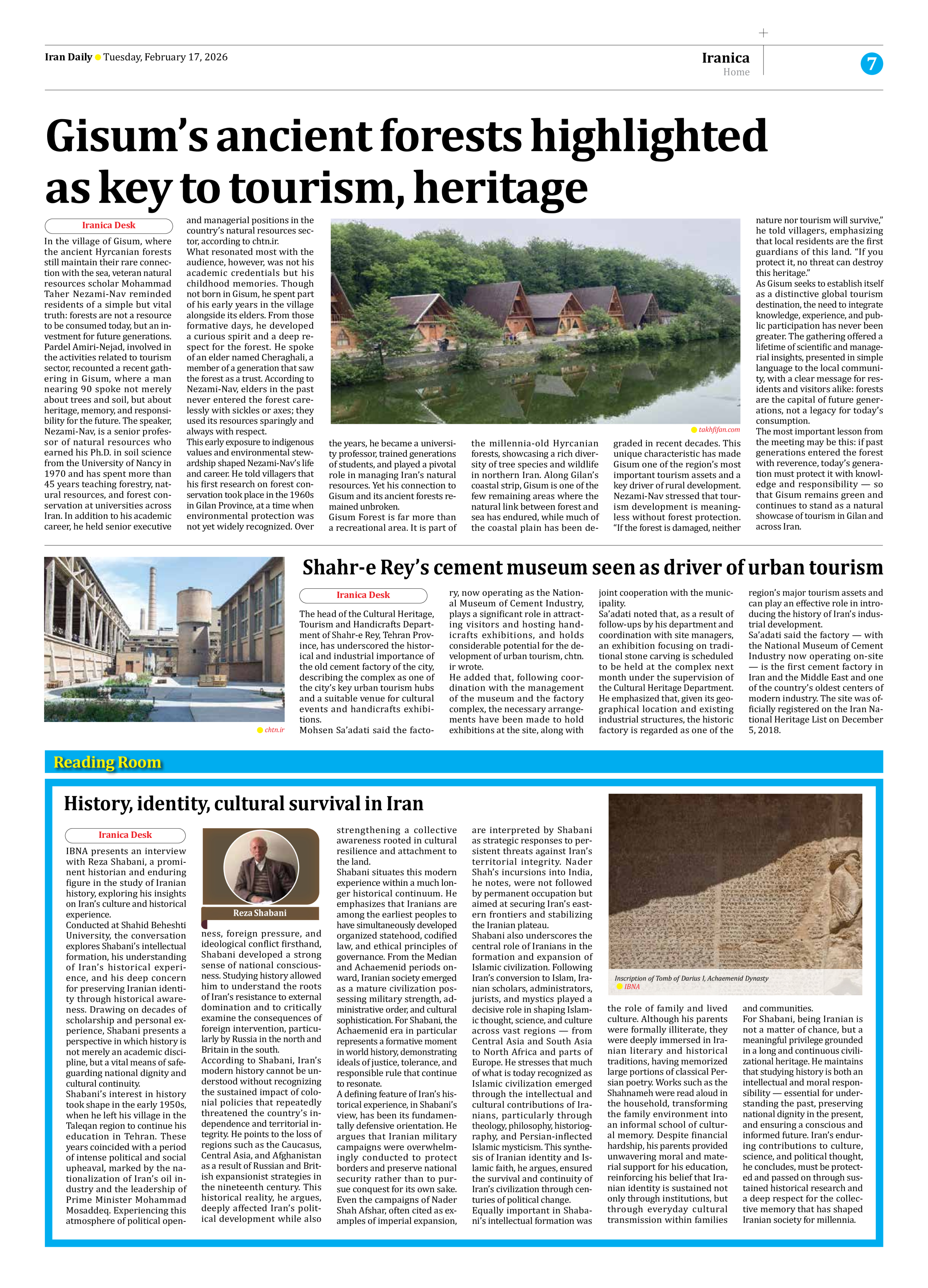
Shabani situates this modern experience within a much longer historical continuum. He emphasizes that Iranians are among the earliest peoples to have simultaneously developed organized statehood, codified law, and ethical principles of governance. From the Median and Achaemenid periods onward, Iranian society emerged as a mature civilization possessing military strength, administrative order, and cultural sophistication. For Shabani, the Achaemenid era in particular represents a formative moment in world history, demonstrating ideals of justice, tolerance, and responsible rule that continue to resonate.
A defining feature of Iran’s historical experience, in Shabani’s view, has been its fundamentally defensive orientation. He argues that Iranian military campaigns were overwhelmingly conducted to protect borders and preserve national security rather than to pursue conquest for its own sake. Even the campaigns of Nader Shah Afshar, often cited as examples of imperial expansion, are interpreted by Shabani as strategic responses to persistent threats against Iran’s territorial integrity. Nader Shah’s incursions into India, he notes, were not followed by permanent occupation but aimed at securing Iran’s eastern frontiers and stabilizing the Iranian plateau.
Shabani also underscores the central role of Iranians in the formation and expansion of Islamic civilization. Following Iran’s conversion to Islam, Iranian scholars, administrators, jurists, and mystics played a decisive role in shaping Islamic thought, science, and culture across vast regions — from Central Asia and South Asia to North Africa and parts of Europe. He stresses that much of what is today recognized as Islamic civilization emerged through the intellectual and cultural contributions of Iranians, particularly through theology, philosophy, historiography, and Persian-inflected Islamic mysticism. This synthesis of Iranian identity and Islamic faith, he argues, ensured the survival and continuity of Iran’s civilization through centuries of political change.
Equally important in Shabani’s intellectual formation was the role of family and lived culture. Although his parents were formally illiterate, they were deeply immersed in Iranian literary and historical traditions, having memorized large portions of classical Persian poetry. Works such as the Shahnameh were read aloud in the household, transforming the family environment into an informal school of cultural memory. Despite financial hardship, his parents provided unwavering moral and material support for his education, reinforcing his belief that Iranian identity is sustained not only through institutions, but through everyday cultural transmission within families and communities.
For Shabani, being Iranian is not a matter of chance, but a meaningful privilege grounded in a long and continuous civilizational heritage. He maintains that studying history is both an intellectual and moral responsibility — essential for understanding the past, preserving national dignity in the present, and ensuring a conscious and informed future. Iran’s enduring contributions to culture, science, and political thought, he concludes, must be protected and passed on through sustained historical research and a deep respect for the collective memory that has shaped Iranian society for millennia.