







Gisum’s ancient forests highlighted as key to tourism, heritage
In the village of Gisum, where the ancient Hyrcanian forests still maintain their rare connection with the sea, veteran natural resources scholar Mohammad Taher Nezami-Nav reminded residents of a simple but vital truth: forests are not a resource to be consumed today, but an investment for future generations.
Pardel Amiri-Nejad, involved in the activities related to tourism sector, recounted a recent gathering in Gisum, where a man nearing 90 spoke not merely about trees and soil, but about heritage, memory, and responsibility for the future. The speaker, Nezami-Nav, is a senior professor of natural resources who earned his Ph.D. in soil science from the University of Nancy in 1970 and has spent more than 45 years teaching forestry, natural resources, and forest conservation at universities across Iran. In addition to his academic career, he held senior executive and managerial positions in the country’s natural resources sector, according to chtn.ir.
What resonated most with the audience, however, was not his academic credentials but his childhood memories. Though not born in Gisum, he spent part of his early years in the village alongside its elders. From those formative days, he developed a curious spirit and a deep respect for the forest. He spoke of an elder named Cheraghali, a member of a generation that saw the forest as a trust. According to Nezami-Nav, elders in the past never entered the forest carelessly with sickles or axes; they used its resources sparingly and always with respect.
This early exposure to indigenous values and environmental stewardship shaped Nezami-Nav’s life and career. He told villagers that his first research on forest conservation took place in the 1960s in Gilan Province, at a time when environmental protection was not yet widely recognized. Over the years, he became a university professor, trained generations of students, and played a pivotal role in managing Iran’s natural resources. Yet his connection to Gisum and its ancient forests remained unbroken.
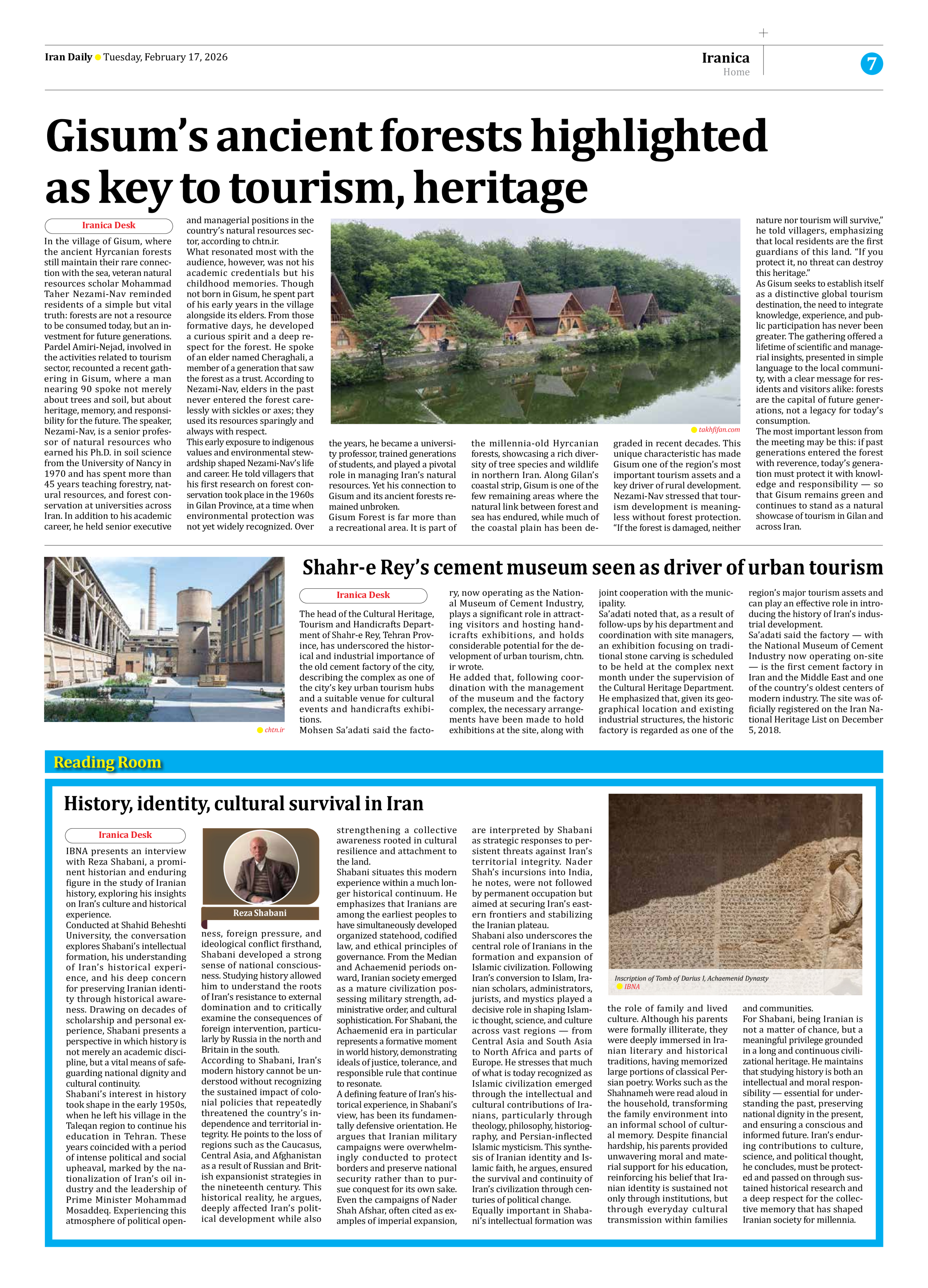
Gisum Forest is far more than a recreational area. It is part of the millennia-old Hyrcanian forests, showcasing a rich diversity of tree species and wildlife in northern Iran. Along Gilan’s coastal strip, Gisum is one of the few remaining areas where the natural link between forest and sea has endured, while much of the coastal plain has been degraded in recent decades. This unique characteristic has made Gisum one of the region’s most important tourism assets and a key driver of rural development.
Nezami-Nav stressed that tourism development is meaningless without forest protection. “If the forest is damaged, neither nature nor tourism will survive,” he told villagers, emphasizing that local residents are the first guardians of this land. “If you protect it, no threat can destroy this heritage.”
As Gisum seeks to establish itself as a distinctive global tourism destination, the need to integrate knowledge, experience, and public participation has never been greater. The gathering offered a lifetime of scientific and managerial insights, presented in simple language to the local community, with a clear message for residents and visitors alike: forests are the capital of future generations, not a legacy for today’s consumption.
The most important lesson from the meeting may be this: if past generations entered the forest with reverence, today’s generation must protect it with knowledge and responsibility — so that Gisum remains green and continues to stand as a natural showcase of tourism in Gilan and across Iran.