







Copy in clipboard...
FM asserts submission before threats ‘not on the table’
Spox: Tehran attending US talks with ‘result-oriented approach’
Iranian Foreign Minister Abbas Araghchi said on Monday that his trip to Geneva to hold indirect talks with the United States is aimed at reaching a just and equitable deal, while dismissing any pressure-driven concessions as well as threats against the Islamic Republic.
“I am in Geneva with real ideas to achieve a fair and equitable deal. What is not on the table: submission before threats,” Araghchi wrote in a post on his X account after arrival in the Swiss city on Monday.
He also outlined other diplomatic agenda in Geneva, saying he will meet “Rafael Grossi (Director General of the International Atomic Energy Agency) for deep technical discussions, as well as Badr Al-Busaid (Foreign Minister of Oman) ahead of diplomacy with (the) US on Tuesday.”
Araghchi, at the head of a high-ranking diplomatic and specialized delegation, landed in Geneva on Sunday night. The Iranian delegation is scheduled to hold talks with the US on February 17 with the mediation of the Omani foreign minister.
The first round of talks was held in Muscat last week, which was described by the two sides as a “good start.”
Iran’s main demand during the Muscat talks was the effective and verifiable lifting of economic sanctions. Iranian officials have repeatedly emphasized that any agreement lacking tangible economic benefits would be meaningless in practice.
The negotiations are taking place as the US has resorted to a significant military buildup across West Asia, starting with sending its USS Abraham Lincoln aircraft carrier to the region.
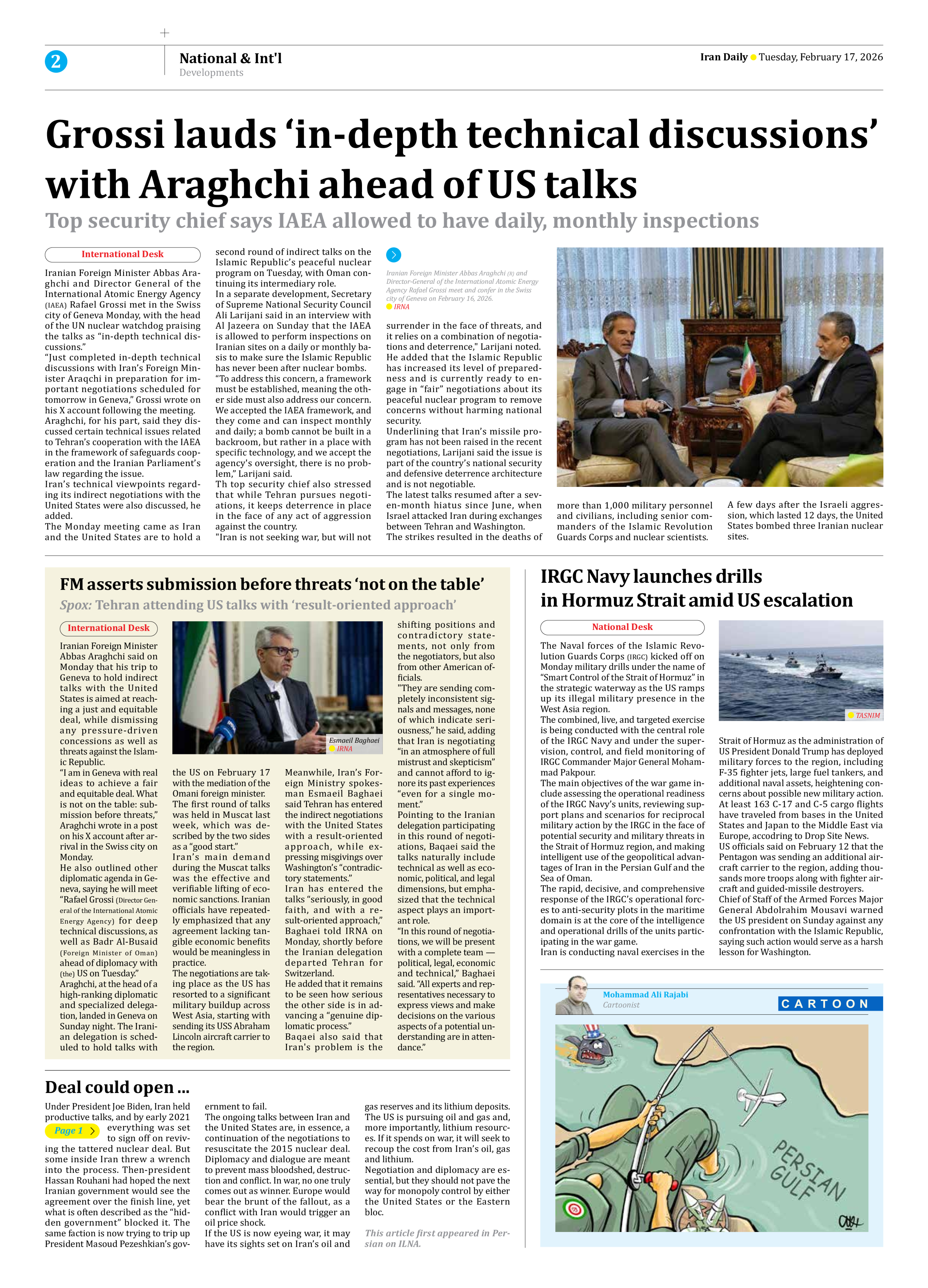
Meanwhile, Iran’s Foreign Ministry spokesman Esmaeil Baghaei said Tehran has entered the indirect negotiations with the United States with a result-oriented approach, while expressing misgivings over Washington’s “contradictory statements.”
Iran has entered the talks “seriously, in good faith, and with a result-oriented approach,” Baghaei told IRNA on Monday, shortly before the Iranian delegation departed Tehran for Switzerland.
He added that it remains to be seen how serious the other side is in advancing a “genuine diplomatic process.”
Baqaei also said that Iran's problem is the shifting positions and contradictory statements, not only from the negotiators, but also from other American officials.
"They are sending completely inconsistent signals and messages, none of which indicate seriousness,” he said, adding that Iran is negotiating “in an atmosphere of full mistrust and skepticism” and cannot afford to ignore its past experiences “even for a single moment.”
Pointing to the Iranian delegation participating in this round of negotiations, Baqaei said the talks naturally include technical as well as economic, political, and legal dimensions, but emphasized that the technical aspect plays an important role.
“In this round of negotiations, we will be present with a complete team — political, legal, economic and technical,” Baghaei said. “All experts and representatives necessary to express views and make decisions on the various aspects of a potential understanding are in attendance.”