







Copy in clipboard...
Grossi lauds ‘in-depth technical discussions’ with Araghchi ahead of US talks
Top security chief says IAEA allowed to have daily, monthly inspections
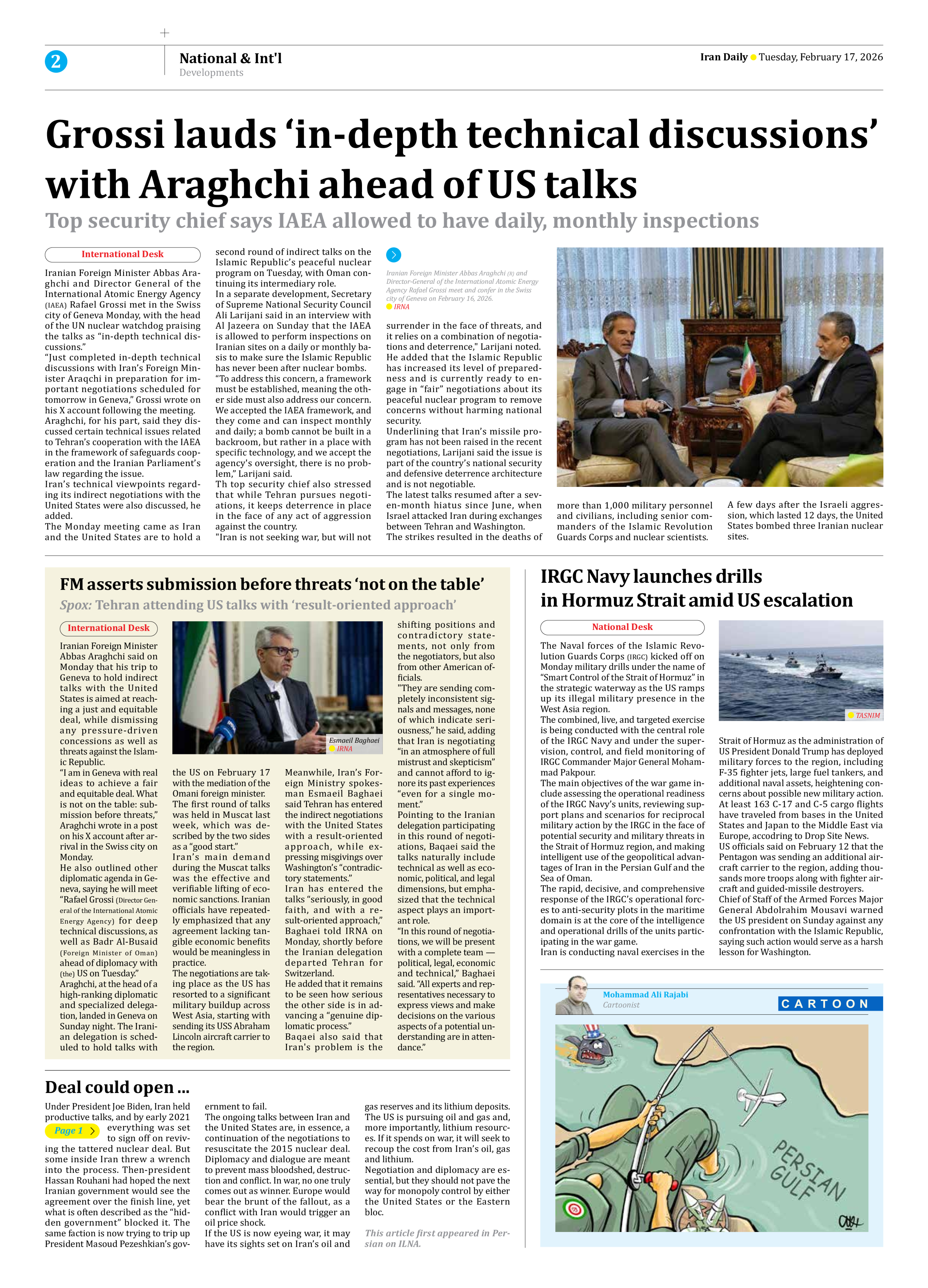
Iranian Foreign Minister Abbas Araghchi and Director General of the International Atomic Energy Agency (IAEA) Rafael Grossi met in the Swiss city of Geneva Monday, with the head of the UN nuclear watchdog praising the talks as “in-depth technical discussions.”
“Just completed in-depth technical discussions with Iran’s Foreign Minister Araqchi in preparation for important negotiations scheduled for tomorrow in Geneva,” Grossi wrote on his X account following the meeting.
Araghchi, for his part, said they discussed certain technical issues related to Tehran’s cooperation with the IAEA in the framework of safeguards cooperation and the Iranian Parliament’s law regarding the issue.
Iran’s technical viewpoints regarding its indirect negotiations with the United States were also discussed, he added.
The Monday meeting came as Iran and the United States are to hold a second round of indirect talks on the Islamic Republic’s peaceful nuclear program on Tuesday, with Oman continuing its intermediary role.
In a separate development, Secretary of Supreme National Security Council Ali Larijani said in an interview with Al Jazeera on Sunday that the IAEA is allowed to perform inspections on Iranian sites on a daily or monthly basis to make sure the Islamic Republic has never been after nuclear bombs.
“To address this concern, a framework must be established, meaning the other side must also address our concern. We accepted the IAEA framework, and they come and can inspect monthly and daily; a bomb cannot be built in a backroom, but rather in a place with specific technology, and we accept the agency's oversight, there is no problem,” Larijani said.
Th top security chief also stressed that while Tehran pursues negotiations, it keeps deterrence in place in the face of any act of aggression against the country.
"Iran is not seeking war, but will not surrender in the face of threats, and it relies on a combination of negotiations and deterrence," Larijani noted.
He added that the Islamic Republic has increased its level of preparedness and is currently ready to engage in “fair” negotiations about its peaceful nuclear program to remove concerns without harming national security.
Underlining that Iran’s missile program has not been raised in the recent negotiations, Larijani said the issue is part of the country’s national security and defensive deterrence architecture and is not negotiable.
The latest talks resumed after a seven-month hiatus since June, when Israel attacked Iran during exchanges between Tehran and Washington.
The strikes resulted in the deaths of more than 1,000 military personnel and civilians, including senior commanders of the Islamic Revolution Guards Corps and nuclear scientists.
A few days after the Israeli aggression, which lasted 12 days, the United States bombed three Iranian nuclear sites.