







Copy in clipboard...
Air pollution tops Iran’s environmental agenda as government moves to unblock clean-air law
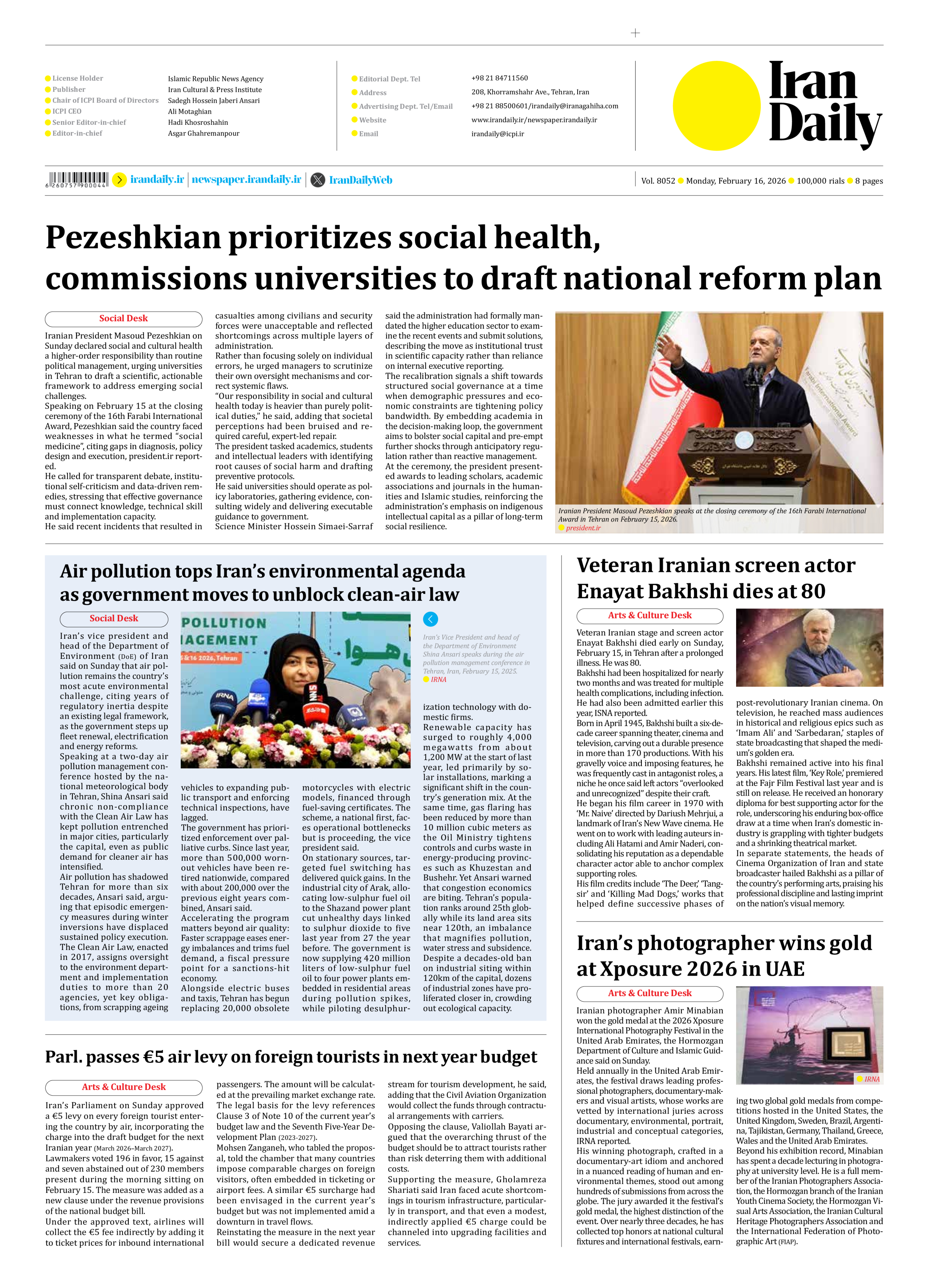
Iran’s vice president and head of the Department of Environment (DoE) of Iran said on Sunday that air pollution remains the country’s most acute environmental challenge, citing years of regulatory inertia despite an existing legal framework, as the government steps up fleet renewal, electrification and energy reforms.
Speaking at a two-day air pollution management conference hosted by the national meteorological body in Tehran, Shina Ansari said chronic non-compliance with the Clean Air Law has kept pollution entrenched in major cities, particularly the capital, even as public demand for cleaner air has intensified.
Air pollution has shadowed Tehran for more than six decades, Ansari said, arguing that episodic emergency measures during winter inversions have displaced sustained policy execution. The Clean Air Law, enacted in 2017, assigns oversight to the environment department and implementation duties to more than 20 agencies, yet key obligations, from scrapping ageing vehicles to expanding public transport and enforcing technical inspections, have lagged.
The government has prioritized enforcement over palliative curbs. Since last year, more than 500,000 worn-out vehicles have been retired nationwide, compared with about 200,000 over the previous eight years combined, Ansari said.
Accelerating the program matters beyond air quality: Faster scrappage eases energy imbalances and trims fuel demand, a fiscal pressure point for a sanctions-hit economy.
Alongside electric buses and taxis, Tehran has begun replacing 20,000 obsolete motorcycles with electric models, financed through fuel-saving certificates. The scheme, a national first, faces operational bottlenecks but is proceeding, the vice president said.
On stationary sources, targeted fuel switching has delivered quick gains. In the industrial city of Arak, allocating low-sulphur fuel oil to the Shazand power plant cut unhealthy days linked to sulphur dioxide to five last year from 27 the year before. The government is now supplying 420 million liters of low-sulphur fuel oil to four power plants embedded in residential areas during pollution spikes, while piloting desulphurization technology with domestic firms.
Renewable capacity has surged to roughly 4,000 megawatts from about 1,200 MW at the start of last year, led primarily by solar installations, marking a significant shift in the country’s generation mix. At the same time, gas flaring has been reduced by more than 10 million cubic meters as the Oil Ministry tightens controls and curbs waste in energy-producing provinces such as Khuzestan and Bushehr. Yet Ansari warned that congestion economics are biting. Tehran’s population ranks around 25th globally while its land area sits near 120th, an imbalance that magnifies pollution, water stress and subsidence. Despite a decades-old ban on industrial siting within 120km of the capital, dozens of industrial zones have proliferated closer in, crowding out ecological capacity.